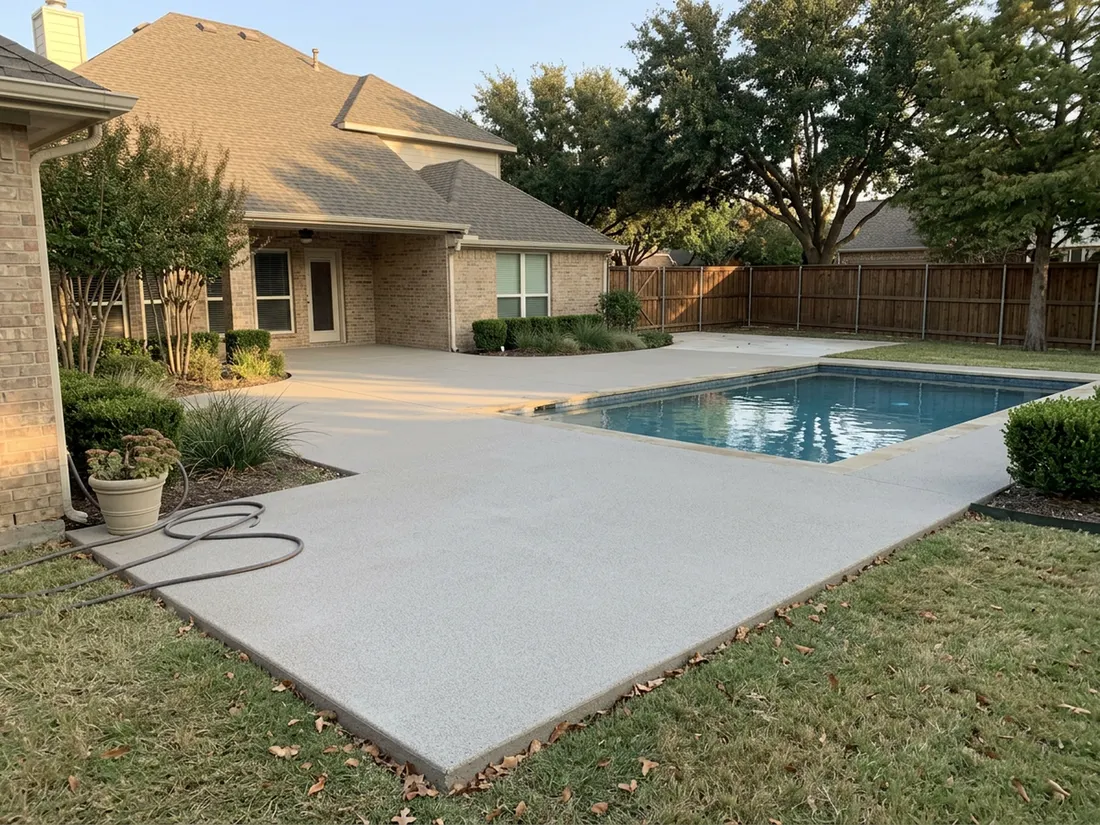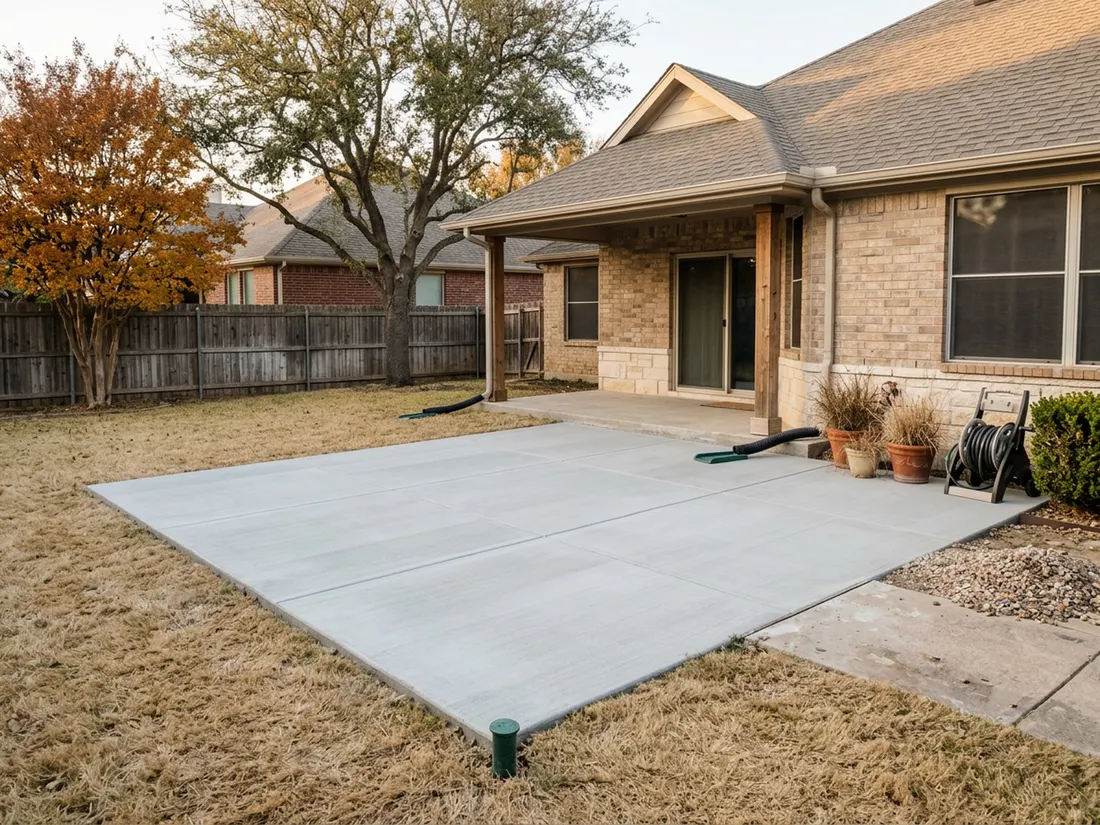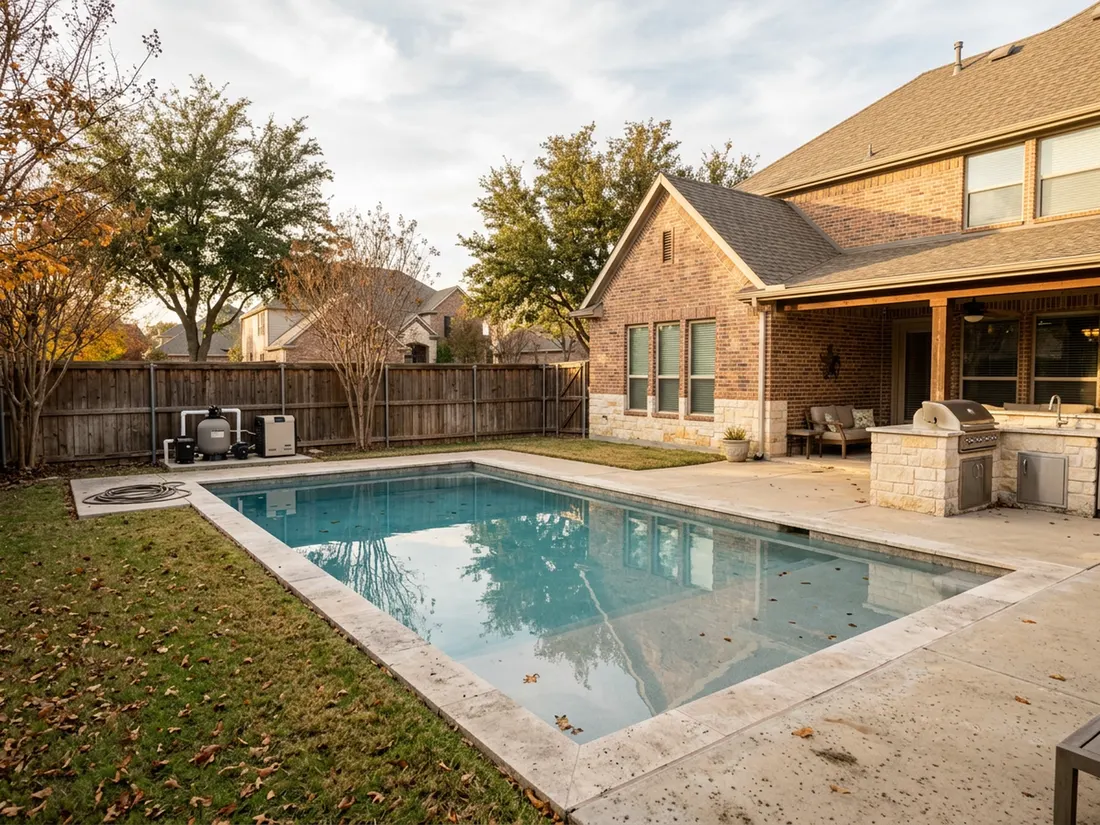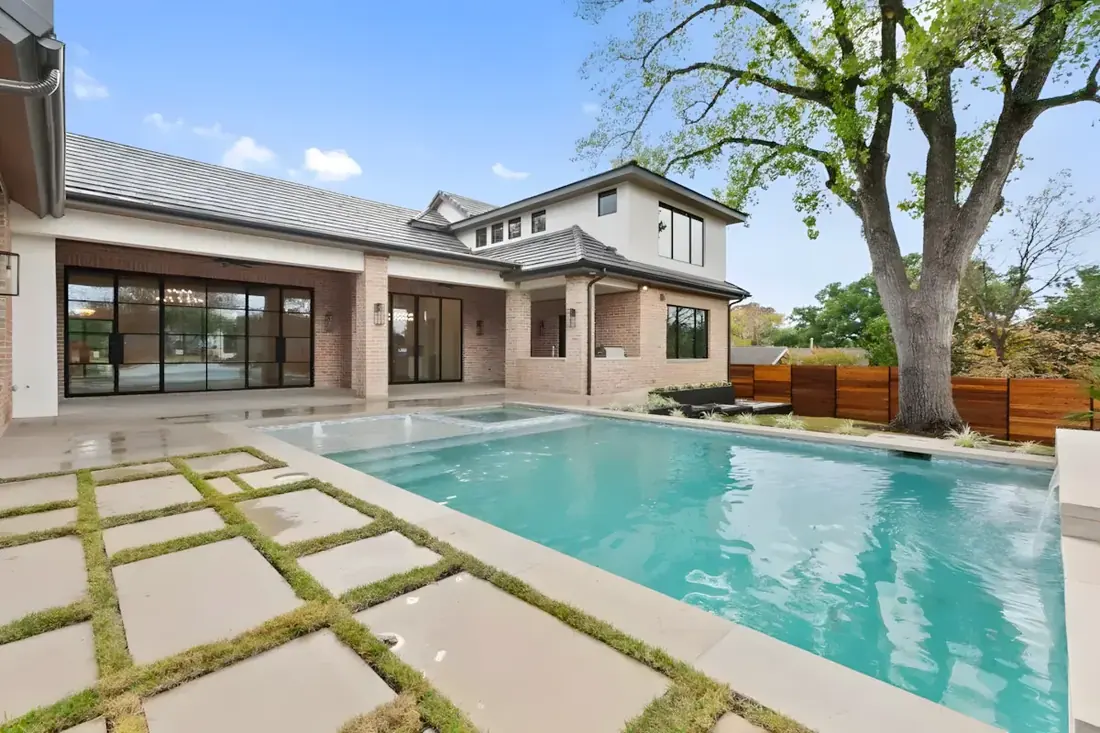

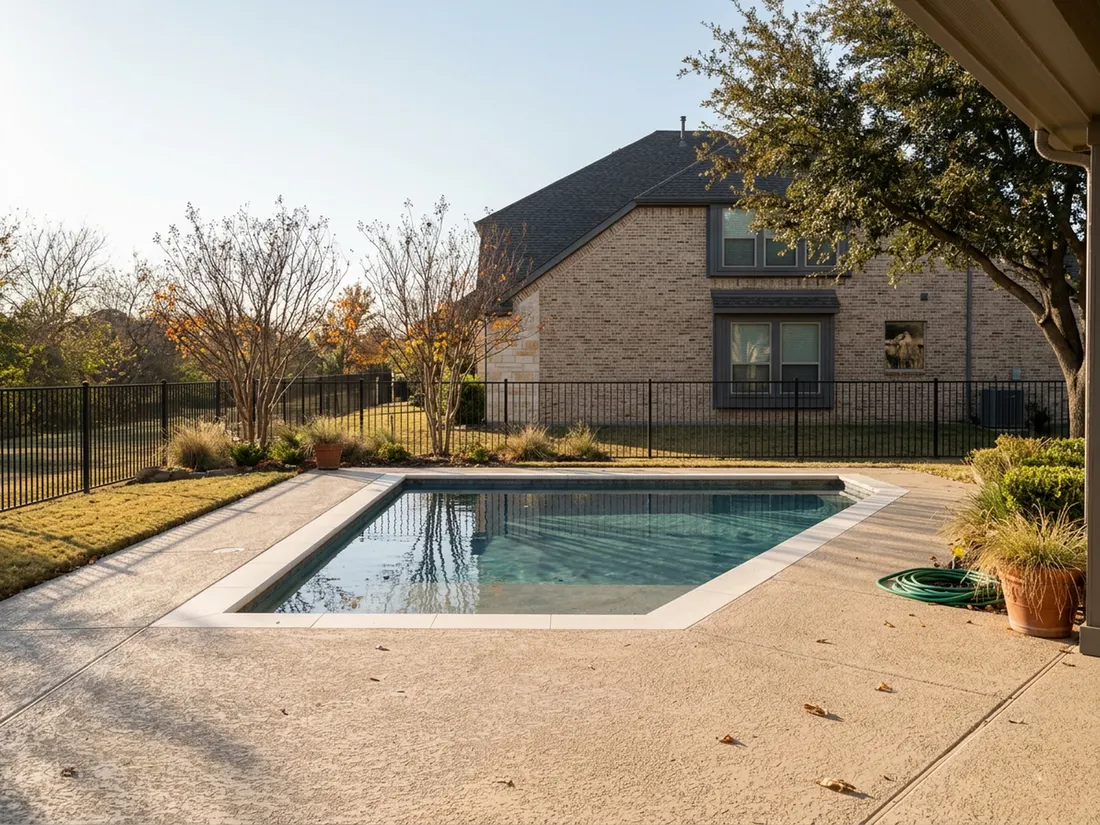
A pool deck coating is a thin, bonded layer over concrete that adds color, grip and heat reflection. The best pool deck coating for Texas yards is a light-colored, textured system over a sound, clean, dry slab. Prep and slab condition decide how long it lasts far more than the brand on the bucket.
A light, finely textured deck is the goal. Whether it stays that way depends on what is under it.
The short answer
- The best coating for a pool deck in Texas is a light-colored, textured system over a sound, clean, dry slab, and prep matters more than the brand.
- Deck surface temperature in a DFW July depends on color, texture, topcoat and sun exposure, and cooling percentages from vendors should be treated as best-case claims.
- A non-slip pool deck coating needs texture built into the finished surface, and a wet DCOF result on that surface is the number worth asking for.
- Coatings peel for four main reasons: moisture vapor, poor prep, slab movement on clay, and pool chemicals, and the pattern of the peeling points to the cause.
- A coating cannot hold a moving slab still, so wide cracks, stepped sections or sunken corners mean repair the slab first.
- November is the month to walk the deck, mark the weak spots again after the first freeze, and book a spring slot with a written spec.
What is the best coating for a pool deck in Texas?
The best coating for a pool deck in Texas is a light-colored, textured system applied over a sound, clean, dry slab. Brand matters less than prep, slab condition and the finished grip. A coating that is smooth, dark or laid over a moving slab will disappoint, whatever the product type.
Four things decide whether a deck coating in Dallas, Plano or Fort Worth lasts. The slab has to be sound, because a coating cannot hold a moving slab still. The surface has to be ground and dry enough to bond. The color and texture have to suit full sun and wet feet. And the film has to survive pool chemicals and the first hard freeze. The sections below take them one at a time.
How hot does a coated pool deck get in a DFW July?
A pool deck in a DFW July can run far hotter than the air, and a coating changes how much hotter. Color, texture, topcoat and sun exposure drive the surface temperature. Light, textured finishes run cooler than dark, smooth ones, but no coating makes a full-sun deck cold.
Sundek, a maker of cool deck coatings, names the topcoat, color, sun exposure and texture as the main drivers of deck temperature. Texture helps because less of the surface touches a foot. Color helps because lighter shades reflect more sunlight.
Be careful with percentages. Vendors advertise cooling figures with the words “up to,” and the fine print can undercut the headline. The Encore cool pool deck page notes that darker earth tones and grays contain black pigments that work against a cool surface. A cool deck coating in Dallas is not automatically a cool deck if the color you pick is a mid-tone gray.
Longhorn Outdoor Living has not published measured readings for coated decks, so we will not quote a degree figure here. Ask any bidder for a dated infrared thermometer reading taken in afternoon sun, on a sample board or a finished job, next to a reading on bare concrete. Shade from a roof or umbrella often does more than any color.
How do you keep a pool deck coating from being slippery when wet?
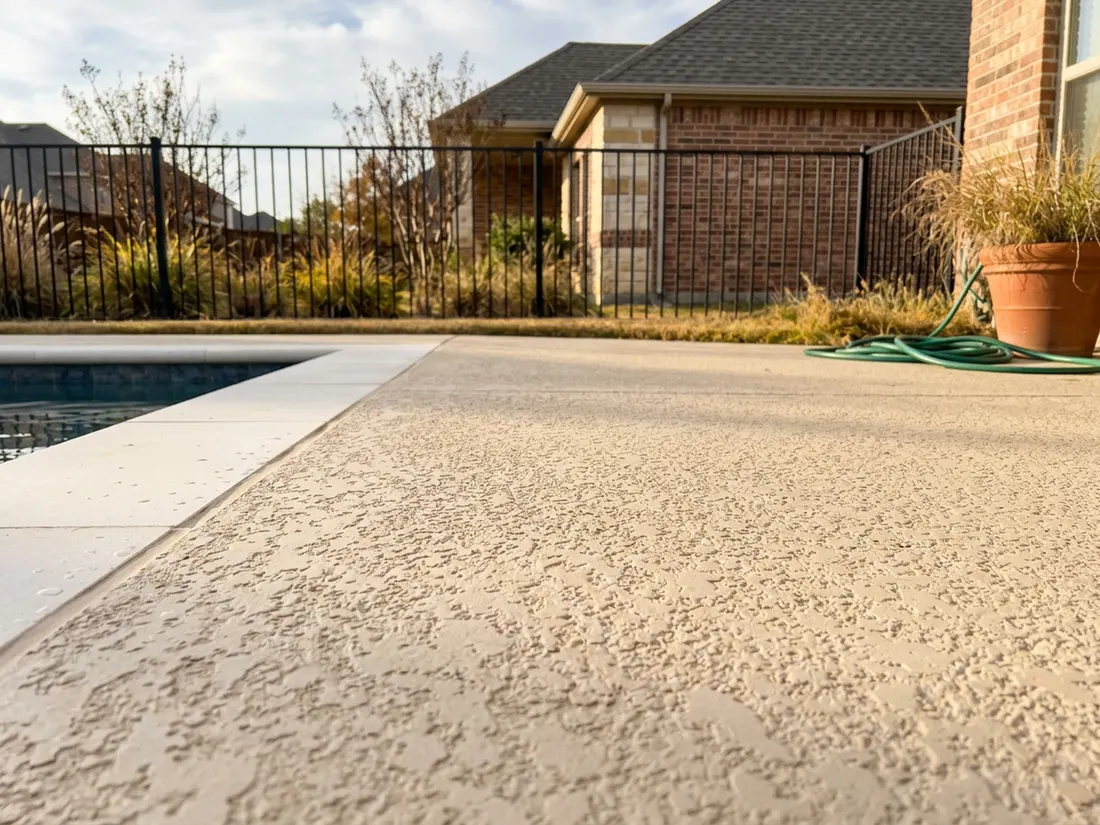
Keep a pool deck coating grippy by putting the texture in the finished surface, not under a glossy sealer, and by asking for a wet slip-resistance result. A non-slip pool deck coating needs fine, even texture that stays after years of foot traffic and cleaning. Smooth, shiny finishes are slick when wet.
A surface can look rough and still be slick. If the grit sits beneath a high-gloss topcoat, water films over it. Polyaspartic and epoxy are the usual offenders when they are applied smooth. Both can grip well when the texture is broadcast into the finish or mixed into the top layer, so the question is how the texture is built, not which family it is.
Grip also changes with use. Sunscreen and body-oil residue, and algae in shaded corners, build a slick film on any surface. Rinse and scrub the shaded areas, and treat grip as something you maintain, not only something you buy.
What does a wet DCOF number mean, and what should you ask a contractor to show?
DCOF is the dynamic coefficient of friction, a number for how much grip a wet surface gives a moving foot. Higher is grippier. The Tile Council of North America points to a wet DCOF of at least 0.42 for level walkways, which is a reasonable starting point to ask a coating contractor to meet.
That number needs a caveat. One testing consultancy points out that the standard tile tests, ANSI A137.1 and A326.3, were written for indoor level floors and do not predict slip risk on a wet outdoor deck. So treat 0.42 as a starting question, not a guarantee. Ask for the test method, the wet result on the finished product with its texture, and a sample board you can wet and walk on barefoot in your own yard.
Why is my pool deck coating peeling in North Texas?
A pool deck coating peels in North Texas because the bond failed, and the bond usually fails for one or more of four reasons: moisture vapor from the slab, poor surface prep, slab movement on clay, or pool chemicals. A recoat over a failed bond fails again, so find the cause first.
- Moisture vapor. Water moves up through the slab and blisters a film that cannot breathe.
- Poor prep. Dirt, old sealer, sunscreen film or a smooth, unprofiled surface leaves nothing for the coating to grip.
- Slab movement. Clay swells and shrinks, and a rigid film cracks where the slab cracks.
- Chemicals. Acid splash, shock and heavy chlorine attack weak topcoats at the edge of the water.
Read the pattern before you spend any money. Peeling that starts at the coping and at joints points to chemicals and movement. Round blisters in the middle of the slab point to vapor. Large sheets that lift in one piece point to prep.
Can moisture vapor from the slab make a coating peel or bubble?
Yes. Concrete is porous, so moisture moves up through it, and a thick film that cannot breathe traps that vapor. When afternoon sun heats the slab, pressure builds under the film and lifts it into blisters.
In DFW the water source differs from a coastal city with a high water table. Here it is sprinklers that soak the slab edge, rain, splash-out from the pool, and moisture held in the clay under the deck. Pool decks get wet, then bake dry under afternoon sun, and that daily cycle works on every coating.
A simple screening test is to tape a clear plastic sheet to bare concrete and look for moisture underneath once it has sat. It shows whether moisture is present, not how much. Flooring practice goes further with ASTM F1869, which measures vapor emission from the surface, and ASTM F2170, which uses in-situ probes to read internal humidity. We did not find a pool-deck standard that applies them outdoors, so treat them as borrowed from flooring work and ask the contractor what they do.
What does clay soil movement do to a pool deck coating?
Clay movement cracks any rigid coating bonded to the slab. Blackland Prairie clay, found mostly east of I-35, swells in wet months and shrinks in dry ones, and the deck moves with it. A coating can hide a cosmetic crack. It cannot hold a moving slab still.
Look at the cracks before you pick a color. Hairline cracks that have not changed are candidates for a coating with proper crack repair. Wide cracks, one side sitting higher than the other, or a sunken corner point to a problem below the surface. Fix drainage and the slab first, as we explain in our guide to why a DFW patio cracked and what fixes it.
Soil changes across the metro, so ask a local pro about your own lot. Plano, Frisco, Garland and Rockwall are largely on or near Blackland Prairie clay. Much of Fort Worth and Weatherford sits on thinner soil over limestone, which generally swells less. Denton, Keller and Flower Mound fall in or near the Eastern Cross Timbers, with sandy loam over clay. The same movement shapes the pool shell, which our post on fiberglass versus gunite pools on Texas clay covers.
Does the first freeze show which coatings failed?
Often, yes. DFW freezes tend to be sudden overnight snaps that hit slabs already soaked by rain or sprinklers. Water in a hairline crack or under a weak bond freezes, expands and lifts the film, so peeling can show up the morning after.
The February 2021 freeze and the December 2022 freeze are the two most homeowners remember. Both showed North Texas that a deck does not need months of ice to be stressed, only a wet slab and one hard night. If a coating lifted after either one, the bond was probably already weak at that spot. Our post on winterizing a Dallas pool after two freezes covers what else to check around the water.
November is a good month to walk the deck. Peeling you can see now marks the weak spots, and patching them before spring keeps water out until the recoat.
Do pool chemicals, salt and sunscreen damage a pool deck coating?
They can. Chlorine, salt-water splash, acid used for pool cleaning and algae treatments stain or etch weak topcoats, and sunscreen residue turns a good surface slick. Concentrated acid on a deck will mark almost any finish.
The edge of the pool takes the most punishment. Splash-out carries chlorine or salt onto the first few feet of deck and the bond line near the coping, and that is where failures usually start. Ask for the data sheet’s chemical resistance statement for your sanitizer type, whether chlorine tablets or a salt cell. Rinse spills, especially from shock or acid, off the deck the same day.
Which coating types work on a sunny DFW pool deck?
There is no single winner. Textured acrylic and cool deck films, polyaspartic and polyurea, epoxy, and cement-based overlays each fit different decks. Match the family to the slab, the sun and the failure history, not to the loudest sales pitch.
| Coating family | What it does well | Tradeoff on a DFW deck |
|---|---|---|
| Acrylic and cool deck films | Thin, textured, available in light colors, and made to reflect heat | May need recoating sooner at the water’s edge, and a thick film over a damp slab can blister |
| Polyaspartic and polyurea | Hard, UV-stable, quick to cure | Slick when applied smooth or glossy, so texture has to be built in, and the slab has to be dry |
| Epoxy | Strong bond and chemical resistance | Not the usual pick for full sun, since ultraviolet light dulls it, and glossy epoxy is very slick wet |
| Cement-based overlay | Thick, decorative, good natural texture | Rigid, so it cracks where the slab cracks, and the slab must be sound first |
Should you repair, recoat, resurface or replace a peeling pool deck?
Repair when damage is local, recoat when the old coating is bonded and clean, strip and resurface when it is peeling widely, and fix the slab when it has moved. A coating is never the answer for a slab that is still moving.
- Spot repair: a few small peeled patches over solid concrete. Grind back to sound edges, patch and blend.
- Recoat: the existing coating is tight, clean and only worn. Confirm the old and new products are compatible.
- Strip and resurface: peeling over large areas, blisters, or an unknown old product. Remove the failed film down to sound concrete and start over.
- Repair or replace the slab: wide cracks, steps between sections, sunken corners or water pooling toward the house. Coat after, not before.
Do not simply repaint a peeling deck. Paint over a failed bond lifts with it, often soon after. Our luxury coatings page describes the coating work we do, and the slab assessment comes first on every one.
What should you ask a contractor before they coat your pool deck?
Ask eight questions and expect specific answers in writing. A contractor who names the product, the prep method and the slip result is bidding the job. One who says “we use the best” is selling it.
- What is the exact product and system, and can I see the data sheet?
- How will you prep the surface? Will it be ground or shot blasted, not only pressure washed?
- How will you repair cracks and joints, and what happens if the slab is still moving?
- Will you test for moisture, and with which method?
- What is the wet slip-resistance result for the finished, textured surface, and how was it tested?
- What light colors are available, and can I see a sample in full sun next to bare concrete?
- What does the warranty cover, and does it exclude chemical splash, cracks or peeling at the coping?
- Can I call two DFW homeowners whose decks are a few years old?
When should you book a pool deck coating in DFW?
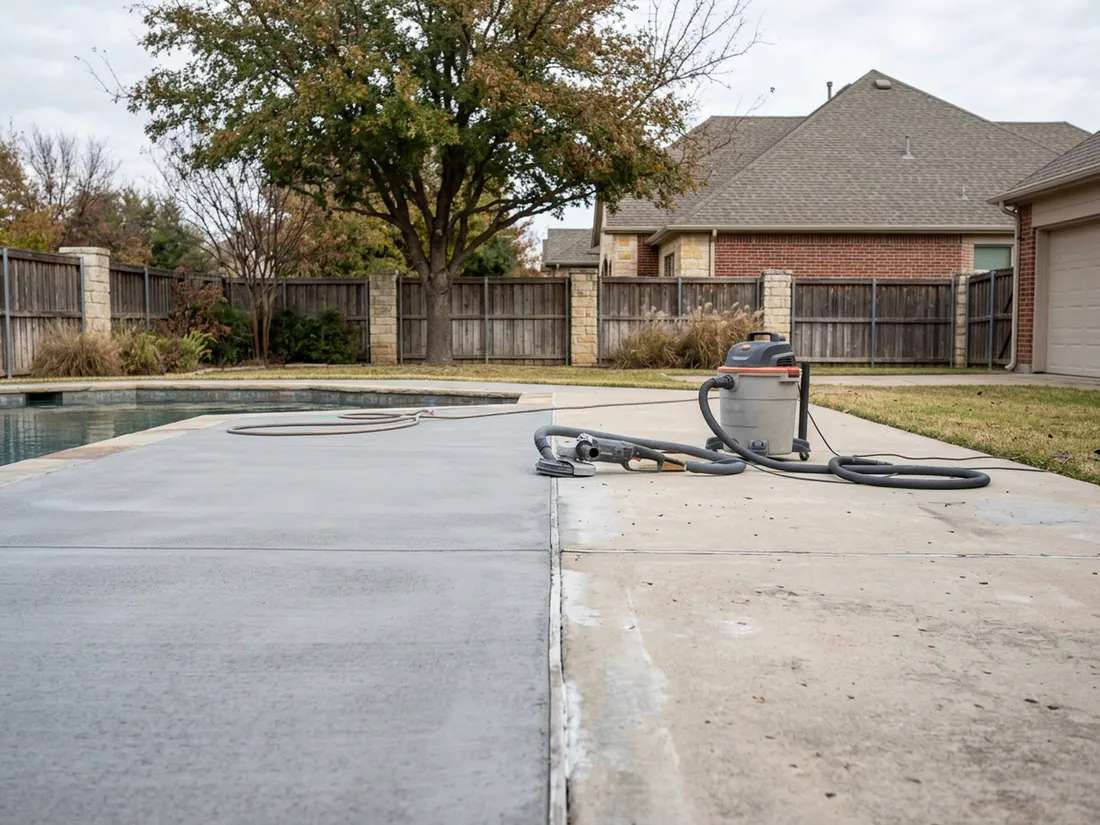
Book in November or December for a spring start. The fall window we covered in our post on coating a DFW patio in October has closed, and spring slots fill as pools reopen. Every product has temperature, moisture and rain limits on its data sheet, so get those limits in writing rather than accepting a promise about the coldest weeks.
Until then, walk the deck after the next rain and again after the first freeze. Photograph every peeled patch, blister and widened crack, and mark them with chalk. Those photos make a bid far more accurate than a phone description.
At Longhorn Outdoor Living we have built backyards across Dallas and Fort Worth since 1984, and we would rather look at the slab than sell you a color. If the deck sits beside a pool and spa we built or one we did not, we will walk it, tell you which of the four failure causes we see, and tell you plainly whether a coating is the right next step.
Thinking about this for your own home? See how Longhorn builds hardscaping.
Questions we get asked about this
Not reliably. Paint or a new coat over a failed bond lifts with the old film, often soon after. Scrape and grind back to sound edges, find out why it peeled, and fix that cause first, whether moisture, prep, movement or chemicals. Then recoat with a product the data sheet says is compatible.
Generally yes. Lighter shades reflect more sunlight, and texture reduces the contact area under a foot. Darker tones and grays contain black pigments that work against a cool surface, as Encore’s own product page notes. Shade from a roof or umbrella helps more than any color, and no coating makes a full-sun deck cold.
Sometimes. The existing layer has to be tight, clean and compatible with the new product, and the contractor should test a small area for bond before quoting. If the old film is peeling or its type is unknown, strip it back to concrete. Ask for the compatibility statement from the data sheet in writing.
We have not published a coating price, so we will not guess one. The drivers are deck size, how much old coating must come off, crack and joint repair, the system chosen, the texture level and access to the yard. Ask for a written scope that lists prep and repairs line by line so bids compare fairly.
Sometimes, but every product has temperature, moisture and rain limits on its data sheet, and cold or damp slabs are where bonds go wrong. Ask the contractor for those limits in writing rather than accepting a promise. Booking in November for a spring start is a common way to avoid the coldest weeks.
Epoxy bonds well and resists chemicals, but ultraviolet light dulls it, and glossy epoxy is very slick when wet. Most full-sun decks in Dallas and Fort Worth do better with a UV-stable topcoat or a textured system built for sun. Epoxy can work as a base layer under a sun-stable finish.