
The right Andersen window series for a DFW house depends on your walls, your trim and your budget. The 100 Series suits budget jobs and rentals, the 400 is the mainstream wood-clad choice, the A-Series adds finish and customization, and the E-Series is for premium custom work. On a west wall, the glass matters as much as the series.
The short answer
- The 100 Series is Fibrex composite inside and out, while the 400, A and E Series all have wood interiors with different exterior skins.
- On a hot west or south wall in North Texas, the glass package and its solar heat gain number matter more than the series name.
- Andersen’s impact options differ by series, and no source we found ties StormWatch to a North Texas hail rating or an insurance discount.
- Check HOA window rules and your city’s permit requirements before choosing, because frame color, material and grid pattern are often what gets reviewed.
- Sticking windows can be an early sign of clay-soil foundation movement, so have the foundation looked at before ordering. No window series will fix it.
Which Andersen window series fits a DFW house?
The Andersen window series that fits a DFW house depends on three things: the wall the window sits in, the look your house or HOA expects, and how much you want to spend. The 100 Series is the value pick, the 400 is the mainstream wood-clad choice, the A-Series adds finish and customization, and the E-Series is for premium custom work.
| Series | Built from | Best DFW fit | Look elsewhere when |
|---|---|---|---|
| 100 Series | Fibrex composite inside and out | 1980s to 2000s homes with tired builder-grade windows, rentals and budget-first jobs | You need to match stained or painted wood trim inside |
| 400 Series | Wood interior, vinyl-clad exterior | Most owner-occupied homes in Plano, Frisco, McKinney and Arlington | Your openings are standard and the 100 Series already meets them |
| A-Series | Wood interior, fiberglass and Fibrex composite exterior | Houses where finish, color range and custom sizes matter | The 100 or 400 already covers your openings |
| E-Series | Wood interior, extruded aluminum exterior | Premium and fully custom projects, large or unusual openings | You want the simplest low-cost fix, or you have a hot west wall with no glass plan |
You may have seen a 200 Series in other guides. It sits between the 100 and the 400 in Andersen’s lineup. This post compares four lines, so ask your installer where the 200 fits if a quote includes it.
What is actually different between the four series?
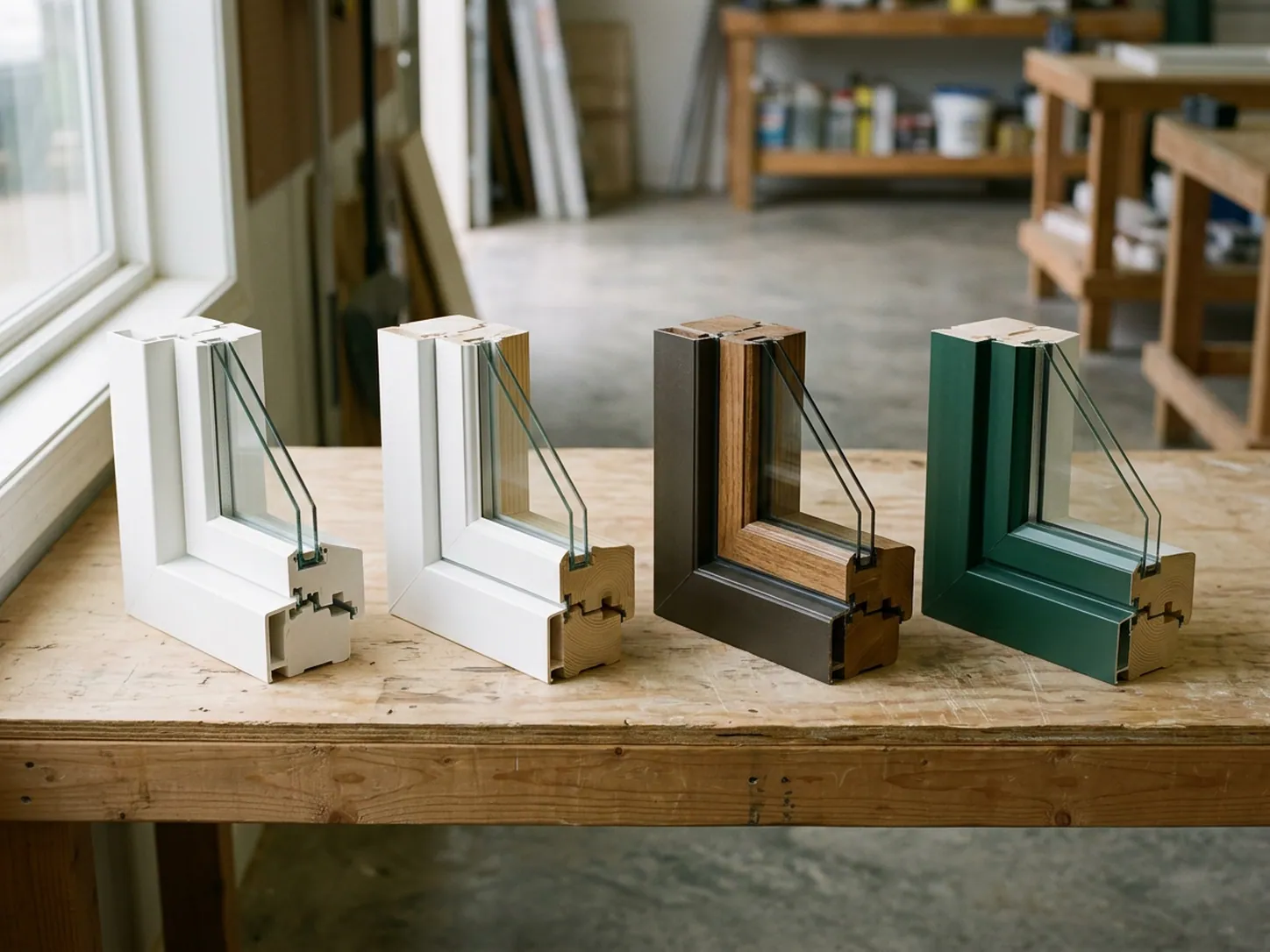
The biggest difference is what the window is made of. The 100 Series is Fibrex composite inside and out, while the 400, A and E Series all have wood interiors with different exterior skins. Glass, size limits and finish options then add separate layers on top.
- 100 Series: Fibrex composite throughout. Nothing inside needs staining or painting, and Andersen describes the frame as more stable in temperature swings than ordinary vinyl.
- 400 Series: a wood interior you can stain or paint, with a vinyl-clad exterior that Andersen calls Perma-Shield.
- A-Series: a wood interior with a fiberglass and Fibrex composite exterior, built for finish and architectural detail.
- E-Series: a wood interior with an extruded aluminum exterior, aimed at custom shapes and large openings.
Descriptions of the 400 Series exterior vary online, and some pages call it Fibrex. Andersen’s own materials page names Perma-Shield vinyl cladding, so that is the term to expect on a quote. Ask for the exterior material in writing on any estimate you compare.
Which Andersen series is best for Texas heat and west-facing sun?
No series is best for Texas heat on its own, because the glass package does most of the work on a hot wall. Pick the series for fit and budget, then choose a low solar heat gain option such as Andersen’s SmartSun glass for west and south openings.
In North Texas the afternoon sun is the hard part. A west wall in Dallas or Fort Worth takes direct light from mid-afternoon until sundown, right when the air is hottest. On that wall, compare the solar heat gain coefficient (SHGC) on the NFRC label of the exact unit, not the series name. A lower SHGC lets less solar heat in. Ask for the SHGC and U-factor in writing for each elevation before you sign.
Plan glass by wall, not by house. Heat-control glass on the west and south openings and standard Low-E glass on the shaded north and east sides can be a sensible split. Triple-pane glass is not where we would put your money in DFW. It earns its keep in cold climates where holding heat in is the goal, not in a cooling-dominated metro.
Frame material matters a little at the edges. Andersen describes the Fibrex on the 100 Series as moving less in temperature swings than ordinary vinyl. On the E-Series, the extruded aluminum exterior conducts more heat than fiberglass or vinyl, which is one more reason to plan the glass with care on a west wall.
A 4 p.m. walk-through settles more than a brochure
Walk around your house late on a sunny afternoon and note which windows sit in direct sun. Those openings get the heat-control glass. The rest can stay on standard Low-E and put the savings toward better installation.
Which Andersen series handles North Texas hail?
Series matters here because Andersen’s impact options differ by line. As of October 2026, Andersen lists the 100 Series with a PG50 upgrade only, the 400 casement and awning with StormWatch, and the A-Series with PG50 standard and StormWatch optional. We found no source linking any of these to a North Texas hail rating.
| Series | Impact option from Andersen |
|---|---|
| 100 Series | PG50 upgrade only, not available with StormWatch |
| 400 Series | Casement and awning available with StormWatch (PG70) |
| A-Series | PG50 standard, StormWatch optional |
| E-Series | StormWatch discontinued as of January 31, 2022 |
Andersen’s impact options come from its coastal program, built around hurricane-zone requirements. We did not find a source tying StormWatch to a DFW hail rating or to an insurance discount, so we will not promise either. If hail is your main worry, ask your insurer what it credits and ask your installer about PG-rated and laminated glass. Laminated glass also helps with sound, which our post on replacement windows that reduce outside noise covers.
Is the Andersen 100 Series good enough for a 1980s to 2000s house or a rental?
Yes, for most of them. The 100 Series is Andersen’s value line, made of Fibrex composite rather than plain vinyl, and it replaces aging builder-grade windows without a wood interior to maintain. It is the wrong choice when you need to match stained or painted wood trim.
Many North Texas houses from the 1980s through the 2000s, in cities like Plano, Garland and Arlington, still have builder-grade frames that were never built for 100-degree afternoons. Longhorn Outdoor Living has worked on North Texas homes like these since 1984, and the pattern is plain. When the interior trim is painted and the goal is a tighter, cooler house, the 100 Series does the job at the lowest cost in the lineup. Landlords like it for the same reason, since nothing inside needs refinishing.
Is the Andersen 400 Series worth the extra money over the 100 Series?
It is worth it when you want a wood interior to stain or paint, need to match existing wood trim, or want more style options. If your trim is painted and your openings are standard, the 100 Series often does the same job for less.
The 400 Series is the mainstream choice for owner-occupied homes in Frisco, McKinney and Plano because it pairs a wood interior with a low-maintenance exterior. Matching trim is the deciding factor. If the room has stained casing you plan to keep, a composite interior will not sit the same way beside it. The premium buys the interior and the options, not a better answer to afternoon sun, because glass choice drives heat performance on either line.
When does the A-Series make sense, and when is it overkill?
The A-Series makes sense when finish, color range, custom sizes and architectural detail matter, such as a street-facing elevation with a distinct style. It is overkill when the 100 or 400 already fits your openings, which describes most standard replacement jobs.
Think of the A-Series as paying for choice. If the front elevation of a house in Southlake or Colleyville calls for a particular grid pattern or a deeper color, it gives you room the 400 does not. If your only goals are a tighter house and lower summer bills, that money is better spent on glass and careful installation.
When is the E-Series the right call for custom or premium work?
The E-Series is right for premium and fully custom work: large or unusual openings, specific shapes and a wood interior with an extruded aluminum exterior. It costs the most, and on a hot west wall it needs a careful glass plan because aluminum conducts more heat than fiberglass or vinyl.
One change matters here. As of January 31, 2022, Andersen discontinued E-Series windows with StormWatch, so a custom E-Series job is not an impact-window plan. Choose it for design, and settle the glass and any laminated option before the order is placed.
Do I need HOA approval or a permit to replace windows in DFW?
Often you need at least HOA approval, and you should confirm permits with your own city. Many HOAs restrict window material, frame color or grid pattern and want approval before work starts. We did not find one permit rule that applies across the metro.
- Get the HOA’s written window rules or its submittal form before anyone quotes a series.
- List the series, frame color and grid pattern by Andersen’s names on the application so approval matches what is installed.
- Call your city’s building department to ask whether a window replacement needs a permit, since requirements vary by city.
- In a Dallas Landmark District, get the Certificate of Appropriateness before any exterior work begins.
In Dallas, the Office of Historic Preservation says a Certificate of Appropriateness is required before exterior work begins on all properties in Dallas Landmark Districts. A window swap is exterior work. A newer home in Prosper or Celina may not have failing windows at all, so replace there for a specific reason, such as better glass on a west wall.
Will clay-soil foundation movement make new windows stick?
New windows will not fix foundation movement, and no series resists it. Expansive clay, like the Blackland Prairie soil east of I-35, swells when wet and shrinks when dry, so a house can shift with the seasons. If your windows already stick, have the foundation checked before you order.
Sticking windows and doors can be an early sign of uneven settling. Square openings and careful installation matter more than the frame brand. Ask any installer to check each opening for square and for gaps before ordering, because a window made to size for a moved opening will bind again. Tell them which sashes stick today.
Is a dealer-installed Andersen the same as Renewal by Andersen?
Renewal by Andersen is a separate replacement-focused business, so its quotes are not a line-by-line match with a contractor installing Andersen 100, 400, A or E Series windows. Compare any two quotes by series, glass package and installation method.
We do not publish price figures in this post. The cost drivers are the series, the number and size of the windows, the glass package, and whether the job is an insert or a full-frame replacement. A quote is only worth comparing when it lists those items for every opening.
What we would talk you out of
Longhorn would talk you out of the A-Series or E-Series when a 100 or 400 meets your openings, and out of triple-pane glass for a DFW cooling load. We would also steer you away from choosing by series name alone, since the glass on a west wall changes the result more.
A higher series does not mean impact glass, as the table above shows. If hail is the reason for the project, ask about PG-rated options by name before paying for a premium label.
Pick the glass by wall, then the series by house
Choose the glass by wall first, then the series by house. A 100 Series suits a budget job or rental, a 400 suits most owner-occupied homes, an A-Series suits a house where finish matters, and an E-Series suits custom work. Bring a list of your west and south windows and your HOA rules, and Longhorn Outdoor Living will walk the house with you in the afternoon sun.
Questions we get asked about this
No single series wins on heat, because the glass package does most of the work. Choose a low solar heat gain option such as SmartSun for west and south walls, and compare the SHGC on the NFRC label of the exact unit. Then pick the series by budget, trim and HOA rules.
The 100 Series is Fibrex composite inside and out, with nothing to stain or paint. The 400 Series has a wood interior and a vinyl-clad exterior, so it matches wood trim and offers more style options. For painted trim and standard openings, the 100 often does the same job.
Both have wood interiors. The A-Series has a fiberglass and Fibrex composite exterior, PG50 as standard and StormWatch as an option. The E-Series has an extruded aluminum exterior and is aimed at fully custom work, and Andersen discontinued E-Series windows with StormWatch as of January 31, 2022.
It depends on the series. Andersen lists the 100 Series with a PG50 upgrade only, the 400 casement and awning with StormWatch, and the A-Series with PG50 standard and StormWatch optional. We found no source tying these to a North Texas hail rating or insurance discount, so ask your insurer.
Many HOAs require approval of window material, color and grid pattern before work starts, and Dallas Landmark Districts require a Certificate of Appropriateness before exterior work. Permit rules vary by city, so call your building department and get the HOA’s written rules before choosing a series.
Cost depends on the series, the number and size of the openings, the glass package and whether the job is an insert or a full-frame replacement. We do not publish price figures in a blog post. A written quote should list each of those items per window so two quotes can be compared fairly.