
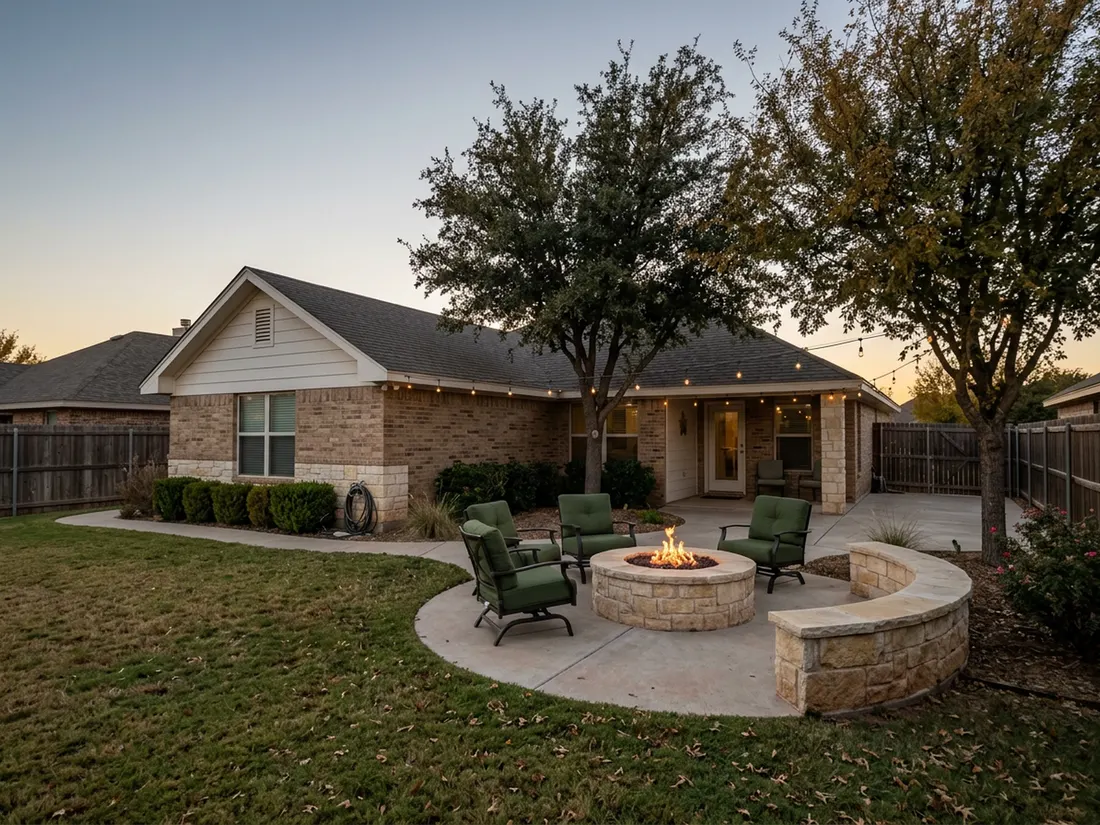
A fire pit for an Abilene backyard is a contained wood or gas fire set on a patio or in the yard for warmth and gathering. Gas is the best year-round choice here because it usually stays legal when wood fires are restricted. You still need to check city rules, burn bans, clearance and the surface first.
A gas fire pit set well out from the house and near a low seating wall is a setup people tend to use often.
The short answer
- Natural gas and propane fire pits are the dependable year-round choice in Texas, because wood fires are the first thing a county burn ban shuts down.
- Fire rules in Texas are set by the city and the county on top of the state rule. An Abilene homeowner should confirm with the Abilene fire marshal rather than rely on another city’s numbers.
- The 2021 Fire Code of Dallas shows how the categories differ: portable recreational fires, portable fireplaces and permanent pits each carry a different distance from structures.
- Under a patio cover or pergola, the burner manufacturer’s overhead clearance governs, and a wood-burning pit does not belong under any roof.
- In summer a fire pit earns its place on late evenings, so spend part of the budget on shade, fans and a windbreak instead of heat output you will rarely use.
What do you check before planning a fire pit for an Abilene backyard?
Four things, in this order: your HOA, the city fire code, any county burn ban, and the clearance in the burner manufacturer’s manual. Gas pits clear those checks far more often than wood pits do. That single fact shapes most of the decisions below.
Texas sets a floor. The state rule on outdoor burning, TCEQ’s Outdoor Burning in Texas guide (RG-049), covers fires for recreation, cooking and warmth. Cities and counties then add their own limits on top, and many do.
Abilene sits in Taylor County, in West Texas, so Abilene’s fire code and Taylor County’s burn ban orders apply to you. Dallas’s do not. We have not reproduced Abilene’s ordinance here, and a blog should not be your source for it. Call the city fire marshal before you design anything. We use the Dallas Fire Code below only because it is published in full and shows how the categories work.
Gas or wood: which fire pit works year-round in Texas?
Gas, either natural gas or propane, works year-round. It lights on demand, turns off with a valve, throws no embers and usually stays legal when a wood fire is not. Wood is fine for a few evenings a year, but it is the fuel most likely to be locked out.
| Wood | Propane | Natural gas | |
|---|---|---|---|
| During a burn ban | First to be prohibited | Often allowed, but read the specific order | Often allowed, but read the specific order |
| Setup | No utility work | Tank or cylinder, no trenching | Gas line from the meter, licensed plumber |
| Wind and embers | Sparks travel on a windy night | No embers, flame still needs a windbreak | No embers, flame still needs a windbreak |
| Control | Hard to turn down or off fast | Valve and ignition | Valve and ignition |
| Best for | Occasional, open-yard, rural lots | Retrofit onto an existing patio | Permanent built-ins near the house |
Propane and natural gas also differ when winter turns bad. Natural gas supply was strained across Texas during the February 2021 freeze. An owner who keeps a propane tank filled ahead of a cold snap holds a self-contained supply. Neither is a reason to choose a fuel by itself, but the question comes up often on our design visits.
Does a burn ban shut your fire pit down?
A burn ban shuts down wood fires almost every time. Whether it reaches a gas appliance depends on the wording of that county’s order. Many orders exempt LP-gas appliances with an on/off valve, but “many” is not “all,” so read the order currently in force before you light anything.
The Dallas County Fire Marshal describes a burn ban as an emergency declaration that bars outdoor burning or open flame during drought or extreme weather. Counties declare and lift them as conditions change. A wood pit that was legal on Saturday can be a violation on Wednesday.
Dry, windy stretches are what trigger these orders in West Texas, and the same conditions make a spark dangerous. A gas burner with a controlled flame keeps the pit usable and the yard safer. Check the order on your county’s site or call the fire marshal, and do the same after any long dry spell.
How far does a fire pit have to sit from your house?
It depends on the category the code puts your fire in. Under the 2021 Fire Code of Dallas, a portable recreational fire must stay at least 25 feet from structures. A portable outdoor fireplace needs at least 15 feet. A permanent outdoor fire pit needs at least 10 feet from a structure or combustible material.
| Category (2021 Fire Code of Dallas) | Minimum distance from structures | Other conditions |
|---|---|---|
| Recreational fire (portable, open) | 25 feet | Attended at all times, extinguisher or approved equipment on hand |
| Portable outdoor fireplace | 15 feet | Attended at all times, stay on site after extinguishing |
| Permanent outdoor fire pit | 10 feet from structure or combustible material | Fireplaces built to the building code are treated separately |
The Dallas text also requires an attendant to stay at least 30 minutes after a recreational fire or portable fireplace is put out. A 4-A extinguisher or other approved equipment must be within reach. Read it yourself in the adopted code, section 307.4.4. Abilene may adopt a different edition or amend it, which is why the fire marshal’s answer outranks this table for an Abilene lot.
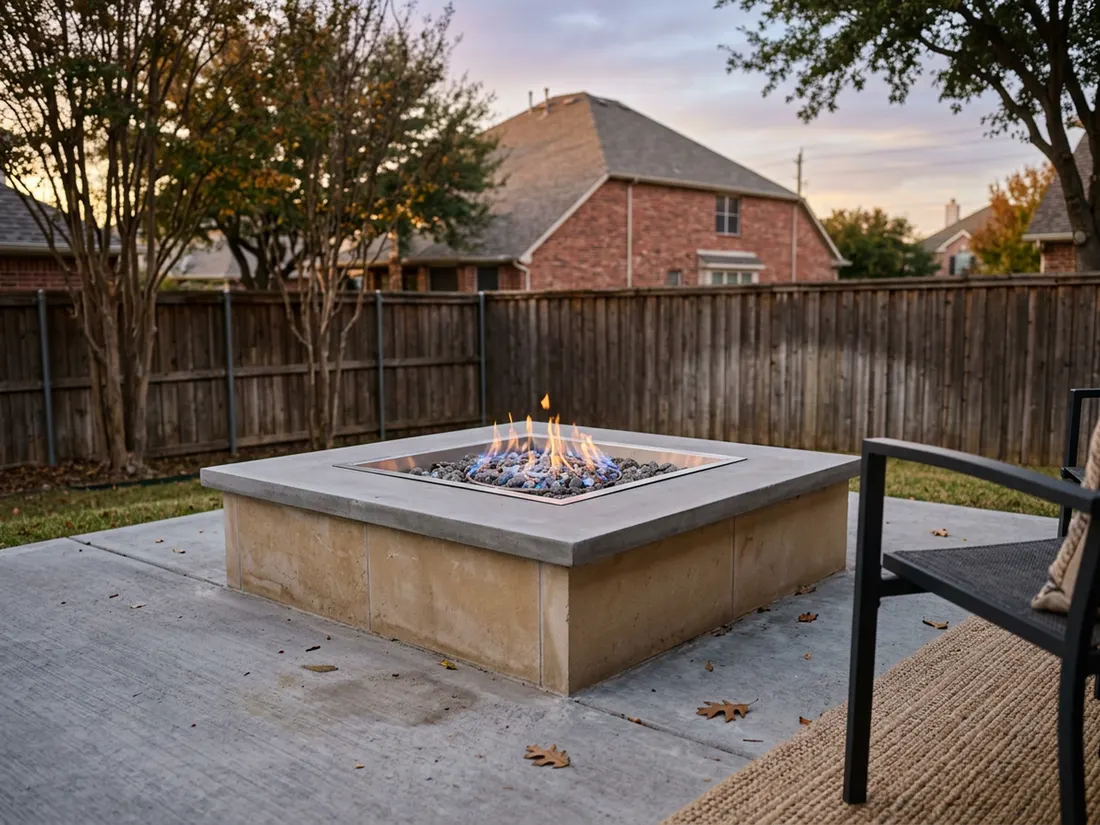
Can you put a fire pit under a patio cover or pergola?
Sometimes, with gas, and never with wood. A gas fire feature can sit under a roof only if the unit is listed for it and the overhead clearance in the manual is met. Wood smoke and sparks under any roof are a fire and carbon monoxide problem, whatever the roof is made of.
Measure from the top of the burner, not from the slab, up to the lowest combustible surface above it. That includes beams, ceiling boards and fan blades. The manufacturer’s number governs, and local code often defers to it. Our advice is to design with margin. A pit that only barely clears on paper tends to stain the ceiling and wear down the finish over time.
An open-slat pergola is a different case from a solid roof. Slats let heat and combustion gases escape, but wood beams still burn, and a pergola counts as a structure under the distance rules above. A solid patio roof or cover traps heat and fumes, so it needs the most clearance and the most ventilation. If you are deciding between structures first, our Abilene patio cover guide covers wind and heat, and a pergola is the better partner for a fire feature on a lower roofline.
What should the fire pit sit on?
A fire pit should sit on a stable, non-combustible base: a concrete slab, compacted pavers or a masonry footing. Wood and composite decks need a listed protective pad and a burner rated for deck use. Never set a pit on a cracked or moving slab.
Retrofitting onto an existing slab has two catches. Trenching a gas line means cutting the concrete, then patching it, and a badly placed patch becomes the next crack. Heat from a wood fire directly on bare concrete can also flake the surface, so a masonry ring with a fire-brick liner is the usual fix. In Dallas and Plano, the swelling Blackland Prairie clay makes slab movement the bigger worry, as we explain in why DFW patios crack. Ground conditions in Abilene can differ, which is why we look at the actual soil before we cut or pour.
Longhorn Outdoor Living builds the patios, covers and pergolas that fire features sit in or under. We plan the hardscape surface and the clearances together. We recommend a licensed plumber for the gas connection itself.
Do you need a permit or a plumber for a gas fire pit?
A built-in gas pit with a gas line is generally permitted plumbing or gas work, done by a licensed plumber and inspected. A portable propane pit that plugs into a standard cylinder usually needs no trade work. Confirm with Abilene’s building department, because each city sets its own thresholds.
A separate permit often applies if you add electrical for ignition, lighting or a fan. And if a built-in pit changes the footprint of a covered area, check whether lot coverage limits come into play. Our outdoor kitchen planning guide walks through the same gas, permit and heat questions for a built-in grill, and the sequence is nearly identical.
How do you make a fire pit usable in an Abilene summer and in winter wind?
Plan for the evening, not the afternoon. A fire pit earns its place from the first cool night of fall through the last of spring, plus late summer nights after the patio has shed its heat. In the July daytime, nobody wants a flame, so build shade and airflow around it instead.
- Wind: Put a low seating wall or a masonry ring on the windward side. A burner flame bent sideways by a West Texas gust is both a nuisance and a hazard.
- Summer: Use a gas pit with a valve you can shut instantly, a ceiling fan on a covered patio, and shade over the seating. At low or no flame, the same ring works as a table.
- Winter: Seat people close and out of the wind. Radiant warmth works within a few feet, and it drops quickly with distance.
The honest don’ts
Do not pay for a large, high-output burner if you expect to light it on ten nights a year. And do not put one under a low solid roof to save space. The clearance and the ceiling staining cost more than the extra square footage is worth. A smaller burner, good seating and a windbreak get more use than a showpiece.
What drives the cost of installing a fire pit?
Longhorn has not published prices for fire pits, so we will not guess at them here. The main drivers are the gas line run from the meter or tank, the slab that has to be cut and patched, and the size and finish of the ring. The burner, the ignition system, and permit and inspection time count too. Cost only becomes real once someone has walked the yard.
In what order should you check the rules?
- HOA first. Some associations ban wood-burning pits or limit structure heights even when the city allows them.
- City fire marshal next. Ask which category your pit falls into and what distance applies. Get the answer in writing if you can.
- County burn ban status. Find the current order and see whether it exempts gas appliances.
- Your insurance agent. Ask whether a built-in fire feature changes your policy, before you build.
- Plumber and permit. Only after the first four are settled should anyone price a gas line.
If you already have a patio cover or pergola, do the clearance check against the manual on the day of the design visit, not after the pit is installed. It is cheaper to move a line on paper than to move a ring in concrete.
Thinking about this for your own home? See how Longhorn builds hardscaping.
Questions we get asked about this
It depends on the city. Portable pits usually need none, but a built-in gas pit with a gas line is generally permitted plumbing work. The state sets a floor for outdoor burning, and cities and counties add their own rules. Check with your city’s building department and fire marshal before you buy or build.
Wood fires are almost always prohibited during a burn ban. Gas and propane appliances are often exempt, particularly those with an on/off valve, but that depends on the wording of your county’s order. Read the order or call the fire marshal before you light it.
The 2021 Fire Code of Dallas sets at least 25 feet for portable recreational fires, 15 feet for portable outdoor fireplaces and 10 feet for permanent pits. Abilene may differ, so confirm with the Abilene fire marshal. Always follow the manufacturer’s manual if it asks for more.
Only a gas unit listed for it, and only if the manual’s overhead clearance is met. Measure from the top of the burner to the lowest combustible surface. Wood-burning pits do not belong under any roof because of fire and carbon monoxide risk.
A sound concrete slab works well, with a masonry ring or protective liner to limit heat damage. Wood and composite decks need a listed protective pad and a burner rated for deck use. A cracked or moving slab should be repaired before anything permanent goes on it.
It can. Some insurers ask about built-in fire features, and many HOAs restrict wood-burning pits or structures near property lines. Ask your agent and read your HOA rules before you build. Both are quick questions, and they can save an expensive change later.