
Outdoor kitchen planning in DFW comes down to four decisions made in order: where the cooking sits against the south wind and afternoon sun, which surfaces survive heat, hail and freezes, which fuel you run, and what your city permits and inspects. Settle those before you pick appliances.
The short answer
- Plan an outdoor kitchen in this order: location, surfaces, fuel, permit path, then the cover and appliances.
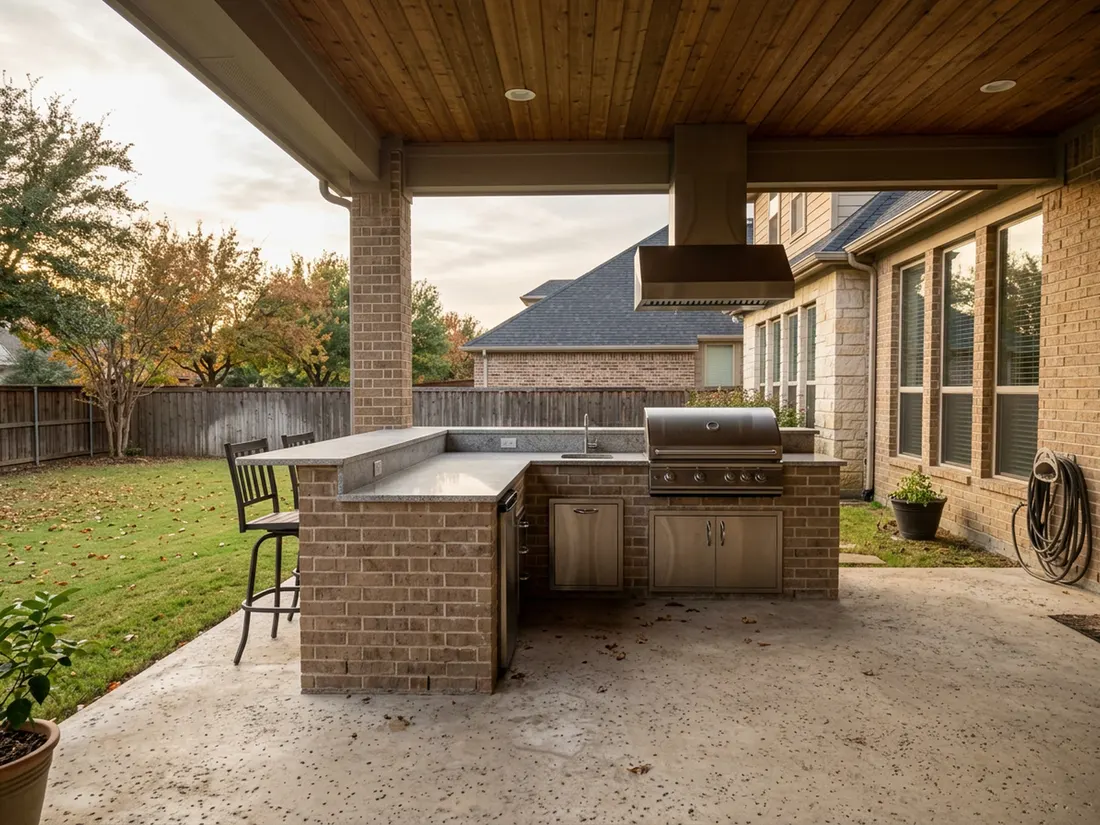
- Put the cooking line so the prevailing south wind carries smoke away from seating, and keep sinks, refrigerators and dark stone out of the hot west sun.
- Granite, porcelain or sintered stone and sealed concrete suit North Texas heat and freezes, while stainless steel and powder-coated aluminum are the safest cabinet materials.
- On a natural gas kitchen you own the piping from the Atmos Energy meter to the grill, so a licensed plumber should design and test it and you should call 811 before any digging.
- The grill maker’s manual sets the clearance under a patio cover or pergola, and no city or web page rule overrides it.
- Gas, electrical, plumbing and roofed structures usually each trigger review, and the rules differ by city, so confirm with your own building department before you design.
What should you decide first when planning an outdoor kitchen in North Texas?
Decide the location first, then the surfaces, then the fuel, then the permit path, and only then the appliances. The first four choices set the layout and the budget. Appliances can be swapped later. If you want a cover over the cooking area, it belongs in the first conversation too.
- Location. Place the cooking line with the south wind, the afternoon sun and the distance to the gas meter in mind.
- Surfaces. Pick counters and cabinets that take 100°F summers, hail and hard freezes.
- Fuel. Choose natural gas, propane or electric, and know who owns the line.
- Permit path. Gas, electrical, plumbing and any roofed structure usually each trigger review.
- Cover. The overhead decides how much clearance and venting the grill needs.
Longhorn Outdoor Living has built patios across Dallas–Fort Worth since 1984. The planning problems we see most often start with the grill being chosen first, and then the ceiling, the gas line and the slab have to catch up. Our outdoor kitchens page shows what we build. This guide covers the thinking before the build.
Where should an outdoor kitchen go relative to the south wind and afternoon sun?
Put the cooking line where the prevailing south wind carries smoke and grease away from your seating, and keep the west end of the kitchen out of the late sun. South is the usual wind in North Texas, so a grill on the north side of the seating area sends smoke away from guests. That is our field judgment, not a code requirement.
Cold fronts flip the pattern. Strong northerlies arrive with fronts through the cooler months and push smoke and ash back toward the seats. They can also blow out burner flames. A short wind screen, a hood or a solid wall on the north side lets the same layout work in a football-season cold snap and in July.
Afternoon sun is the second filter. Summer highs in Dallas and Fort Worth regularly pass 100°F, and the west side of a patio takes the sun at its worst hour. Keep the sink, the refrigerator and any dark stone out of that exposure, or shade them. Dark counters and stainless handles can be too hot to touch by late afternoon.
Keep the heat off the house
Leave the distance the grill manual calls for between the cabinet back and any wall. Grill heat can distort vinyl siding and scorch wood trim, and a kitchen pushed tight to the house is the layout we talk people out of first.
Which countertops survive DFW heat, hail and freezes?
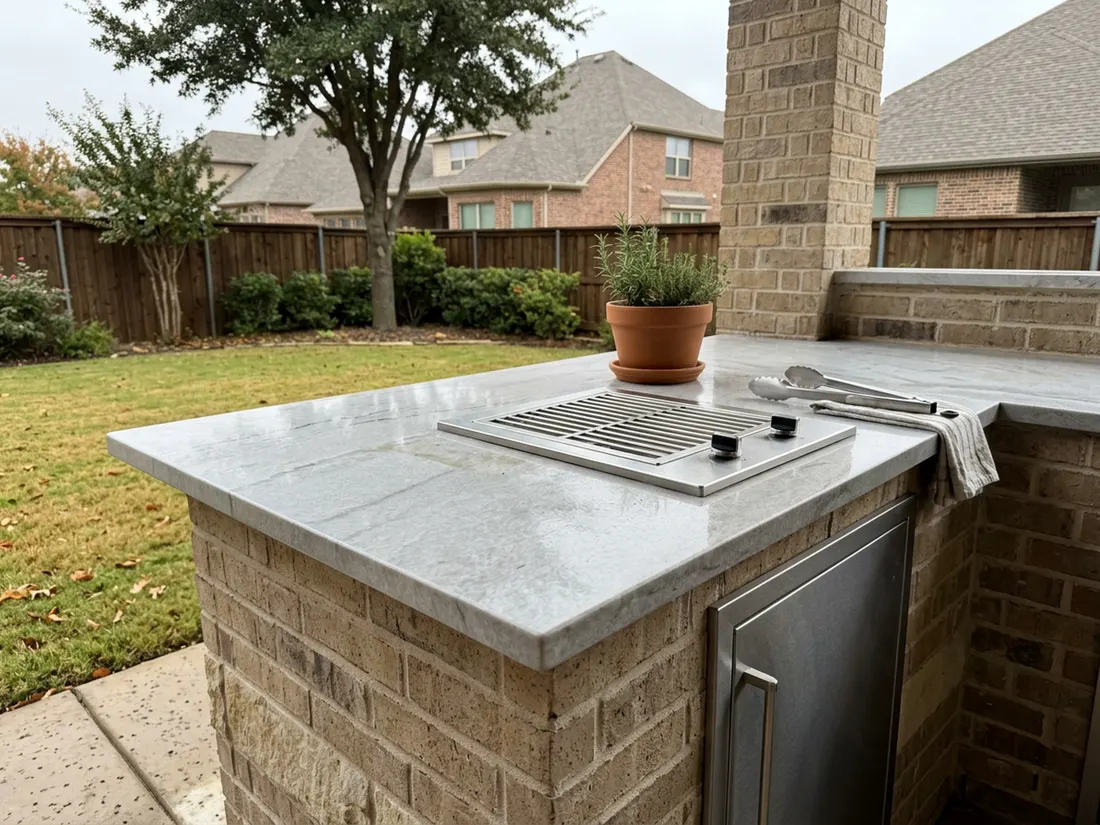
Granite, porcelain or sintered stone slabs, and well-sealed concrete hold up best in North Texas. The stone slabs are dense and low in porosity, and sealed concrete depends on its sealer to keep water out. That matters because water in tiny pores expands when it freezes and slowly damages a surface. Lighter colors stay cooler under summer sun than dark ones.
| Material | Why it works here | What to watch |
|---|---|---|
| Granite | Dense natural stone that takes pot heat and sun | Seal it on the installer’s schedule. Dark colors get hot to the touch |
| Porcelain or sintered stone | Very low porosity, and the color often runs through the slab | Thin edges can chip. Use a fabricator who has cut it before |
| Sealed concrete | Cast to any shape and heat tolerant | Hairline cracks are normal, and stains show up if the sealer lapses |
| Standard quartz | Handsome and easy to clean indoors | Resin binder. Many makers do not rate it for direct sun, so read the outdoor warranty first |
| Tile over a slab base | Wide range of looks | Grout lines hold water and can crack in a freeze |
Hail rarely hurts a stone top. The damage we hear about after a storm is to glass, refrigerator doors, grill lids and hood finishes. That is one more reason to think about a cover. If you do not have one, check those parts after every hail event.
Which cabinet and frame materials hold up in North Texas?
304 stainless steel and powder-coated aluminum are the safest cabinet choices for North Texas, with a masonry or stucco island as the heavier option. Stainless resists rust and heat. Polymer (HDPE) cabinets are waterproof and UV-stable, but extreme heat can warp them near a grill, so they need insulated grill jackets.
Masonry and stucco islands look solid but come with a clay-soil problem. East of I-35, the Blackland Prairie clay swells in wet springs and shrinks in dry summers, and a heavy island on a slab that moves can crack its veneer. Our post on why DFW patios crack covers the slab side. In parts of Fort Worth, shallow limestone is stable but can be slower to dig for footings and utility trenches.
Natural gas, propane or electric: which fits your yard?
Natural gas suits a kitchen near the house that gets used often. Propane suits a kitchen far from the meter or a freestanding grill. Electric covers refrigerators, lighting, outlets and small appliances, but is rarely the main cooking fuel on a serious grill line.
| Fuel | Fits when | Watch for |
|---|---|---|
| Natural gas hard line | The island is close to the house and you cook often | Trenching, a permit, a pressure test, and the fact that the piping is yours |
| Propane tank | The island is far from the meter, or you want to avoid a trench | Tank storage and refills. A permanent hookup may still be inspected, so ask your city |
| Electric | Refrigerator, lighting, outlets and small cooking appliances | Dedicated circuits, GFCI protection outdoors and spare capacity in your panel |
Atmos Energy lists underground piping from the meter to a gas grill or other appliance as customer-owned. That means the trench, the pipe and the fittings are yours. A licensed plumber should design and test the run. Call 811 before you dig, and ask how much notice they need. See the Atmos Energy customer-owned piping page.
On the electric side, the National Electrical Code requires GFCI protection on outdoor receptacles, and cities adopt and amend their own editions. A refrigerator, lights and a fan can pull more than people expect, so have an electrician check the panel before the design is final.
Do you need a permit for an outdoor kitchen in Dallas, Fort Worth, Plano or Frisco?
Expect to need a permit whenever the kitchen involves gas piping, new electrical, plumbing or a roofed structure, and expect the details to differ by city. As of October 2026, some of the city pages we found are dated, and some details below come from secondary sources rather than the city. Use the table as a place to start asking, not as a ruling.
| City | What we found | Confirm before you design |
|---|---|---|
| Dallas | The city’s building inspection FAQ has listed patio covers under 200 square feet on single-family or duplex lots, outside front and side setbacks, among permit exemptions. We would not read that as covering gas, electrical or plumbing work. | Current rules on the city’s permit portal, and whether your lot is in a historic district |
| Fort Worth | The contractor-registration page carves out homestead owners doing their own work. | Who pulls each trade permit when you hire the work, and whether your contractor is registered |
| Plano | A secondary source reports a gas permit for a new branch line, with a pressure test and inspection before the pipe is concealed. | Whether inspection is on the rough piping before backfill, and the current review time |
| Frisco | We could not confirm Frisco’s requirements from a city source. | Whether gas, electrical and any roofed structure each need a separate permit |
Where a city inspects gas work, the usual sequence is a pressure test on the rough piping before anything is buried or enclosed, then a final inspection once the appliances are connected. Ask your city whether it wants both. A trench closed too early has to be reopened.
Your HOA is a separate review from the city. Many DFW subdivisions require approval for a built-in kitchen, a hood or a roofed structure, and the city will not check that for you. Get the HOA’s answer before you file for permits, and check the city’s current page for the permit review time, since it varies.
Can you put a built-in grill under a patio cover or pergola?
You can only do it if the grill maker’s manual allows it for your ceiling. The manual’s clearance to the overhead governs, not a rule of thumb from a web page. Wood beams and painted wood decking usually need more clearance than a non-combustible ceiling, and a ducted hood changes the answer.
Local pages disagree here. Some say an open-slat pergola never works over a grill, and others say it works with enough height. Both overstate. Open slats let heat and smoke pass, but they still leave combustible wood above the flame, so the manual’s number still applies.
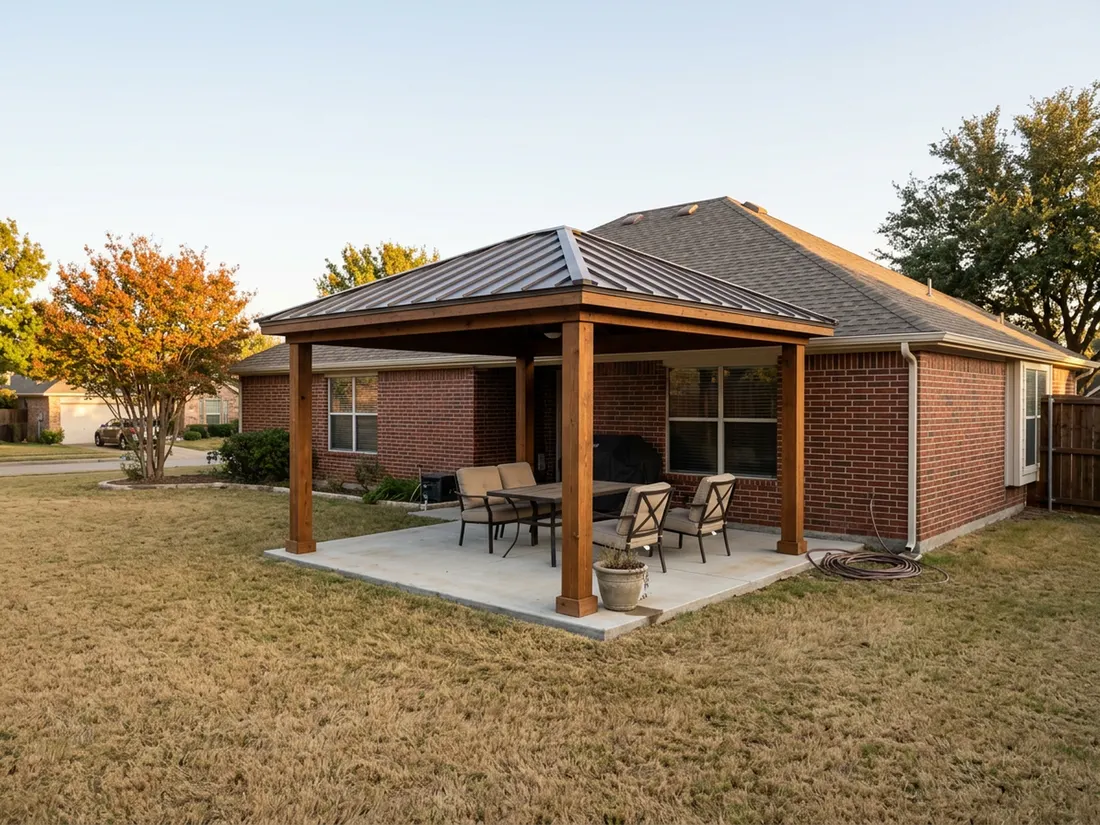
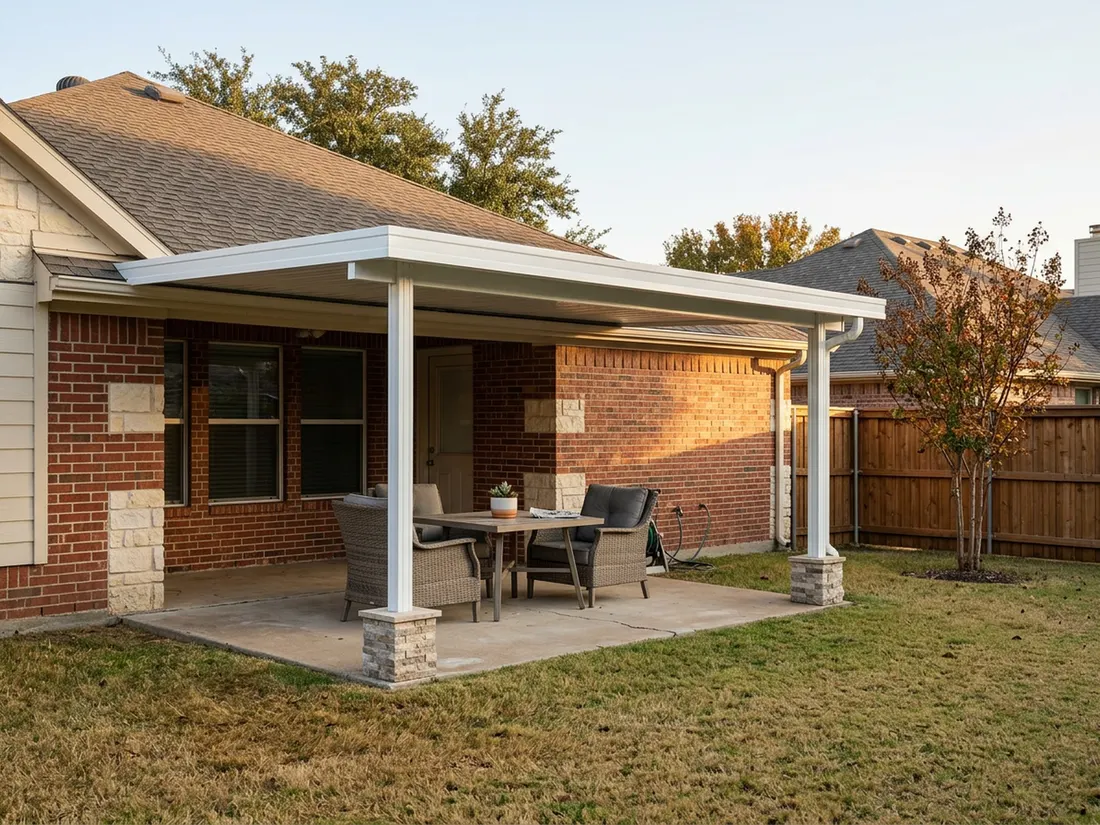
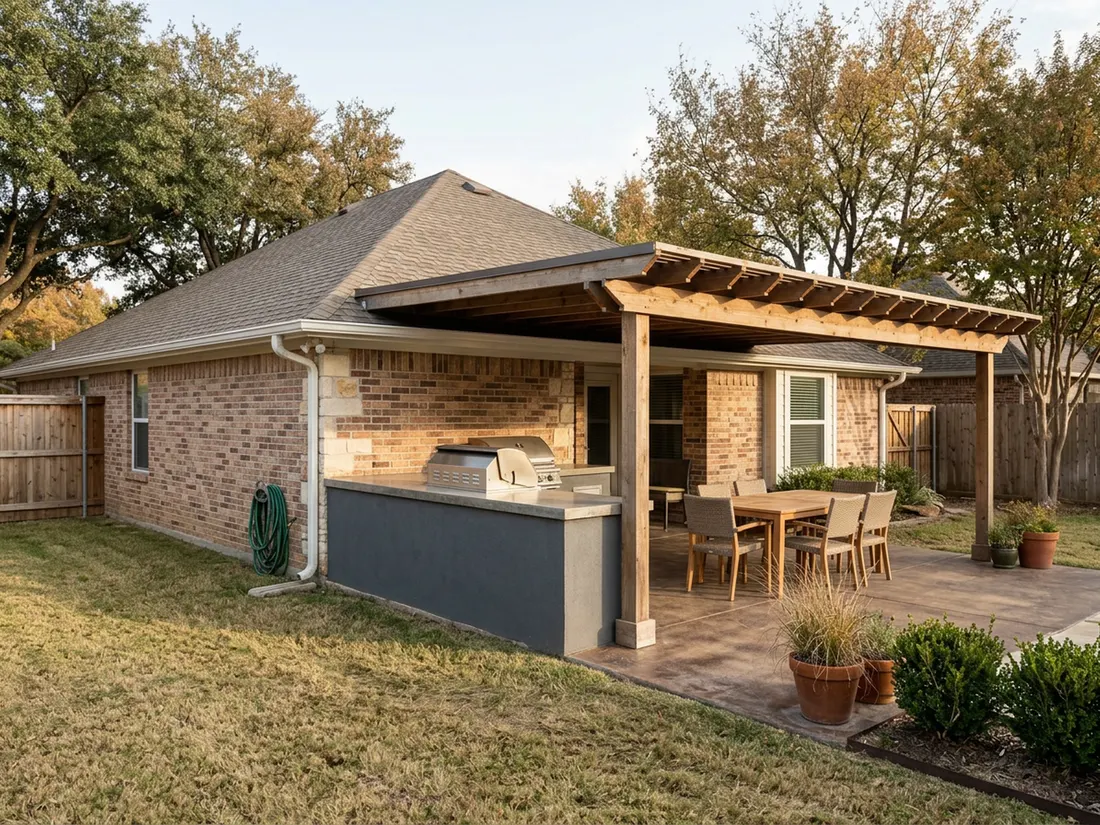
A cover also changes the layout. Posts should land beside the island, not in the cooking path. A hood needs a route to vent outside, and a solid roof over a grill collects smoke unless it is vented. Our guides to pergola vs patio cover in Texas and attached or freestanding patio covers cover the structure, and patio cover materials covers what holds up.
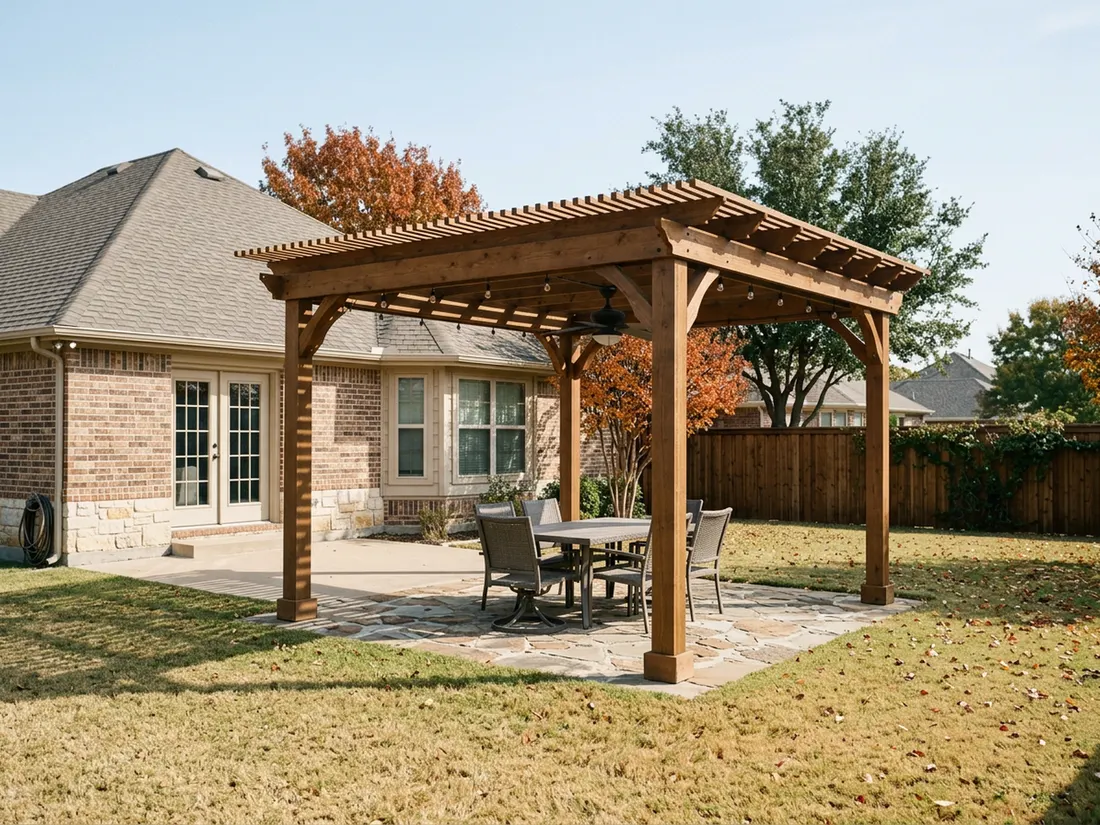
If you are weighing a cover against a pergola, see our patio covers and pergolas pages. Our post on pergola design for sun, soil and slats shows how slat direction affects the shade over a work area.
What drives the cost of an outdoor kitchen in DFW?
Outdoor kitchen cost in DFW is driven by the length and shape of the run, the counter material, the appliances, and what has to be dug, wired and permitted. We do not publish prices here. Ranges you see online mix very different scopes, so compare the drivers, not the totals.
- Linear feet and layout. An L or U shape adds cabinets, counter and slab.
- Counter material and fabrication. Edge profiles, cutouts and slab size matter.
- Appliances. Grill size, side burners, refrigerator, ice maker and hood.
- Gas run. Distance from the meter, trench depth, soil (Blackland clay versus limestone) and the pressure test.
- Electrical. Dedicated circuits, GFCI protection, lighting and panel capacity.
- Plumbing and drain. Sink supply, where the drain goes and freeze protection.
- Hood, ducting and ceiling. A non-combustible ceiling or extra clearance changes the structure.
- Cover or pergola. Building one over the kitchen is its own project.
- Permits, plans and inspections. Plus any HOA review.
- Slab condition. An existing patio may need repair or new footings for a heavy island.
Can you build an outdoor kitchen over winter and have it ready for spring?
Often, yes. Much of an outdoor kitchen can be built over a North Texas winter if the permits and utility work are lined up in the fall. Start the layout, the plumber walk-through and the HOA and city submittals in October, schedule the trench and rough-in for milder weeks, and plan counters and appliances for late winter. The sequence below is typical, but permit review and weather can move it.
| Timing | Work |
|---|---|
| October | Layout, plumber and electrician walk-through, HOA submittal, cover decision |
| November | City permits, 811 call, material and appliance orders |
| December to January | Slab or footings, trench, rough-in, first inspections, weather permitting |
| February to March | Cabinets, counters, appliances, final inspections, testing |
Freeze protection matters from the first winter. The February 2021 and December 2022 freezes burst exposed supply lines across North Texas. Any sink or ice-maker line should shut off and drain from inside the house, and stubbed lines on an unfinished kitchen need caps. Concrete, mortar and thinset also cure slowly in the cold, so installers schedule around freeze nights.
For this fall’s football and holiday cooking, a freestanding grill placed as its manual directs, away from the house and out from under any combustible overhead, is a fair stopgap. Do not move it under a roof to dodge the weather.
What should you ask a contractor before you sign an outdoor kitchen job?
Ask who runs the gas, who pulls each permit, and which grill model the design assumes. A clear answer to those three questions tells you whether the plan has been thought through. Our guide on how to choose a patio cover contractor in DFW has the rest of the list.
- Is the gas piping done by a licensed plumber, and will that person pull and own the permit?
- Which grill, hood and clearance numbers did you design to, from the manual?
- What happens to the plan if the slab or soil is not what you expected?
- Does the price cover inspections, and who schedules them?
- What is the winter plan for freeze protection on lines that are not yet finished?
If you bring us your lot, your patio and the grill you want, we will walk the yard with you and sort out wind, sun, gas and cover before anything is drawn.
Questions we get asked about this
Usually yes, if the kitchen involves gas piping, new electrical, plumbing or a roofed structure. A freestanding grill on propane often needs none. Rules differ by city, and an HOA is a separate review, so call your building department with the full scope before you design or order anything.
Gas piping is plumbing work, so plan on a licensed plumber. Atmos Energy treats the piping from the meter to the grill as customer-owned, and the plumber usually pulls the permit and schedules inspection. Call 811 before any digging, and ask how much notice they need.
Natural gas fits a kitchen near the house that you use often, since there is no refilling. Propane fits a kitchen far from the meter or a freestanding grill. Either one with a permanent hookup may need a permit and inspection, so ask your city before you choose.
Whatever the grill maker’s manual says for your ceiling type. Built-in grills publish a clearance to combustibles, and the figure is larger for wood overheads than for non-combustible ones. A ducted hood can change what is allowed. A web page rule never overrides the manual.
Yes. The February 2021 and December 2022 freezes showed how fast exposed lines fail. Shut off and drain the sink supply from inside the house before a hard freeze, and follow the maker’s instructions for the refrigerator and ice maker. Cap any stubbed lines on an unfinished kitchen.