
For a patio cover in Abilene, TX that summers and storms will not wreck, choose an engineered aluminum or steel frame, a solid or insulated roof for real shade, a wind rating checked against the city’s requirement, and footings built for clay. Open slatted pergolas look good but give up the most shade.
The short answer
- The best patio cover for Abilene is an engineered aluminum or steel frame under a solid or insulated roof, because the roof is what makes shade on a 100-degree afternoon.
- The National Weather Service counts an average of 19 days a year at 100 degrees or more in Abilene, with a record of 81 in 2011 and 66 in 2023.
- A wind rating is only as good as the stamped engineering drawing for your address, so ask the City of Abilene and your contractor for the design wind speed rather than trusting a brochure number.
- Abilene’s clay swells and shrinks with moisture, so posts need footings designed for the soil and a slab that has not already settled.
- Call Building Inspections at the City of Abilene before signing a contract, since the city publishes a Carports and Patio Covers handout and a separate Carport Application.
What is the best patio cover for hot, windy weather in Abilene?
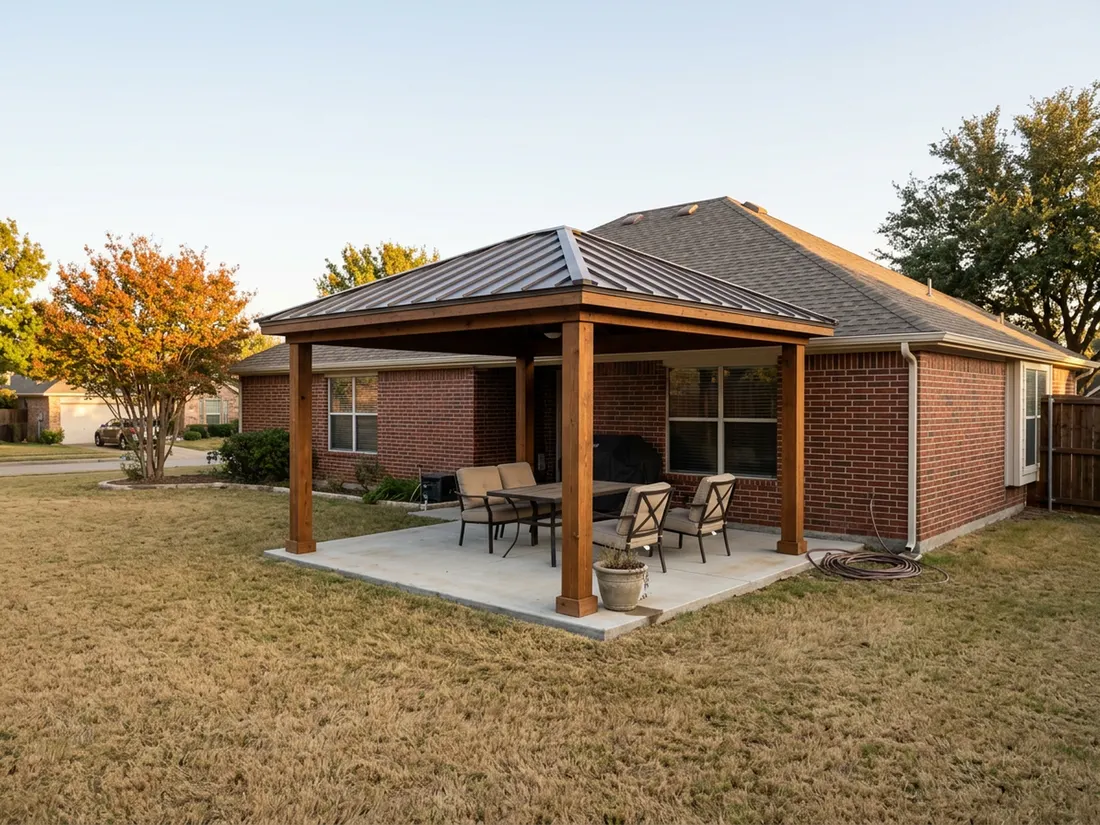
The best patio cover for Abilene is an engineered aluminum or steel frame under a solid or insulated roof, with a wind rating checked for your address and footings set for clay soil. A pergola works when shade is a bonus. For a patio you want to sit on in July, the roof does the real work.
Abilene is its own market. The city began in 1881 on the Texas and Pacific Railway, is the Taylor County seat, and sits well west of Fort Worth. It has West Texas heat, West Texas wind and a building office of its own, so advice written for Dallas or Fort Worth yards does not carry over cleanly. Longhorn Outdoor Living, a family-owned company building since 1984, wrote this page for Abilene patios.
What does Abilene weather do to a patio cover?
Abilene weather hits a patio cover three ways: long stretches of 100-degree heat, gusty thunderstorm wind and hail. The roof has to survive all three, and the cheapest structures usually fail at the weakest link. Here is what the National Weather Service records show.
Heat: some summers pile up 60 or more days at 100 degrees
The National Weather Service lists an average of 19 days a year at 100 degrees or more in Abilene for 1991 to 2020. The record is 81 such days in 2011, and 2023 reached 66. The NWS climate page for Abilene and the San Angelo office’s monthly highlights also report that Abilene ended a record 34-day streak of 100-degree highs on Sept. 4, 2026. A cover that only dims the sun, rather than blocking it, gets tested hard in summers like those.
Wind: severe storms start at 58 mph
The National Weather Service defines a severe thunderstorm as one with winds of at least 58 mph, hail at least 1 inch in diameter, or both. Abilene Regional Airport recorded a 60 mph peak gust on June 12, 2014. KTXS has also reported storm gusts up to 80 mph across the Big Country, with gas station awnings torn apart. Light canopies and thin kit frames are the first things such gusts take.
Hail: the June 2014 storm still shapes local memory
The June 12, 2014 storm is the one Abilene remembers for hail, and local reporting describes decade-long repair efforts afterward. The National Weather Service counts hail of 1 inch or more as severe. Hail that size can dent thin aluminum and crack plastic panels, so a roof’s hail performance is a separate question from its wind rating. Ask for both in writing.
Pergola or solid patio cover: which handles wind and heat better in Abilene?
A solid or insulated patio cover handles Abilene heat better than an open pergola, because the roof blocks direct sun instead of filtering it. In wind, the frame and footings matter more than the roof style, so an engineered pergola can outlast a flimsy solid cover.
| Cover type | On a 100-degree afternoon | In West Texas wind and hail | Best fit |
|---|---|---|---|
| Insulated panel cover | Blocks direct sun, and the insulated core slows heat moving down onto the patio | Needs an engineered frame; the panel skin takes the hail | A patio used all summer |
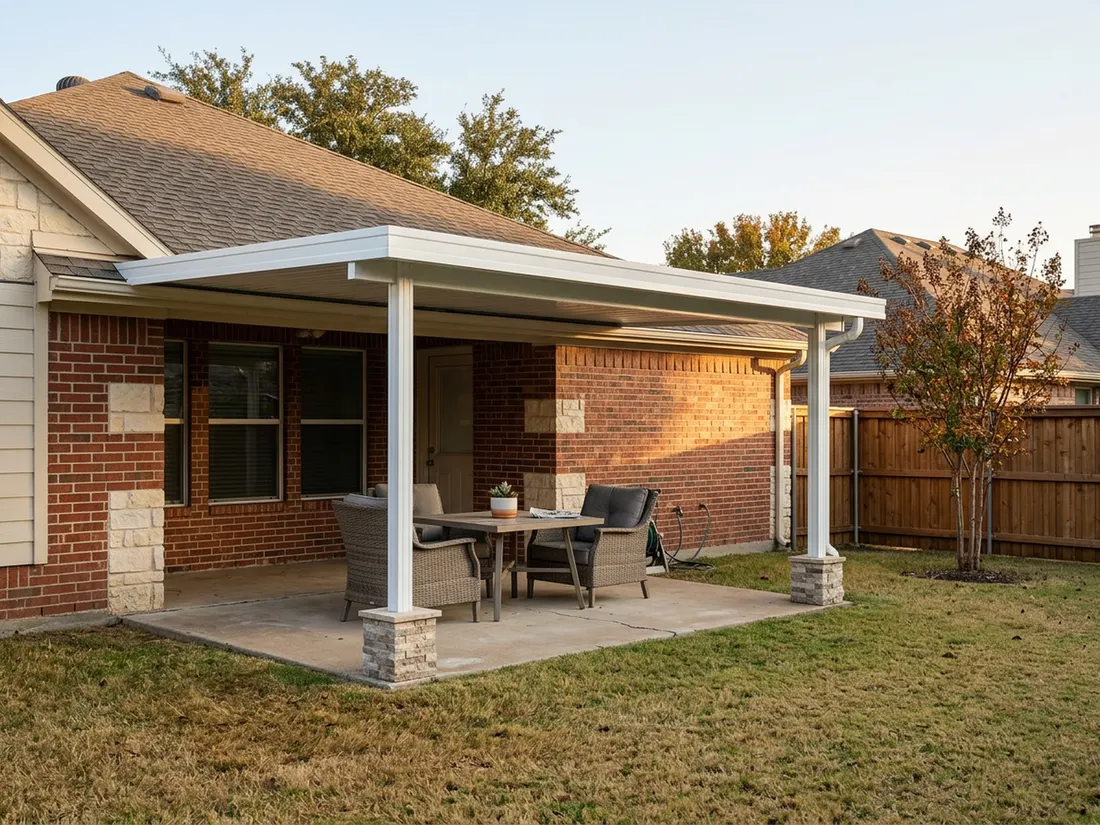
| Solid aluminum roof | Full shade, though bare metal can radiate warmth from above | Needs an engineered frame; ask about panel thickness for hail | Shade on a tighter budget |
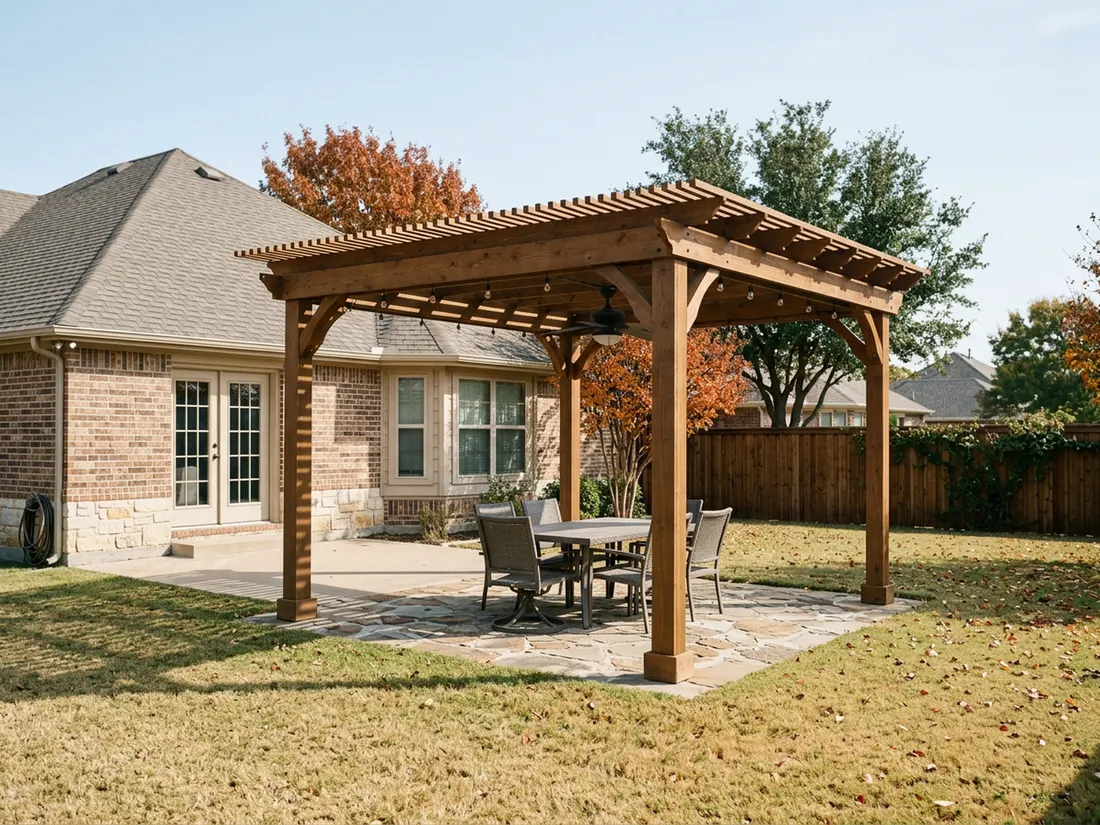
| Open slat pergola | Filters sun, and shade moves as the sun does | Slats let wind pass, but posts and connections must be strong | Evenings, vines and looks |
| Louvered pergola | Closed louvers give shade; open louvers let heat in | Louvers must be closed before a storm; ask for hail data | Owners who want adjustable shade |
| Shade sail | Some shade, little insulation | Catches gusts like a sail and loads its anchors | Short-term or removable shade |
For the general case across Texas, our post on pergola vs patio cover in Texas goes deeper. In Abilene the tipping point is the number of 100-degree days. A pergola is a handsome choice for evenings, but a patio used at 4:00pm in August wants a roof, and an insulated patio cover is the strongest answer to that sun.
Is an aluminum patio cover better than wood in Abilene?
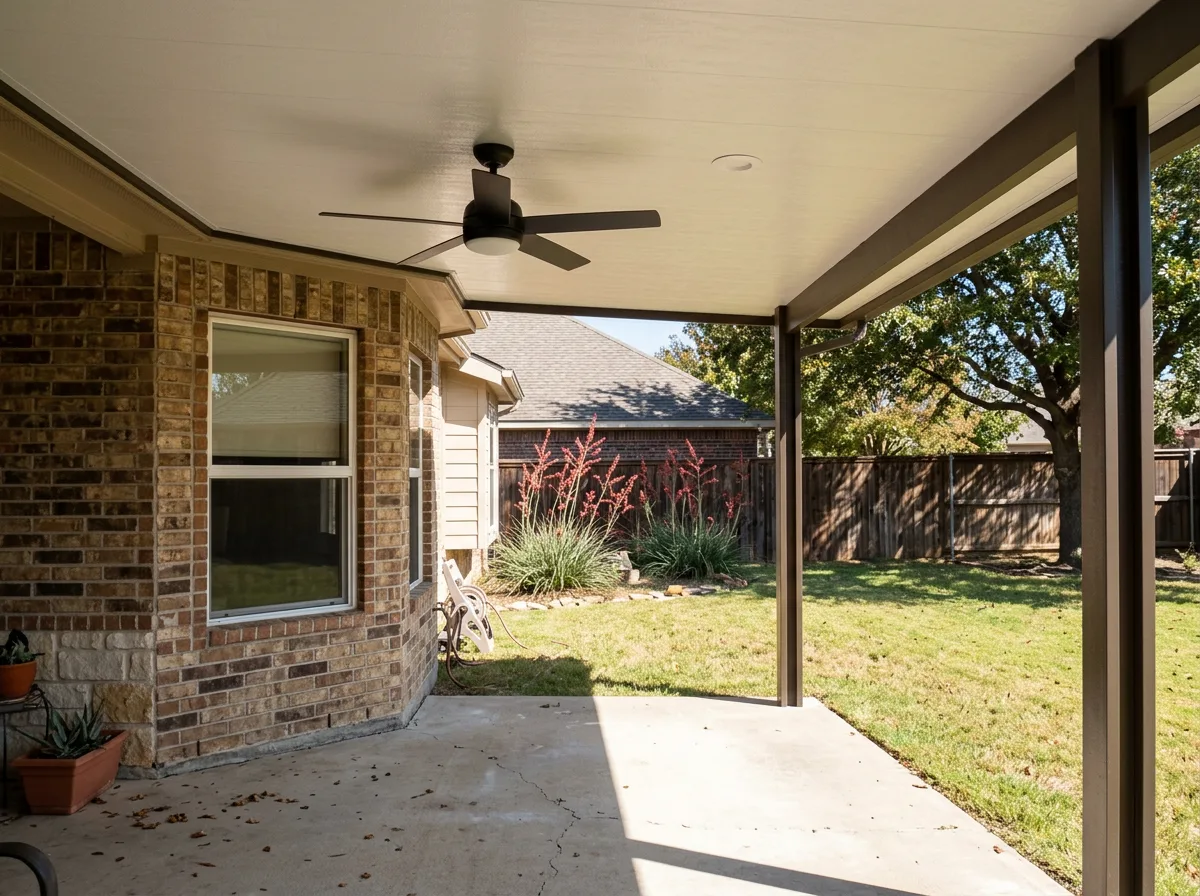
Aluminum or steel is usually the better fit in Abilene, because metal does not rot, warp or need a sealing schedule under constant sun. Wood can work when the sections are heavy and the connections are tight, but it asks for more upkeep here.
Wood is the choice for looks, and sealed cedar or similar timber can last. The catch is the West Texas combination of hard sun, dry air and sudden heavy rain, which keeps boards swelling and shrinking and loosens joints over time. A metal frame from our patio roofs and covers line avoids that cycle. For a deeper look at the trade-offs, read our post on patio cover materials in Texas.
Can a louvered pergola handle West Texas wind and hail?
A louvered pergola can handle wind and hail if it is engineered for the address, the louvers close tight, and someone closes them before the storm. Closed louvers act like a roof and take the hail. Left open, they leave the storm to the hardware.
Storm lines in West Texas can arrive quickly, so the plan for closing matters as much as the product. Ask whether the louvers have a sensor or a timer, whether a power outage leaves them stuck open, and whether a manual override exists. Ask what the warranty says about damage when louvers were left open. A louvered system is a good shade tool, but its owner takes on a job that a fixed roof never asks for.
What does 'wind rated' actually mean, and how do you check it?
A wind rating is the design wind speed a structure was engineered to resist, tied to a specific site and set of conditions. Vendors quote different numbers, so treat a brochure figure as a claim until a stamped engineering drawing for your address backs it up.
Published wind claims vary from one vendor to the next, and none of them is a rule for Abilene. The design wind speed and exposure category for your lot come from the City of Abilene or the project engineer. A buyer who asks for those two items has already filtered out many of the weak bids.
- Ask for the design wind speed and exposure category the city requires at your address.
- Ask for a stamped drawing of the exact model, size and anchoring, not a brochure.
- Check the footing detail on the drawing against what will be built on your slab and soil.
- Ask what the rating assumes, such as louvers closed or all roof panels fastened.
- Ask who submits the drawing to Building Inspections and who answers if the city has questions.
Does Abilene’s clay soil change how posts and footings are built?
Yes. Abilene’s clay swells when wet and shrinks when dry, so a post set shallow or bolted to a thin, already-moving slab can shift, and a shifting post racks the whole frame. Footings should be designed for the soil, not copied from a detail used in another city.
The USDA’s Abilene soil series is described as very deep clay, about 35 to 50 percent clay, with secondary carbonates roughly 10 to 28 inches down. Local foundation crews quoted by KTXS blame the clay’s wet-dry swelling and shrinking for settling slabs. A patio cover post that lands on a settling slab moves with it, and the roof frame pays for that movement.
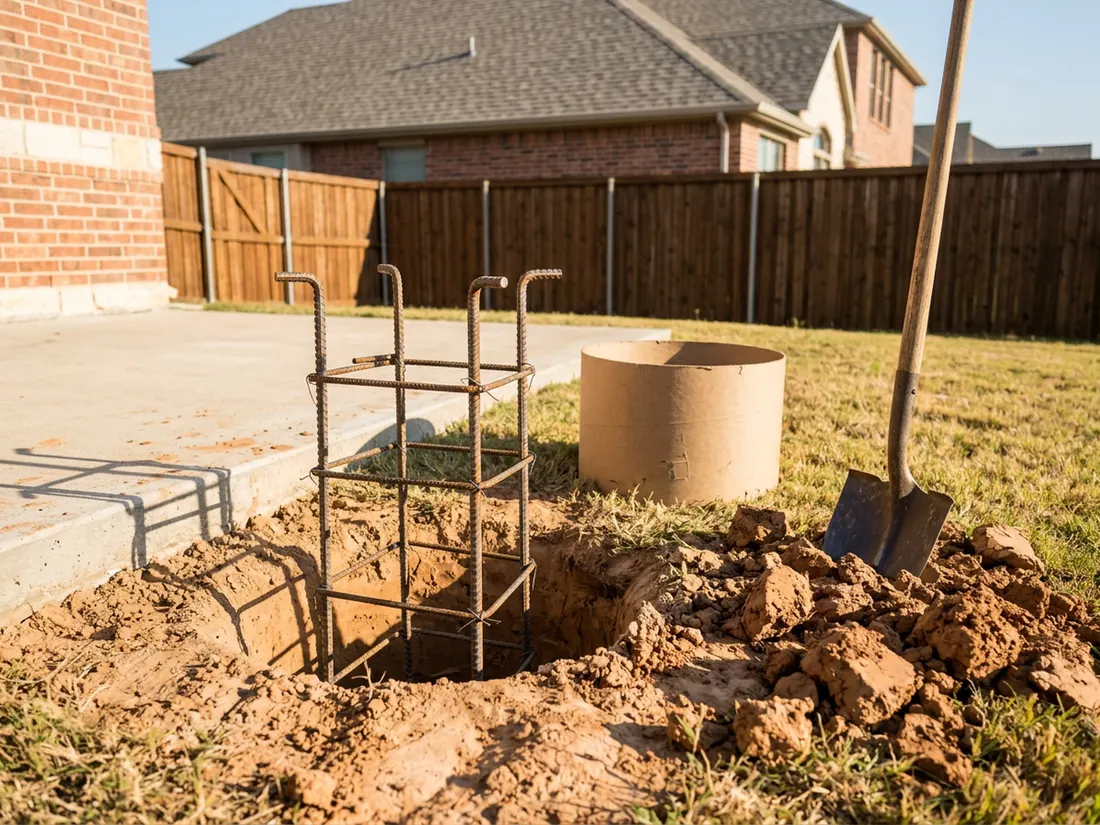
Before any cover goes over an existing slab, walk it. Look for cracks, tilt, and gaps where the slab meets the house. If the slab has settled, the first fix is the footing plan, not the roof. Water matters too. Abilene’s supply comes from Lake Fort Phantom Hill and Hubbard Creek Lake, with Lake O.H. Ivie by contract. That is a good reason to plant drought-tolerant beds near posts and to keep irrigation and downspout runoff away from them.
Should a patio cover be attached or freestanding for wind?
Neither wins on its own. An attached cover shares the house’s strength but sends wind load into the wall and roof line. A freestanding cover carries its whole load on its own footings, which is where Abilene’s clay matters most. Choose by how your house is built.
Our post on attached or freestanding patio covers lays out the structural trade-offs. In Abilene, the deciding question is usually what the house wall and roof edge can safely carry, and what the soil under each footing will do over the next ten dry-wet cycles.
Do you need a permit for a patio cover in Abilene?
Call the City of Abilene’s Building Inspections office before you sign. The city publishes a Carports and Patio Covers handout and a separate Carport Application, so plan on the city wanting to review a patio cover. Do not reuse permit rules from Dallas or Fort Worth.
Some online guides give a square-foot threshold for when a freestanding cover needs a permit. We have not confirmed any such number with the city, so we are not repeating one. Ask Building Inspections for the handouts page and what drawings they want. If the cover goes over a pool deck, the city also has an in-ground pool application handled through Building Inspections, which schedules inspections, and the two plans should agree.
What drives the cost of a wind-ready patio cover?
Cost follows size, frame, roof type, engineering, footings and extras such as motors and wiring, not just square footage. Wind-ready work puts more money into the parts you cannot see. We do not quote prices in a blog post, because a fair number needs your slab, your soil and your plans.
- Span and size: wider spans need heavier beams and more posts.
- Frame: an engineered aluminum or steel frame costs more than light kit sections.
- Roof: solid, insulated panel, open slat or motorized louver each carry a different price.
- Engineering and permit drawings for your address.
- Footings: depth, number, and any repair to a slab that has moved.
- Attachment: an attached cover needs flashing and a safe connection to the house.
- Power: fans, lights and louver motors need electrical work.
What we would talk you out of in Abilene’s wind
We would talk you out of a shade sail as permanent cover, a light kit pergola with a few small fasteners, and any louvered system with no plan for closing it. Each one fails first in the same wind that a sound frame survives. The money saved at purchase is easy to lose in one storm season.
We would also talk you out of building over a slab that has already settled. Fix the footing plan first, then choose the roof. And no brochure number, ours included, replaces the stamped drawing and the city’s review.
Ready for shade that survives West Texas?
Start with a site visit, because the slab, the soil, the sun direction and the city’s wind requirement come before any color or style. See our Abilene service page or call (214) 251-4928, Monday through Friday from 8:00am to 6:00pm, and we will walk the patio and talk through the right cover for it.
Questions we get asked about this
An engineered aluminum or steel frame with a stamped drawing for your address is the best starting point. The roof can be solid or insulated for heat. Ask the City of Abilene or the project engineer for the design wind speed, and do not rely on a brochure number alone.
A well-engineered pergola can, because open slats let wind pass. The risk sits in the posts, connections and footings, not the slats. Light kit pergolas and wood with loose joints fail first. Ask for a stamped drawing and footings designed for Abilene’s clay soil.
Generally yes. A solid roof blocks direct sun, while slats only filter it, and an insulated panel adds a core that slows heat moving onto the patio. Abilene averages 19 days a year at 100 degrees or more, so full shade is worth having for afternoon use.
Hail of 1 inch or more counts as severe to the National Weather Service, and it can dent thin aluminum or crack plastic panels. Coverage depends on your policy, so ask your insurer about wind and hail terms and deductibles before building, and photograph the cover afterward.
Rarely as permanent cover. A shade sail catches gusts like a sail and loads its anchors and fabric. A thunderstorm is severe at winds of 58 mph, and Abilene Regional Airport saw a 60 mph peak gust on June 12, 2014. Take sails down before storms, or choose a fixed frame.
Call the City of Abilene’s Building Inspections office. The city lists a Carports and Patio Covers handout and a separate Carport Application. Online square-foot rules are unconfirmed, so ask the city what applies to your lot and what drawings it wants before you sign a contract.