
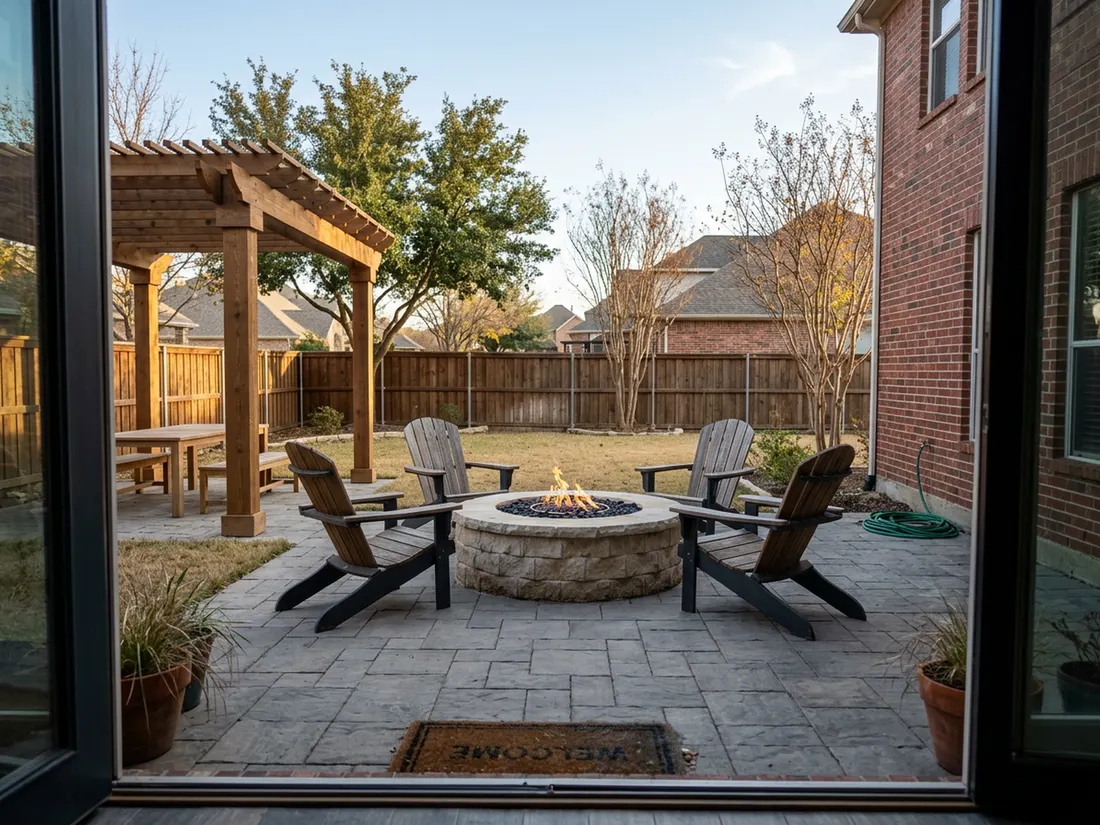
A fire pit rule is a requirement from your city, county or HOA that sets where, when and how a backyard fire may burn. Fire pit rules in DFW do not match from city to city, so there is no single answer. Gas units may keep running when a burn ban closes wood fires, but the order’s wording decides.
A pit that earns its keep is placed for wind, clearance and seating before anyone picks a style.
The short answer
- Texas has no single statewide backyard-fire rule, so your city fire code, your county burn order, your HOA and your city building department each have a say in a fire pit.
- Published clearances differ even inside the metro: the Dallas fire code uses 15 feet for approved containers, while Dallas County’s unincorporated-area page says 25 feet, so your own city’s number is the one that counts.
- A county commissioners court in Tarrant County can approve an outdoor burning ban of up to 90 days, which can leave a wood pit unusable for a full season.
- Gas is the better fit for most DFW yards because it works on short notice and may continue during a ban, but the wording of each burn order decides, so read it every time.
- A wood fire never belongs under a roof, pergola or patio cover, and a gas unit goes under cover only when the manufacturer, the fire code and the roof material all allow it.
- Blackland Prairie clay moves the base under a fire pit just as it moves a patio slab, so the base matters as much as the bowl.
What are the fire pit rules in DFW cities?
A fire pit is a contained, non-combustible fire feature set on a hard base away from structures. Fire pit rules in DFW come in four layers: your city fire code, your county burn order, your HOA, and your city building department if a gas line is involved. Texas has no single statewide backyard-fire rule, so the same pit can be fine in one yard and a problem in the next.
The Dallas fire code, adopted in its 2021 edition, is posted online. Its Chapter 3 text puts approved containers at least 15 feet from a structure, and Section 307.4.4 addresses permanent outdoor fire pits. Dallas County’s page for unincorporated areas says 25 feet. Both are public sources, and the numbers differ. That gap is why no number from a blog, ours included, should replace a call to your own fire marshal.
Fort Worth adopts its own fire code, and Plano, Frisco, McKinney and Arlington each adopt their own as well. We have not confirmed the clearance or attendance rules for permanent pits in any of those cities, so treat them as questions to ask the local fire department, not answers.
| Who decides | What they control | What to ask | How often it changes |
|---|---|---|---|
| City fire code (fire marshal) | Clearance from structures, container rules, attendance | What is the minimum distance for a permanent pit, and does it need a permit? | Only when the code is updated |
| County burn order | Whether open wood fires are allowed at all | Is an order in effect, and does it mention gas appliances? | Can change within days |
| HOA | Fuel type, size, placement, appearance | What do you have to submit for approval? | Rarely, but approvals take time |
| City building department | Gas line permit and inspection | Does a gas line to a fire pit need a permit? | Only when codes change |
What does a burn ban do to your fire pit?
A burn ban closes open wood fires for as long as the order stands. Whether gas units are exempt depends on the order’s wording. Read the order in effect for your county before you light anything.
The Tarrant County fire marshal explains that commissioners can approve an outdoor burning ban of up to 90 days, and that breaking the ban is a Class C misdemeanor. Ninety days is a full season. A homeowner in Fort Worth, Arlington or Keller who built a wood pit for fall evenings can find it off limits for most of them.
Read the gas language, not the headline
Some county orders treat gas appliances with a shutoff valve differently from wood fires, because gas throws no embers. Others do not. Call the fire marshal or read the order itself, and do not rely on a neighbor’s memory of the last one.
Is a gas or wood fire pit better in North Texas?
Gas is the better fit for most DFW yards because it lights on short notice, throws no embers and may keep running during a burn ban. Wood suits people who want the crackle and the cooking and can live with idle weeks.
| Gas (natural or propane) | Wood | |
|---|---|---|
| Burn bans | May be allowed, so read the order | Closed while the order stands |
| Wind and embers | No sparks, though the flame can lean | Embers carry, so clearance and attendance matter |
| Smoke | None | Neighbors and patio cushions notice it |
| Setup | Gas line or tank, licensed connection | Base, fire brick liner and a spot clear of structures |
| Starting it | A switch or igniter | Kindling, time and ash cleanup |
| Feel | Steady flame, little crackle | Real fire and real smell |
| Upkeep | Burner, media and shutoff valve checks | Ash removal and liner inspection |
Natural gas pits need a line run by a licensed professional. Distance from the meter, the surface the trench crosses, the burner size and the finish on the surround all drive the cost, and we do not quote figures here. At Longhorn Outdoor Living we build the base and surround as part of our hardscaping work, and the gas connection goes to a licensed pro. Plan the gas run before the pad is poured. Cutting a finished slab later costs more and shows.
How far should a fire pit sit from the house, fence and patio cover?
A fire pit should sit as far from the house, fences and overhangs as your city’s rule and the manufacturer’s sheet require, whichever number is larger. The two published numbers we found for approved containers run from 15 to 25 feet. Get yours from your city, in writing if you can.
Overhead clearance matters as much as side clearance. A wood fire under a roof, pergola or patio cover is a flat no, because heat and sparks reach the structure fast. A listed gas feature may be allowed under cover, but only if the manufacturer’s sheet, the fire code and the roof material all agree. Our comparison of a patio cover versus a pergola in DFW shows how each structure handles heat, and our patio roofs and covers page shows the options.
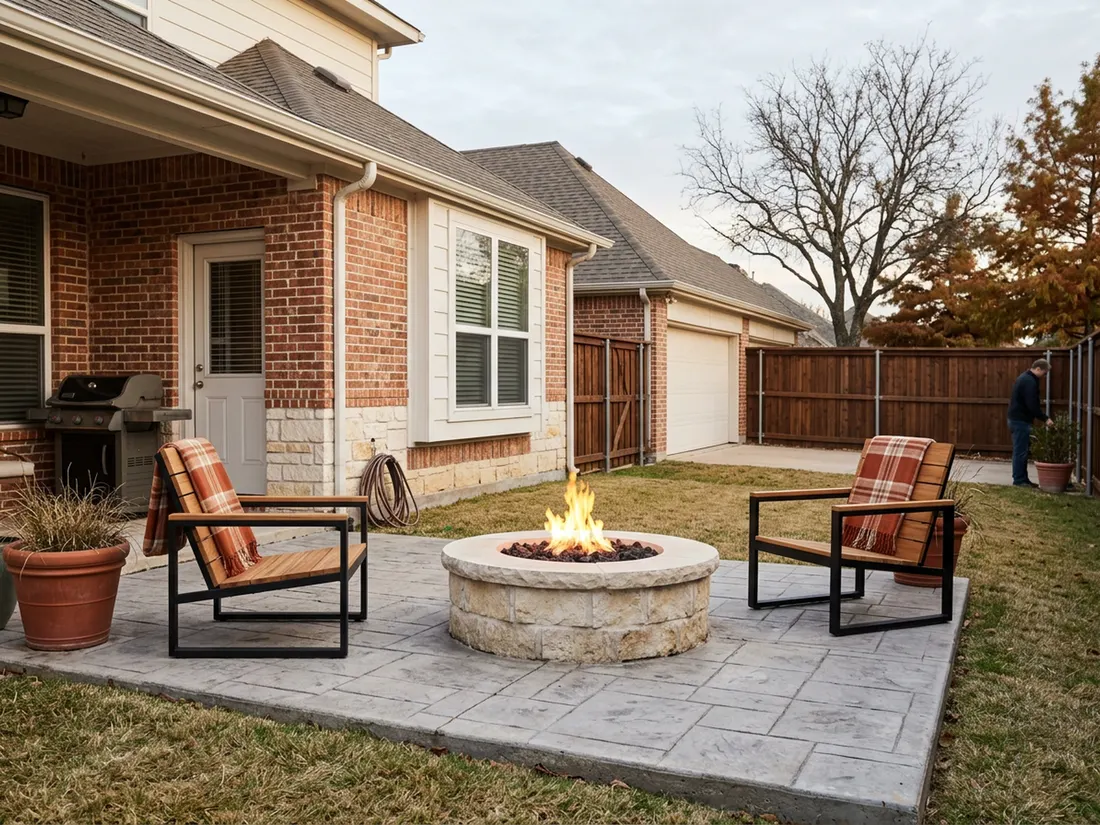
Wind is the last placement test. Spend a breezy afternoon in the yard before you mark the spot, and notice where leaves and dust travel. Put the pit where smoke and sparks will not reach the house, a neighbor’s fence or your own seating.
Does your HOA have a say, and what should you send?
Yes. Many DFW neighborhoods have HOA rules on fuel type, size and placement, and meeting the city code does not exempt you from them. A one-page submittal usually answers the board’s first questions and speeds approval.
- A sketch of the yard with the pit’s location and its distance to the house and fences.
- The fuel type, and the manufacturer’s spec sheet for any gas burner or kit.
- The pit’s size, height and finish, with a photo or sample of the stone.
- A line confirming the city fire department’s clearance requirement.
Call the city before you call the board. If the city number is larger than the manufacturer’s, the larger number is the one to put on the plan.
What base holds up on North Texas soil?
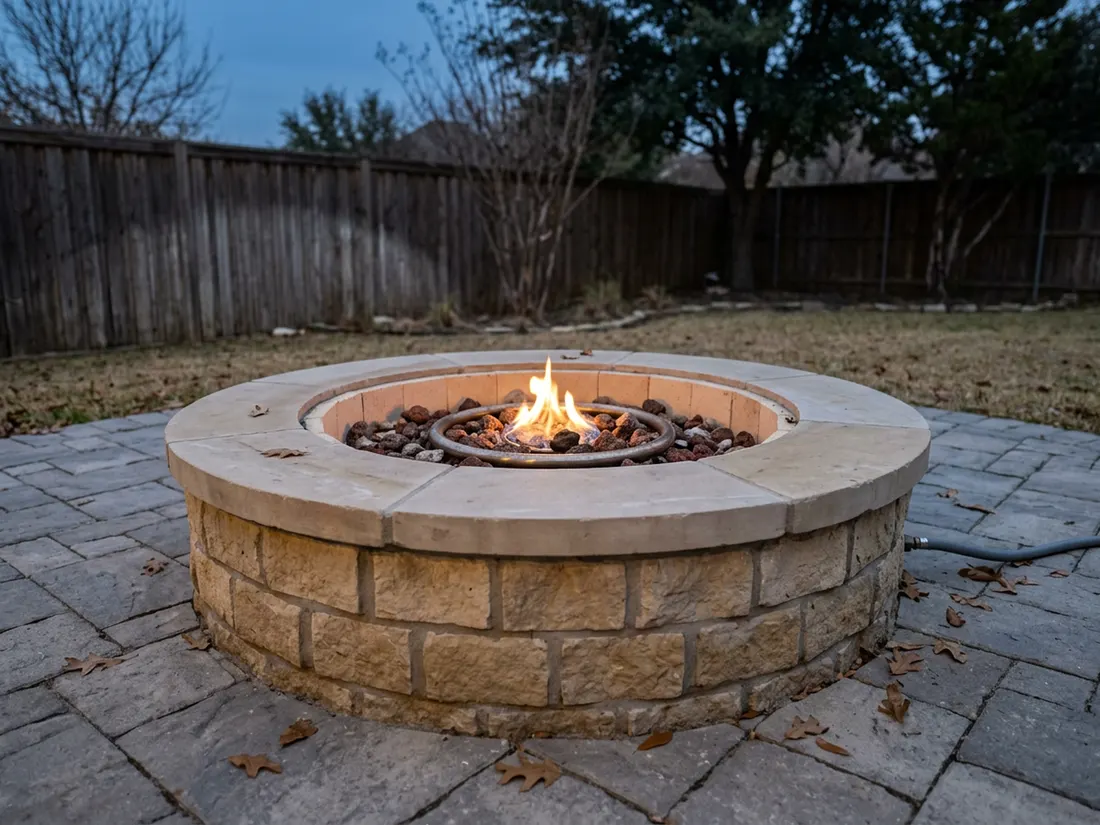
Build on a level, non-combustible base such as pavers on compacted stone or poured concrete, and line the bowl with fire brick. Never set a pit on grass, mulch or a wood deck. Then check what the soil under that base is likely to do.
Across much of Dallas, Plano, Frisco, Rockwall and Waxahachie, the ground is Blackland Prairie clay that swells in a wet spring and shrinks hard through August. A fire pit on a thin base moves with it, and the cap stones open at the joints for the same reasons DFW patios crack and lift. In much of Fort Worth, Crowley and Weatherford, thin soil over limestone usually means less movement but harder digging. Through the Eastern Cross Timbers around Denton and Flower Mound, sandy loam often sits over clay, so water can collect at the interface and a drain path matters more.
Can you use a fire pit year-round in DFW?
You can use the area year-round, but not always the fire. Evenings from late October through March are the pit’s season. In summer the same spot needs shade, moving air and lighting, with the burner off.
After a hot DFW summer, few homeowners need convincing that July evenings belong to shade and fans. Plan the seating for August, not only for December. A pergola set beside the pit, not over it, shades the chairs while the fire stays in open air. If the pit will sit near cooking, our outdoor kitchen planning guide for DFW covers gas, permits and heat in the same yard.
When should you hold off on a fire pit?
Wait if the slab or yard still has drainage problems, if a wood fence or low branches sit inside the clearance, or if you want a fire only a few weekends a year. In those cases the money does more good elsewhere.
A cracked, tilting patio is the most common reason to wait. A pit built on it inherits the movement, and the fix costs more once the stone is set. Settle drainage and the base first, then build the fire feature on solid ground.
Thinking about this for your own home? See how Longhorn builds hardscaping.
Questions we get asked about this
It depends on the pit and the city. A permanent pit or a gas line to one can trigger a permit or inspection, while a small portable one may not. We have not verified current requirements for every city, so ask your fire department about the pit and your building department about the gas line.
Maybe. Some county orders exempt gas appliances with a shutoff valve because they throw no embers, and others do not. The wording of the order in effect for your county decides, so read it or call the fire marshal before you light the pit.
Your city fire code and the manufacturer’s sheet both set a minimum, and the larger number wins. The Dallas fire code uses 15 feet for approved containers, and Dallas County’s unincorporated-area page says 25 feet. Ask your own city for its number.
Gas is usually better because it lights on short notice, throws no embers and may keep running during a burn ban. Wood suits homeowners who want real fire and accept idle weeks. A ban of up to 90 days, which Tarrant County commissioners can approve, shows how long a wood pit can sit unused.
Not with a wood fire. A listed gas unit may be allowed under cover only if the manufacturer’s clearances, the fire code and the roof material all permit it. Otherwise, set the pit in open air beside the structure and keep the shade next to it.
Yes. HOA rules can be stricter than the city’s, and meeting the city code does not exempt you from them. Send the board a simple sketch with the fuel type, size and distances to the house and fences, plus the manufacturer’s spec sheet.