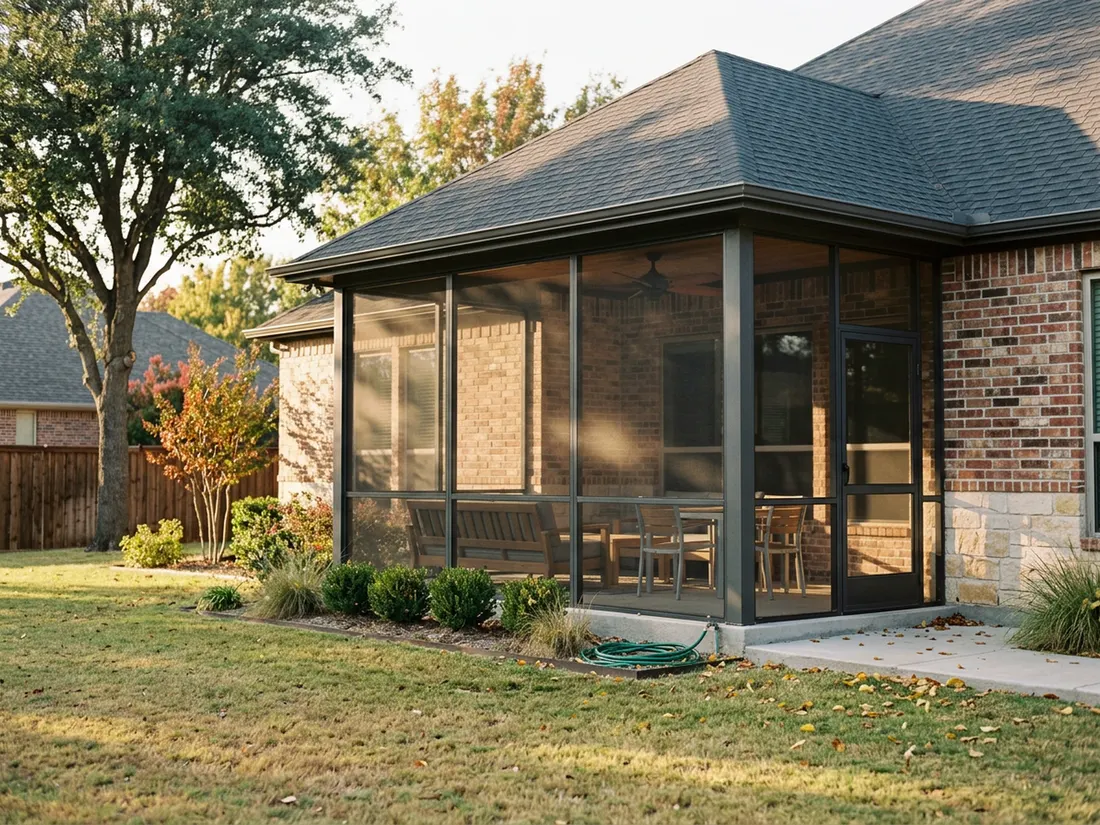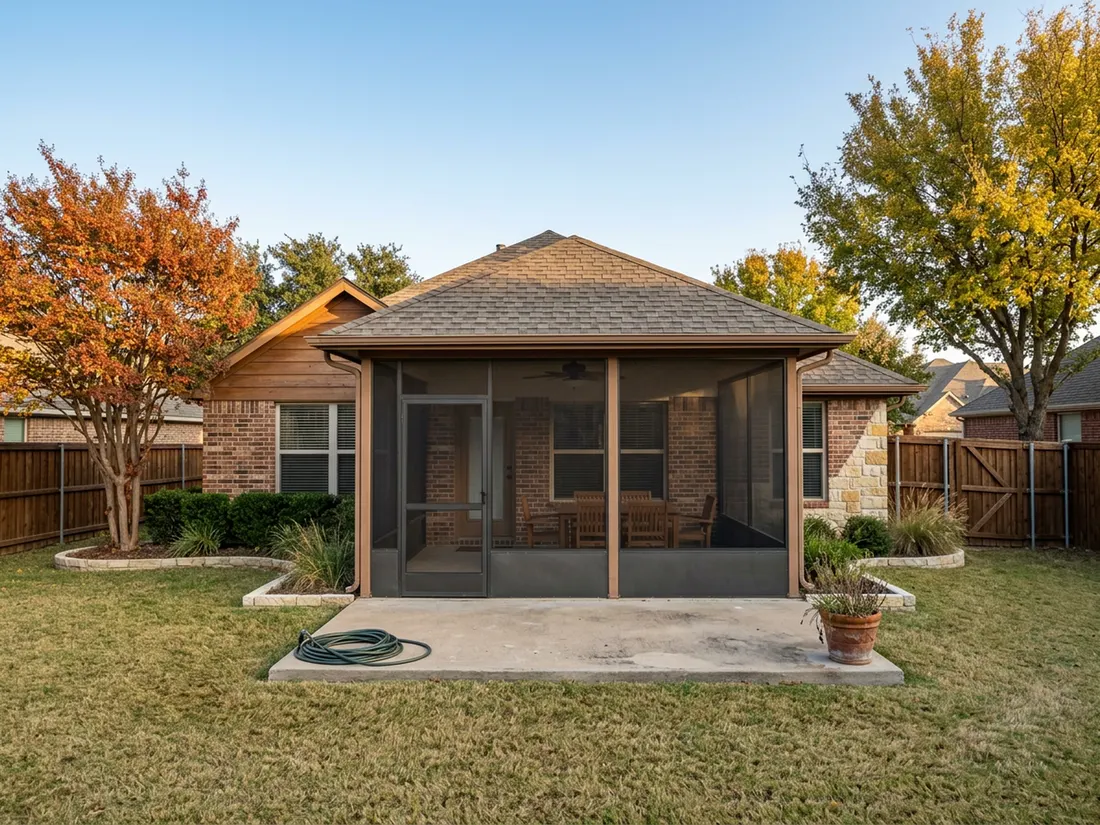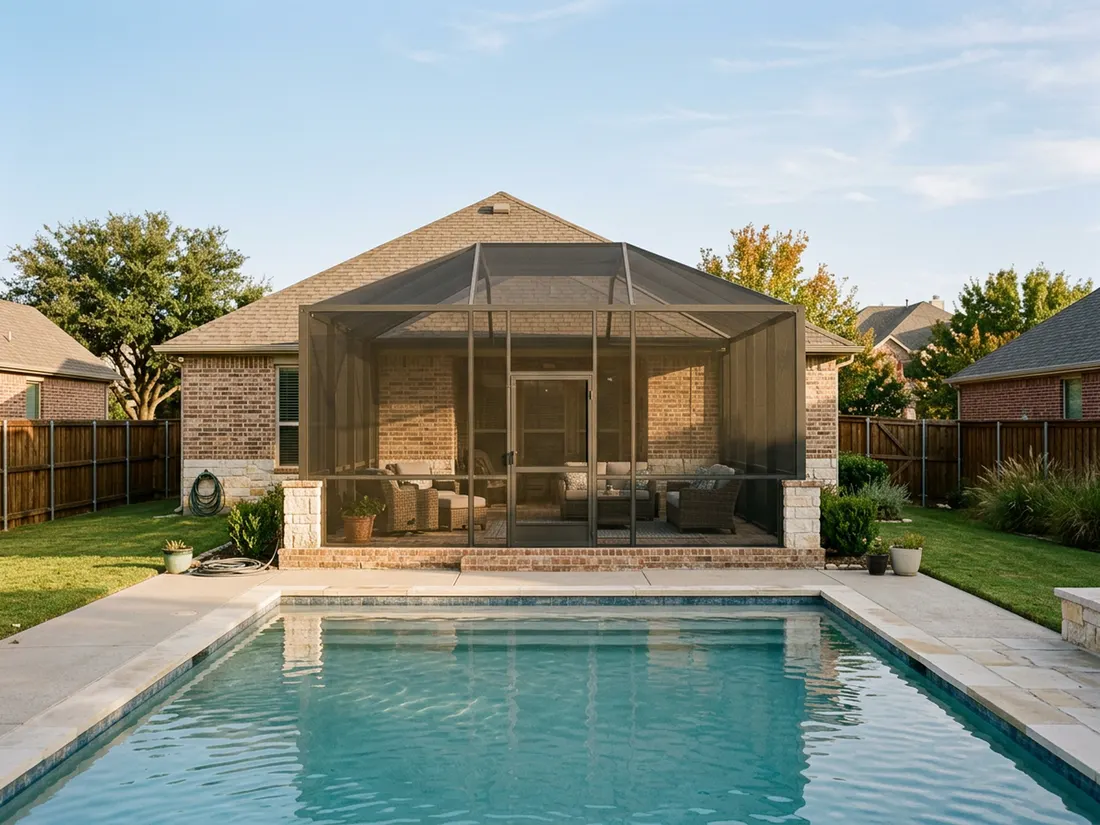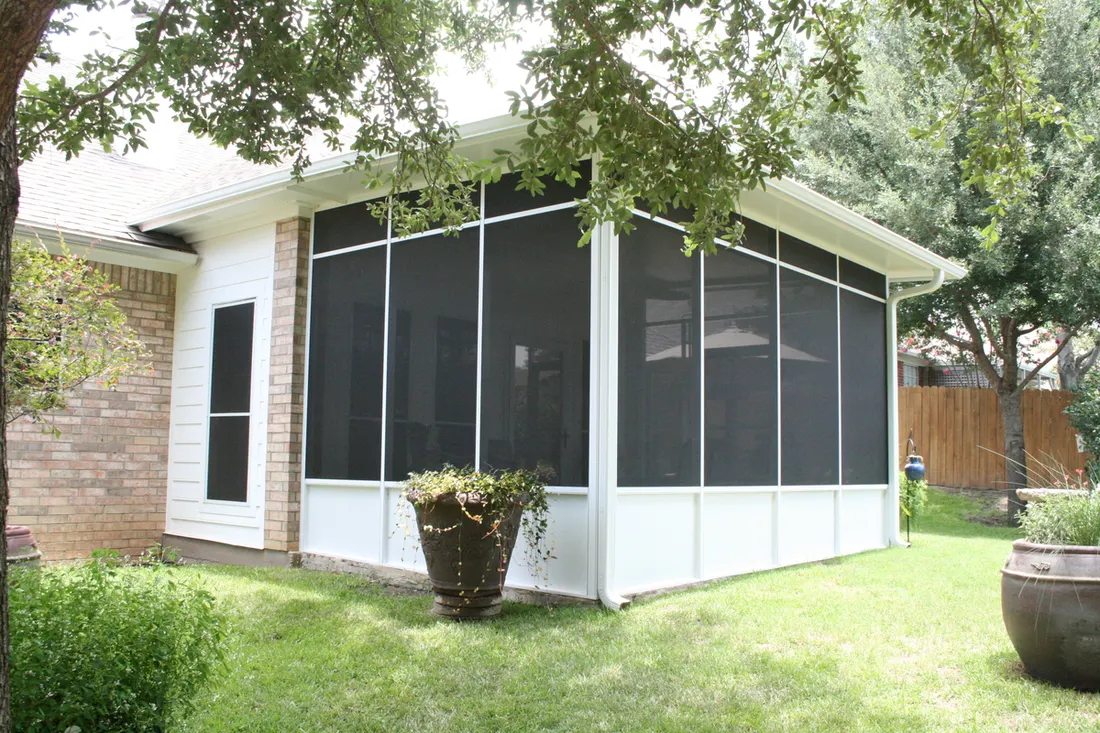

All-season room or sunroom? In North Texas the difference is conditioning. A sunroom is a glass-walled room that may stay unheated and uncooled. An all-season room is a permitted, insulated room served by heating and cooling, built for use in August and January. Pick by how many months you want to sit in it.
The short answer
- An all-season room is conditioned, insulated and permitted as living space, while a sunroom is a glass room that may have no heating or cooling at all.
- In North Texas the cooling load in August decides how comfortable a glass room is, so solar heat gain, roof design and wall orientation matter more than winter performance.
- A conditioned room gets its heating and cooling one of two ways, extended ducts or a dedicated mini-split, and a written load calculation should decide which.
- An enclosed room with walls and glass is generally treated as a room addition rather than a patio cover, so expect building, electrical and mechanical review, and check with your city and HOA first.
- A permitted, conditioned room is likely to show up on your appraisal district record, and a lender’s square footage test is a separate question from your tax bill.
All-season room or sunroom: what is the difference in a DFW home?
A sunroom is a glass-walled room that may or may not be heated and cooled. An all-season room is built and permitted as living space: insulated, served by heating and cooling, and meant for use in August and January. In DFW, the line between them is conditioning, not how much glass is on the walls.
| Feature | Sunroom (unconditioned) | All-season room |
|---|---|---|
| Heating and cooling | None, or a fan and a space heater | Ducted from the house system or a dedicated mini-split |
| Glass | Often single or double pane, clear or lightly coated | Double-pane low-E with a low solar heat gain coefficient |
| Roof | Glass, polycarbonate or a light panel | Insulated panel or an engineered insulated roof |
| Frame | Often standard aluminum | Thermally broken frame |
| Floor | Patio slab, sometimes with a covering | Engineered slab or piers tied to the house |
| Permit class | Depends on the walls and the city | Room addition with building, electrical and mechanical review |
| Appraisal district | May still be added to the record | Likely valued as improved living area |
| August afternoon | Hot, especially on the west side | Comfortable when the system is sized for the glass |
| January cold snap | Close to the outdoor temperature | Heated like the rest of the house |
| Best for | Spring and fall mornings and evenings | Daily use as an office, family room or play space |
Vendors use these words loosely. Some call every glass room a sunroom and treat all-season as the premium version. Others use four-season and all-season to mean the same thing, and we do too. Ask what is actually on the quote: the glass numbers, the roof, and whether heating and cooling are included. Our All-Season Sunrooms page covers the conditioned version, and the Sunrooms page covers the glass-room version.
How does an all-season room get heated and cooled in a DFW home?
An all-season room gets conditioned one of two ways: ducts extended from the house system, or a dedicated ductless mini-split. Neither is automatically better. A Manual J load calculation, which accounts for glass area, orientation and insulation, tells you whether your existing equipment has room to spare.
- Extend the ducts. This works when the existing unit and duct system have spare capacity. You keep one system to maintain, but the room shares a thermostat and airflow with the house.
- Add a mini-split. A separate system with its own thermostat. It is often the better fit when the house unit already runs flat out in August, or when the room is far from the existing ducts.
- Leave it unconditioned. Fans and a portable heater make a comfortable shoulder-season room, but the result is a sunroom, not an all-season room.
Capacity is the question most quotes skip. A house system sized years ago for the house alone now has a glassy room added to its load. In a long DFW summer, such as the 2023 heat run, that can leave the new room and the old rooms both short on cooling. Longhorn Outdoor Living has built in North Texas since 1984, and the rooms that disappoint are the ones where nobody ran the numbers first.
What glass and roof make a room usable in August and January?
Cooling load decides it in North Texas, so look for glass with a low solar heat gain coefficient, a roof that is insulated rather than clear, and a thermally broken frame. Winter comfort follows from the same upgrades. The glass numbers are printed on the NFRC label, so you can compare them from quote to quote.
U-factor measures how fast heat flows through a window. Solar heat gain coefficient measures how much of the sun’s heat comes through it. Low-E coatings improve both, but in DFW the second number matters more, because the sun does most of the damage on a west or south wall. ENERGY STAR publishes target numbers by climate region, and North Texas falls in its South-Central region, so check the label on any quote against that criteria table.
The roof is the part most buyers overlook. A clear glass roof lets in heat all afternoon and gives no shade. An insulated roof panel lets far less through. Our insulated patio covers are built on the same idea of an insulated panel in place of a bare surface, and a room under that kind of roof is far easier to cool.
Why the west wall decides it
Afternoon sun on a west wall arrives when the air is already at its hottest. If the room has one big glass wall facing west, specify the lowest solar heat gain glass there, add an overhang or shade, or put the solid wall on that side. Hail is the other check. North Texas hail can crack glass and dent frames, so ask what the glass and roof are built to withstand.
Is a three-season sunroom enough in North Texas?
A three-season sunroom is enough for spring and fall, but not for the middle of a DFW summer or a hard freeze. With no insulation or conditioning, the room tracks the outdoor temperature, with extra sun on it.
The two events people here remember make the case. During the February 2021 freeze, an unheated glass room was little more than a windbreak. During the 2023 heat run, the same room in afternoon sun was hotter than the shade in the yard. Glass keeps the weather off, but it does not manage temperature without equipment and a good envelope.
Skip the all-season upgrade if you will mostly sit out there on October and April evenings. A well-built sunroom with ceiling fans, good shade and screening does that job for less money and keeps the project simpler. If screens are what you want, our posts on what a screened enclosure stops and enclosure mistakes that cost money cover that side.
Do you need a permit to build an all-season room in Dallas or Fort Worth?
Usually yes. A roof over an open patio is one thing, but an enclosed room with walls, glass and conditioning is generally treated as a room addition. That brings a building permit and separate electrical and mechanical review. Confirm with your city before you sign anything.
Appendix H of the International Residential Code, which cities may adopt, sets the limits for patio covers, including how open they must stay on the sides. Once walls and conditioning are added, the structure leaves that category. Dallas and Fort Worth each handle this through their development services offices, and suburbs run their own permit offices and may amend the code, so check with yours.
Two more checks come before design. Properties in Dallas Landmark Districts need a Certificate of Appropriateness before exterior work, and your HOA may need to approve the plans. Also ask which edition of the energy code your city enforces, because the glass requirements follow it.
Does an all-season room raise your property taxes in Texas?
It can. Appraisal districts value the improvements on your lot, and a permitted, conditioned room is the kind of change they pick up. Texas appraises for tax separately from a lender’s appraisal, so the two questions have different answers.
Appraisal districts draw on public records such as building permits, so a permitted addition is likely to appear on your record. The homestead cap limits yearly increases in the value of existing property, but new improvements are added on top of the capped value. If your notice looks high, you can protest it with your appraisal district, and the Texas Comptroller explains the process and the deadlines.
Square footage for a lender is a different test. Appraisers commonly follow the ANSI Z765 measuring standard, which generally counts a space as living area only when it is finished, heated and cooled like the rest of the house and reached from inside. An unconditioned sunroom generally does not count. An all-season room that ties in and opens to the house may.
What drives the cost of an all-season room compared with a sunroom?
Conditioning drives it. A sunroom is mostly framing, glass and roof. An all-season room adds an engineered foundation, insulation, better glazing, heating and cooling, more electrical work and permits. We do not print dollar ranges here because they go stale and vary by site. Ask for itemized quotes instead.
- Foundation: a slab or piers tied to the house, and what your soil requires.
- Glass: how many walls, how large, and how low the solar heat gain coefficient is.
- Roof: an insulated panel or a glass roof.
- Conditioning: extended ducts or a mini-split, plus the load calculation.
- Electrical: circuits, outlets, lighting and any dedicated circuit for equipment.
- Plans and permits: engineering, trade permits and HOA submittals.
Compare quotes line by line. A low number that leaves out the foundation tie-in, the mechanical work or the permit is not low. It is incomplete.
What does DFW clay do to the foundation of a conditioned room?
Clay soil moves with moisture, and a finished, conditioned room shows that movement as cracks. Blackland Prairie clay east of I-35 swells when wet and shrinks when dry. A new slab for an all-season room has to be designed for that soil and tied to the house on purpose.
Soil changes across the metro: Blackland clay to the east, Eastern Cross Timbers loam and Fort Worth Prairie limestone to the west. A room in Plano or Frisco can need different footing thinking than one in Fort Worth. That is why the foundation should be specified for your lot, not copied from a brochure.
A patio slab poured as a patio is not a room foundation. Walls, glass and a heavy roof add load, and finished flooring and drywall inside show every seam. A common failure is a crack along the line where the new slab meets the old, which tends to happen when the tie-in was an afterthought.
Who is an all-season room right for, and who should buy a sunroom?
Choose an all-season room if you want to use the space most days of the year, as an office, family room or play space. Choose a sunroom if you want a bright, shaded room for spring and fall evenings and you accept that it will not be comfortable in extremes.
- All-season room: home office, family room, kids' play area, a pet space, or a reading nook that still works in a January cold snap.
- Sunroom: plants, morning coffee, a place beside the pool, or evening entertaining from March through May and again in the fall.
- Neither, as a bedroom: a bedroom needs an emergency escape opening and must meet habitable-space rules, so settle that with your city building department before planning one.
Can you start with a sunroom and upgrade to all-season later?
Sometimes, but plan the upgrade from day one. The slab, framing, roof and electrical have to be built for conditioning at the start, or upgrading means tearing out the most expensive parts and redoing them. The easiest thing to add later is the equipment.
- Build the foundation to the engineered, tied-in standard, not as a plain patio slab.
- Frame for an insulated roof, not a clear one.
- Choose thermally broken frames and low-E glass now, if the budget allows.
- Run conduit and a dedicated circuit for future equipment.
- Ask the city whether to permit the room as habitable now or later, and how the upgrade will be reviewed.
Why plan an all-season room in October?
Planning, engineering, permits and HOA review all come before construction. Starting in October gives you time to finish the paperwork before the busy spring season, so the room can be ready when mild weather arrives. We cannot promise a date until we see the site and the city’s queue.
If you are weighing a glass room against a screened or open patio, bring us a photo of the patio, the direction it faces and what you want to do in the room. We will tell you which one fits.
Questions we get asked about this
A sunroom is a glass-walled room that may have no heating or cooling. An all-season room is insulated, has better glazing, is served by heating and cooling, and is permitted as living space. In North Texas the practical test is whether you can sit comfortably in it during a 100-degree August afternoon and a January cold snap.
Usually, yes. Both mean a conditioned, insulated room meant for year-round use. The words are used loosely across the industry, so ask what the quote actually includes: glass specs, roof type, insulation, and whether heating and cooling are part of the price.
Not always. It can be served by ducts extended from the house system if that system has spare capacity, or by a dedicated ductless mini-split. A Manual J load calculation, which accounts for glass area, orientation and insulation, should decide which one fits before any equipment is chosen.
For a lender’s appraisal, a sunroom generally counts as living area only if it is finished, heated and cooled like the rest of the house and accessed from inside. An unconditioned sunroom usually does not. Your appraisal district values improvements for tax purposes separately, so the answers can differ.
Only if it meets habitable-space and bedroom code requirements, including an emergency escape opening. Most sunrooms are not designed for sleeping. Ask your city building department before planning one, because the answer affects the windows, the permit and how the room is conditioned.
Usually yes. An enclosed room with walls, glass and conditioning is generally treated as a room addition, which means a building permit and separate electrical and mechanical review. Dallas Landmark Districts also require a Certificate of Appropriateness. Check with the city and your HOA before you sign a contract.