
Most of what gets written about screened enclosures is written by people selling them, which is how you end up with a brochure that implies a screen room fixes a Texas August. It does not. What it does fix is a specific and genuinely miserable set of problems, and those problems have dates attached to them here.
Mosquito season here has real dates on it
This is the part worth being precise about, because it decides whether a screen room is a seasonal novelty or a thing you use for half the year. Dallas County Health and Human Services states plainly that mosquito season in Dallas County runs May through November. That is not a marketing range — it is the window the county builds its own trapping and testing program around, placing traps across the county and treating around positive samples through the season.
Seven months. That is the frame to hold in your head. And within it, the evenings you actually lose are not evenly spread — they cluster after rain. A wet stretch in late May or a rainy first week of September fills every low spot, every saucer under a pot and every sag in a pool cover, and about a week later the yard is unusable between six and nine in the evening, which is the only part of the day worth being out in.
Screen is the only thing that reliably works through that without you doing anything. Sprays need reapplying, yard treatments need rebooking after rain, and fans only work where the fan is blowing. A screen wall works while you are not thinking about it, which is the whole point.
The honest list, in three columns
We put this table in front of people before they sign, because about a third of the time it changes what they buy.
| What you are hoping to keep out | Does screen do it? | The detail that decides |
|---|---|---|
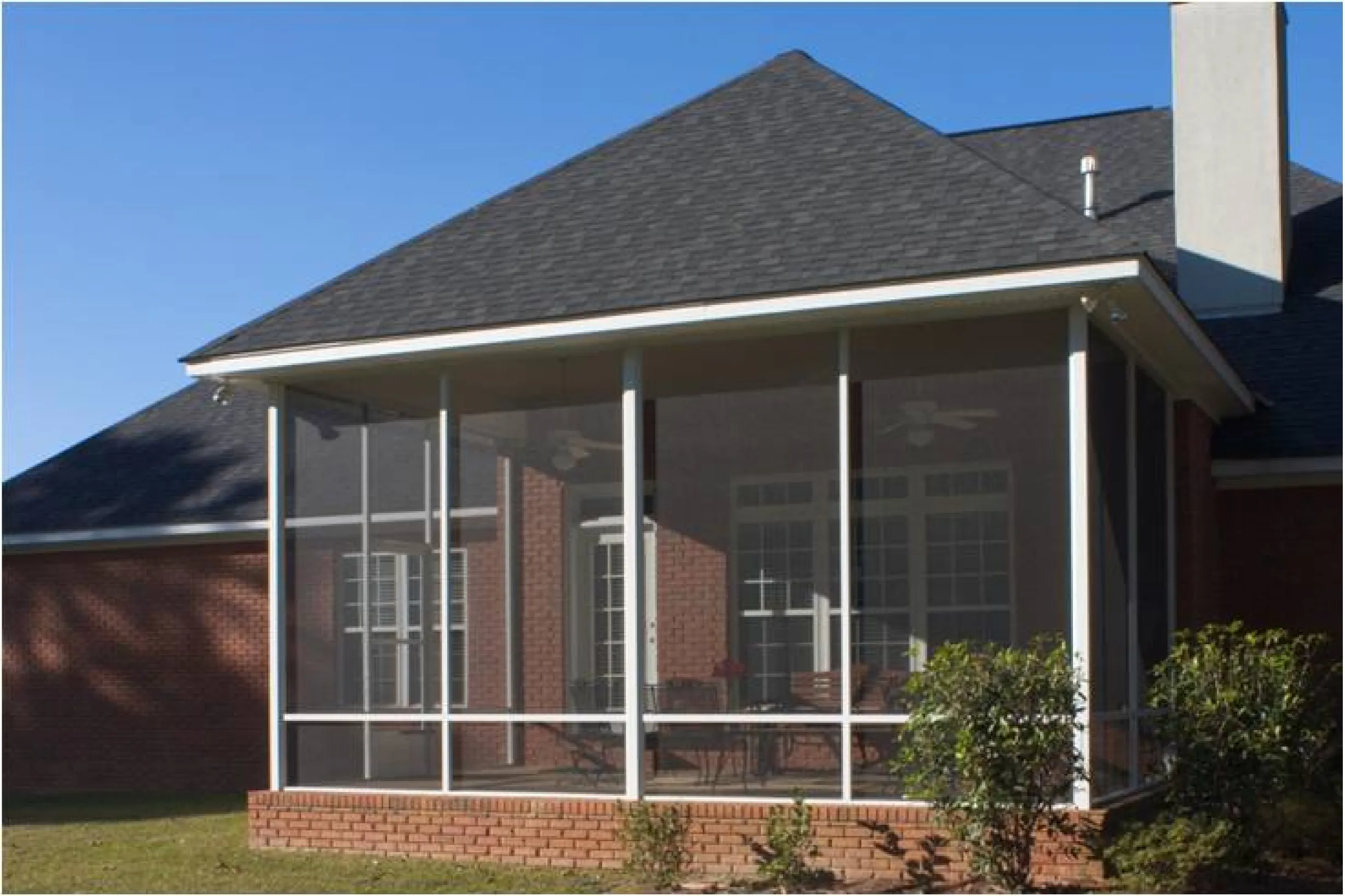
| Mosquitoes, gnats, biting flies | Yes, completely | Standard 18x14 mesh is enough. The failure is never the mesh — it is a gap at the base or a door that does not close itself |
| Wasps and mud daubers nesting under the roof | Yes, and this is the underrated one | Only if the screen meets the roof structure cleanly. A gap along a beam is an open invitation |
| Blown leaves, oak catkins, cottonwood fluff, grass clippings | Yes | Nothing. This one just works, and it is most of why people stop hating spring on the patio |
| Pollen | No, not meaningfully | Mesh is not a filter. It catches debris carrying pollen, not the pollen itself. Anyone telling you otherwise is selling |
| Rain | Partly | Depends entirely on overhang depth and wind direction. A short overhang and a north-wind front will beat any mesh |
| Direct west sun | Only with solar mesh, and only partly | Solar screen cuts a real share of the glare and heat load, at the cost of airflow and view clarity |
| Heat | No | There is nothing to discuss here. Screen is air. See the next section |
| Snakes, rodents, stray cats | Mostly | Entirely down to how the bottom rail meets the slab and whether there is a kickplate |
| Leaves and bugs landing in a pool | Yes, where the enclosure covers the water | A different build from screening a patio, and a different conversation about the pool barrier |
Why it will not do anything about August
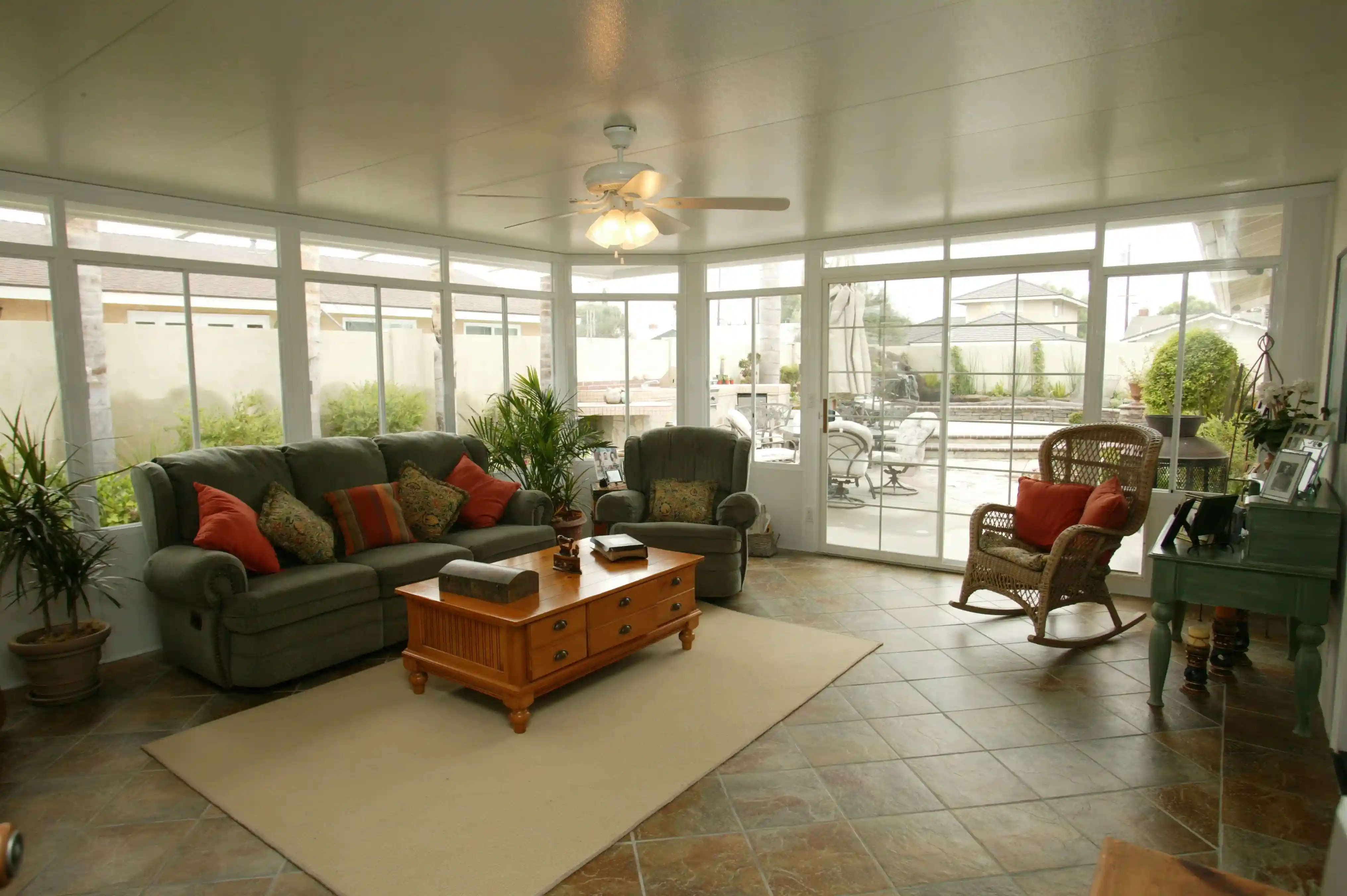
A screened enclosure is a bug barrier stretched over an open room. Air moves through it almost freely, which is the point, and that means the air inside it is outdoor air. When it is 101 in the yard it is 101 on the screened patio.
What you can change is the radiant load — the part of summer discomfort that comes from the sun hitting you directly and from a hot surface overhead. A solid roof, and especially an insulated roof panel, stops that. Solar screen mesh on the west wall stops a good share of the low afternoon sun. Fans move air across skin, which is worth several degrees of felt temperature. Stack all three and a screened patio becomes usable earlier in the evening than an open one. It does not become cool.
Mesh is a comfort decision, not a line item
Every mesh trades something. It is worth understanding the trade before someone picks for you.
- Standard fiberglass mesh. The default. Best airflow, clearest view, least money, least resistance to a dog or a thrown ball.
- Pet-resistant mesh. Much thicker strands, woven tighter. It survives a determined retriever. It also cuts airflow and darkens the view noticeably, which matters on a covered patio that already sits still in July.
- Solar screen mesh. Denser weave that blocks a meaningful share of solar heat and glare. Excellent on a west-facing wall in this metroplex, where the four-to-eight-o’clock sun in July is the actual enemy. Same trade: less airflow, less view.
- No-see-um mesh. Very fine weave. Rarely the right call here — our problem is mosquitoes, not midges, and the airflow penalty is real.
A reasonable compromise on a lot of DFW patios is solar mesh on the west and south-west walls and standard mesh everywhere else. You get the shade where the sun actually comes from and keep the breeze on the other three sides.
The two details that decide whether it lasts here
Where the frame meets the slab
Most of this metroplex east of I-35 sits on Blackland Prairie clay, which swells through a wet spring and shrinks hard by late August. Patio slabs move with it. A screen frame is rigid and is anchored to that slab, so if the slab has a lip that grows through the season, the frame either binds, gaps at the bottom or racks the door out of square.
The fix is not exotic — it is looking at the slab before quoting the enclosure. A flush, stable slab with sound edges takes a frame fine. A slab with a lip you can feel with a fingertip needs dealing with first, or the screen door will be the thing you complain about a year later. Ask any contractor what they saw when they looked at the slab edge. If they did not look, that tells you something.
Where the screen wall meets the roof
Cold fronts here arrive from the north and they arrive fast, and the rain that comes with them travels sideways. A screen wall under a generous overhang stays reasonably dry. The same wall under eight inches of overhang gets a soaking, and so does the furniture. If the enclosure is going under an existing cover that was not designed with screen in mind, that is worth pricing honestly, not glossing over.
What happens to one in a hard freeze
Nothing, and that is the good news. A screened enclosure has no glass to crack and no seals to fail, so February 2021 and December 2022 did not do much to the screen rooms in this metroplex. Aluminum frames and mesh both shrug off cold.
What those two freezes did damage was everything people had put inside screen rooms on the assumption that being under a roof counted as being protected — outdoor sinks, ice makers, a hose bib buried behind a cabinet, a small fridge. A screened enclosure gives those things exactly as much freeze protection as the open yard does, which is none. Plan for that in the fall, not on the day the front arrives.
When we tell people not to screen it
Three cases come up often enough to name.
- You want August back. Covered above. Screen will not do it, and spending the money to find that out is the most common regret in this category.
- The patio is small and the view is the point. On a compact patio with a good outlook, four screen walls can make the space feel like a porch on a fishing cabin. Screening two or three sides and leaving the best view open is often the better room, and it is less money.
- The slab is the real problem. If the concrete is lipped, ponding or cracking through the seasons, an enclosure on top of it is a nice frame around an unsolved problem. Fix the water and the flatwork first. The screen will still be there next year.
The bottom line
A screened enclosure is the highest-use, lowest-drama upgrade we install, and it is honest about what it is. It takes roughly seven months of insect season and hands them back to you, it stops the yard from blowing into the room, and it keeps wasps from setting up over the door. It is not climate control and nobody should sell it as such.
If you are weighing one against a sunroom, the question to answer first is not budget. It is which months you are actually trying to buy back. Answer that and the product picks itself.
Questions we get asked about this
Dallas County Health and Human Services puts mosquito season in this county at May through November, which is the window the county runs its trapping and testing program across. In a mild, wet spring you will notice them earlier than May, and activity usually peaks in the week or two after a heavy rain rather than steadily through the summer.
No. Screen is essentially open air, so the temperature inside a screened enclosure matches the yard. What you can change is the radiant load, with a solid or insulated roof overhead, solar screen mesh on the west-facing wall and fans moving air. That makes a hot evening tolerable earlier. It does not make an August afternoon comfortable.
Partly, and it depends on the roof more than the screen. A deep overhang with screen walls below it stays reasonably dry in ordinary rain. A North Texas cold front drives rain close to horizontal, and under a shallow overhang it will come straight through the mesh. If staying dry in any weather matters, you want glass, not screen.
If you have a dog that leans, scratches or pushes at doors, yes — standard mesh will not survive it and you will be paying for a re-screen. If you do not, the thicker weave costs you airflow and view clarity for no benefit. It is a decision about the animal, not about quality.
Almost always if it is attached to the house or involves structure, footings or electrical, and the requirements differ city to city across the metroplex. Confirm with your building department before design rather than after, since some cities require plan review to finish before any construction starts. We file the submittal and handle the inspection on projects we build.
Usually, and it is the most common version of this job. The two things that decide whether it goes smoothly are the condition of the slab edge the frame anchors to, and how much overhang the existing roof gives the new screen walls. Both should be looked at in person before anyone quotes it.