


A failed window seal lets moist air into the gap between the panes of a double-pane unit. When a Texas home has fog between the panes, that seal is gone, and wiping will not help. Fog on the room side of the glass is humidity, which you can fix without new windows.
The goal is clear glass on a cool morning. Which fix gets you there depends on which side of the pane is wet.
The short answer
- Fog or droplets between the panes mean the sealed glass unit has failed, and no cleaning or dehumidifier will clear it.
- Fog on the room side of the glass means indoor humidity is meeting cold glass, and it can be fixed without replacing the window.
- Dallas and Fort Worth homes fog up in October because the first cool nights chill the glass while summer moisture is still in the house.
- Fog between panes that clears by afternoon is still a failed seal, because the moisture evaporates when the sun warms the glass and returns on the next cold morning.
- One or two failed units on sound frames usually call for new glass, while many failed units or damaged frames are the time to price full replacement.
- Check the warranty paperwork before paying for any glass repair, because the manufacturer’s written terms may still cover the glass.
Which side of the glass is wet, and what does it mean?
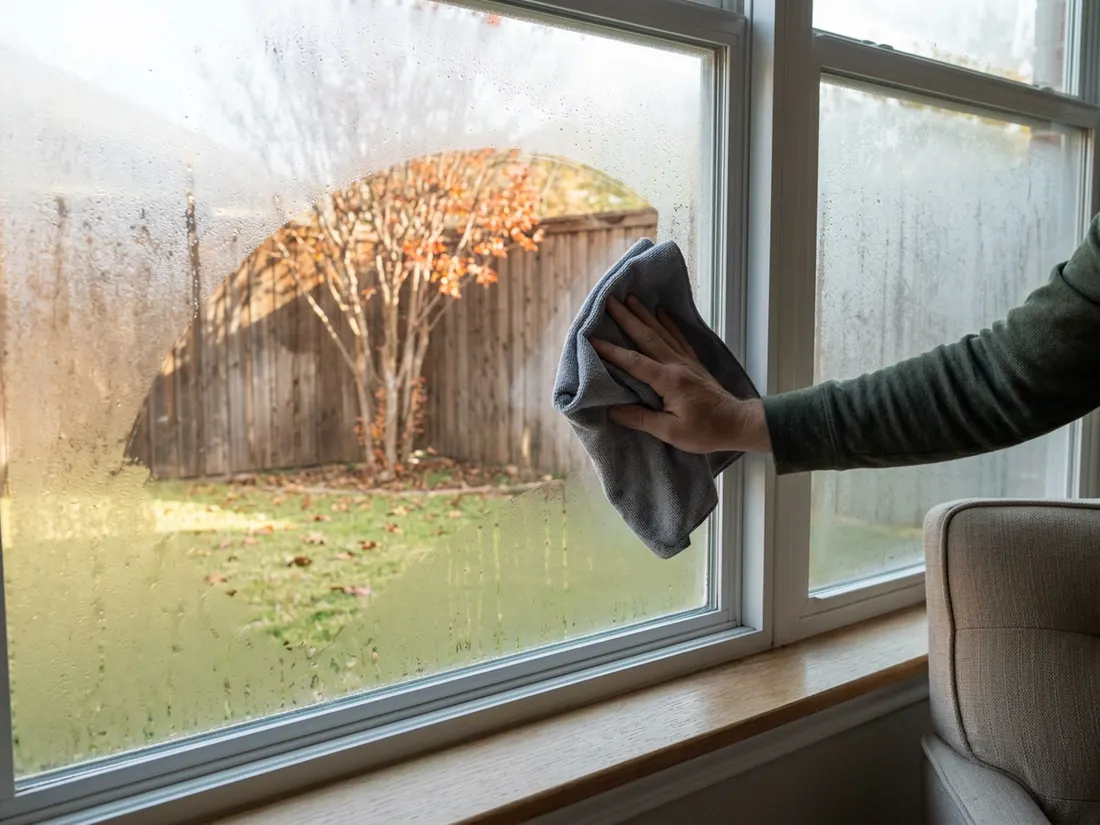
Fog on the room side of the glass means indoor humidity. Fog on the outdoor side is usually dew and is normal. Fog or droplets trapped between the panes mean the sealed unit has failed, and nothing you do inside the house will clear it.
| Where the fog is | What it means | What to do |
|---|---|---|
| Room side of the glass | Indoor humidity is high and the glass is cold. The window is behaving normally. | Lower the humidity and wipe it off. No repair needed. |
| Outdoor side of the glass | Dew from warm, humid air meeting cool glass. Common on A/C-cooled summer mornings and clear fall nights. | Leave it alone. It burns off as the morning warms. |
| Between the panes | The sealed unit has failed and moist air has gotten in. | Replace the glass or the window. Humidity control will not help. |
Which side matters because the fixes have nothing in common. A dehumidifier cannot reach inside a sealed unit, and new windows will not stop a damp house from fogging its glass.
How do you tell if a window seal is broken in 30 seconds?
Wipe the inside of the glass with a dry cloth, then wipe the outside. Whatever haze stays is between the panes. The test needs no tools, only a cool morning when the fog is showing.
- Wipe the room side. If the haze or droplets disappear, the cause is humidity.
- Wipe the outdoor side. If that clears it, you are looking at ordinary dew.
- Look again with a flashlight. Haze, streaks or a dusty film that stays put after both wipes is inside the unit.
- Check at midday. Fog that fades by afternoon and returns on the next cold morning is still a failed seal.
- Photograph and mark each window. Count how many are affected and which walls they are on. You will need that count later.
Why do foggy windows between panes come and go in Texas?
Moisture inside a failed unit changes form with the glass temperature. It condenses as fog on a cold morning and evaporates when the sun warms the pane. A window that looks clear at 3 p.m. is still a failed window.
A double-pane unit holds a sealed air space with a desiccant strip that keeps the gap dry. Once the edge seal opens, humid air moves in and out as temperature and air pressure change. The desiccant fills up, and after that the moisture shows on the inner faces of the glass whenever the pane runs cold. The seal does not heal itself, and no cleaner can reach that space.
Over the years the evaporating water leaves a mineral film behind. That is why old failed units look streaked or cloudy even on a warm afternoon.
Why do DFW windows fog up when October nights cool off?
Glass is one of the coldest surfaces in a room. When a cool night pulls it below the dew point of the indoor air, water condenses on it. In Dallas and Fort Worth the first real fronts arrive while the house still holds summer moisture.
A single fall front can drop overnight lows quickly, and the glass chills right along with them. The house is not ready for it. After a long summer of the A/C running most of the day, the air inside carries moisture from showers, cooking, laundry and people. In a tight home that moisture has nowhere to go. The first cold morning puts it on the glass. The National Weather Service office in Fort Worth posts the local forecast if you want to watch for the first cold snap.
October is also when homes swing between A/C and heat. A warm afternoon runs the A/C, a cool night does not, and the indoor air swings with it. ENERGY STAR explains the mechanism the same way: condensation depends on the glass surface temperature compared with the dew point of the room air, and even certified windows can fog in cold weather. ENERGY STAR’s window guidance has more detail.
Is fog on the outside of my windows normal in Texas?
Yes, almost always. In summer, glass cooled by the A/C meets warm, humid outdoor air, and dew forms on the outside. It wipes off with your hand and burns away as the morning warms.
A well-insulated window can also collect dew on the outer pane after a clear, calm night, because the inner pane keeps the house heat from reaching it. That is the glass doing its job. Outside fog only becomes a worry if it never wipes clean, because then the cloudiness is in the glass itself.
What indoor humidity level stops window condensation?
Aim for the 30 to 50 percent range that the EPA suggests for indoor relative humidity, and run lower on the coldest mornings. An inexpensive hygrometer from a hardware store tells you where your house actually sits.
- Run the bathroom and kitchen exhaust fans during and after showers and cooking, and confirm they really vent outside the house.
- Move air across the glass. Open blinds and curtains on cold mornings, and run a ceiling fan on low.
- Dry laundry in the dryer, not on racks indoors, and check that the dryer vent is not leaking into the house.
- Use a dehumidifier if the reading stays high after the habits above. In a tight home, ask an HVAC contractor whether ventilation is the real gap.
- Let the A/C do its part. Cooling removes moisture while it runs, so a system that short-cycles in the shoulder season leaves the air damper.
Do not buy windows to fix room-side fog
If the fog wipes off the inside of the glass, new windows will not cure it. The same humid house will fog the new glass on the same cold morning. Fix the humidity first. At Longhorn Outdoor Living, we would rather tell you that on the first visit than sell you windows for the wrong problem.
Can foggy windows be fixed without replacing the whole window?
Yes, when the frame and sash are sound. A glass shop can swap only the sealed glass unit, or the sash, and leave the frame in the wall. Services that drill and vent the glass can clear the view, but they do not rebuild the seal.
Glass-only work makes sense on a good window with one or two failed units. It stops making sense when the frame is the real problem, or when so many units have failed that you are buying the same repair again and again. The next two sections show how to weigh those cases.
What does foggy window repair cost in DFW?
Humidity control costs the least, new glass or a new sash sits in the middle, and full replacement costs the most. We do not put figures on windows in a blog post, because size, glass type and access change the quote. A real number needs someone to look at the windows.
| Fix | When it fits | What drives the price |
|---|---|---|
| Humidity control | Fog on the room side only | Whether habits and a hygrometer are enough, or a dehumidifier or ventilation work is needed in a tight house |
| New sealed glass unit | One or a few windows fogged between panes, with frames and sash in good shape | Window size, glass type (low-E, tempered, laminated), second-story access, matching the original glass spec |
| New sash | Glass has failed and the sash or hardware is also worn | Window type and brand, and whether the parts are still made |
| Full replacement | Many units failed, frames soft or stained, or windows hard to open and lock | Number of openings, series and frame material, trim and wall repair, access |
Ask any company that quotes you to price the glass-only scope and the full-window scope on paper, side by side. Our guide to what sets replacement window cost in Texas walks through the same drivers in more depth.
How many failed windows make full replacement the better deal?
There is no magic count, but a pattern tells you. One or two fogged units on sound frames call for new glass. Fogged units on most of a wall, or frames in poor shape, call for pricing full replacement alongside the glass quotes.
- One or two failed units, frames sound, windows operate smoothly: replace the glass.
- Several failed units on the same wall, especially west or south: get a full-replacement quote too. Neighboring units that took the same sun may be close behind.
- Soft wood, warped or stained vinyl, failed caulk or stains inside the wall: new glass will not solve it. Replace the window.
- Windows that are drafty, hard to lock or hard to open: the glass is not the only thing wearing out.
- A warranty still in force: let it cover what it covers before paying for anything.
If the budget is tight, glass-only on the worst windows is a fair way to buy time. Just keep the count honest. Paying for the same repair on a fifth, sixth and seventh window is how a repair plan ends up costing more than the replacement it was meant to avoid.
Is foggy window glass covered by warranty?
Possibly. Many manufacturers publish a written warranty for their insulating glass, and older windows may still fall inside the term. For Andersen windows, read the current document at Andersen Windows to see the term, who it covers, whether seal failure is included and whether labor is covered.
Before you pay for anything, find the purchase or install date and the series name. The series name may be on a label or stamp at the edge of the glass, or in your paperwork. Then ask the original installer or the manufacturer whether the window is covered. Transfer rules for a home you bought after the windows went in vary, so do not assume either way. Get the answer in writing.
Do energy-efficient windows get more condensation?
Usually not on the room side. Warmer inner glass resists condensation better than old single-pane or builder-grade glass. A tight home can still hold more humidity, and ENERGY STAR notes that certified windows can fog in cold weather.
New efficient windows are less likely to fog but are not fog-proof, and a damp house will still win on a cold morning. Our post on whether energy-efficient windows are worth it in Texas covers what they do and do not change on your bills.
Which replacement window fits when the seal is gone?
For a whole-house swap, the Andersen 400 Series is usually where we start the conversation. The 100 Series suits a simpler, lower-cost swap, and the A-Series adds more design and size options. The E-Series sits above those for custom work.
Longhorn Outdoor Living has built and remodeled homes across DFW since 1984, from Frisco and Plano to Arlington and Fort Worth. Our comparison of the Andersen series for DFW homes lays out how the four differ, so you can match the series to the house and not the other way around.
When should you call a pro about foggy windows?
Call when fog stays between the panes, when more than one window has it, or when the frame shows stains or soft spots. Skip the call for room-side fog that wipes clean. Fix the humidity first and see whether the problem returns.
Thinking about this for your own home? See how Longhorn builds replacement windows.
Questions we get asked about this
In nearly every case, yes. Moisture in the sealed space means air got past the edge seal, even if the fog clears by afternoon. The rare exception is a brand-new unit with moisture left from manufacturing, which you should report to the installer or maker right away. In any other window, between-pane fog is a failed seal.
Only if the fog is on the room side of the glass. A dehumidifier lowers indoor humidity, which stops surface condensation on cold mornings. It cannot reach the sealed space between the panes, so it will not clear a failed unit.
Often, yes. If the frame and sash are sound and the window still opens, locks and seals well, a new sealed glass unit can go into the existing frame. If the frame is stained, soft or warped, glass alone will not fix the underlying problem.
It depends on the cause. Humidity control costs the least, a new glass unit or sash costs more, and full replacement costs the most. Window size, glass type, access and the number of failed units set the price. Get glass-only and full-window quotes on paper.
There is no fixed life. Seals age with sun, heat swings and the quality of the unit and its installation. In DFW, failures often show first on south and west walls that bake in the afternoon sun. Age alone does not condemn a window, and a well-made unit can last many years.
It can be. Many manufacturers, Andersen among them, publish written warranty terms for their glass, and some cover seal failure. Check the install date, series name and warranty terms before paying for repairs, and ask whether labor is included. Get the answer in writing.