
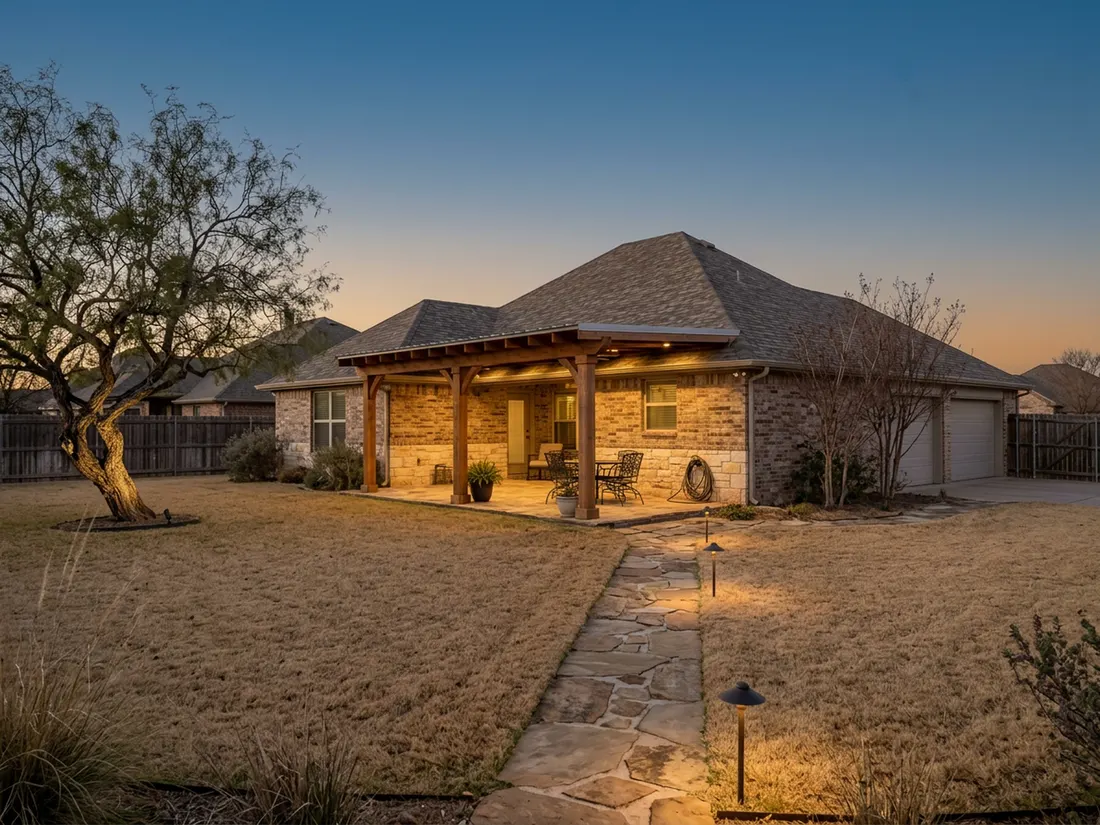
Landscape lighting is a set of outdoor fixtures placed to light steps, paths, plants and patios after dark. For landscape lighting in Abilene, TX, the gain comes from placement, not brightness: low, shielded lights on level changes and entries make a yard safer and better looking at once.
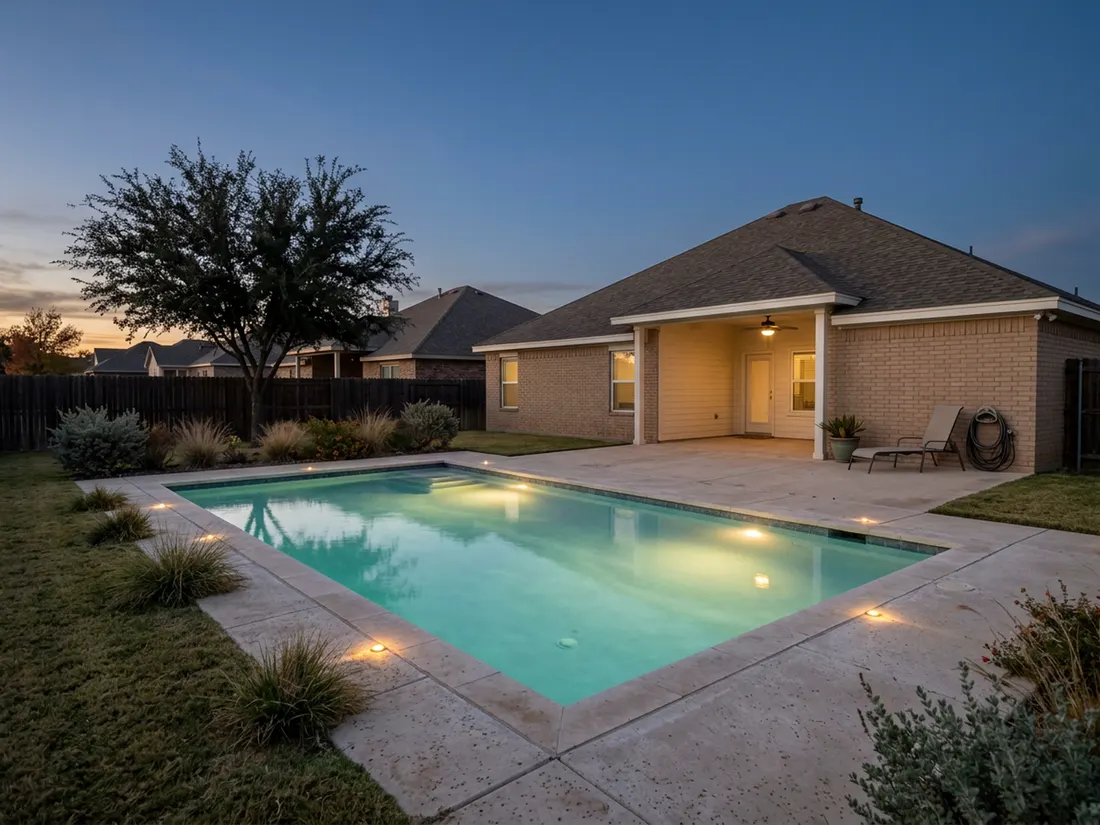
A few shielded fixtures aimed at surfaces, not at eyes, make a patio feel finished after dark.
The short answer
- Landscape lighting improves a backyard by choosing what the eye lands on at night, and a few well-aimed, shielded fixtures beat a yard full of bright ones.
- Lighting steps, level changes and the route to gates removes the most common backyard hazard, which is not seeing where your foot lands.
- Lighting reduces dark cover near doors and gates, but it cannot promise to stop a burglar, and we do not repeat unsourced percentages about it.
- Low-voltage LED with a transformer is the sensible default for most Abilene backyards, with line-voltage reserved for a few fixed wall lights and solar kept to soft accents.
- Trenching conditions, fixture material and transformer capacity can move the price as much as fixture count does, so get itemized written quotes.
- The cheapest time to add lighting is during a patio, pergola or pool build, before the surface is finished.
How does landscape lighting change how an Abilene backyard looks at night?
Landscape lighting changes a backyard’s look by deciding what the eye finds after dark. A lit trunk, a washed wall or a glowing patio edge reads as a plan. Everything left in shadow disappears, which is why a few well-aimed fixtures beat a yard full of bright ones.
Four techniques do most of the work. Each one suits a different surface.
- Uplighting. A fixture at the base aims up a trunk, a stone wall or a column. It adds depth and height.
- Grazing. A fixture set close to a textured surface, such as limestone veneer or board-and-batten siding, throws light across it and shows the texture.
- Downlighting. A fixture mounted high under an eave or beam washes a patio or seating area from above, the way moonlight would.
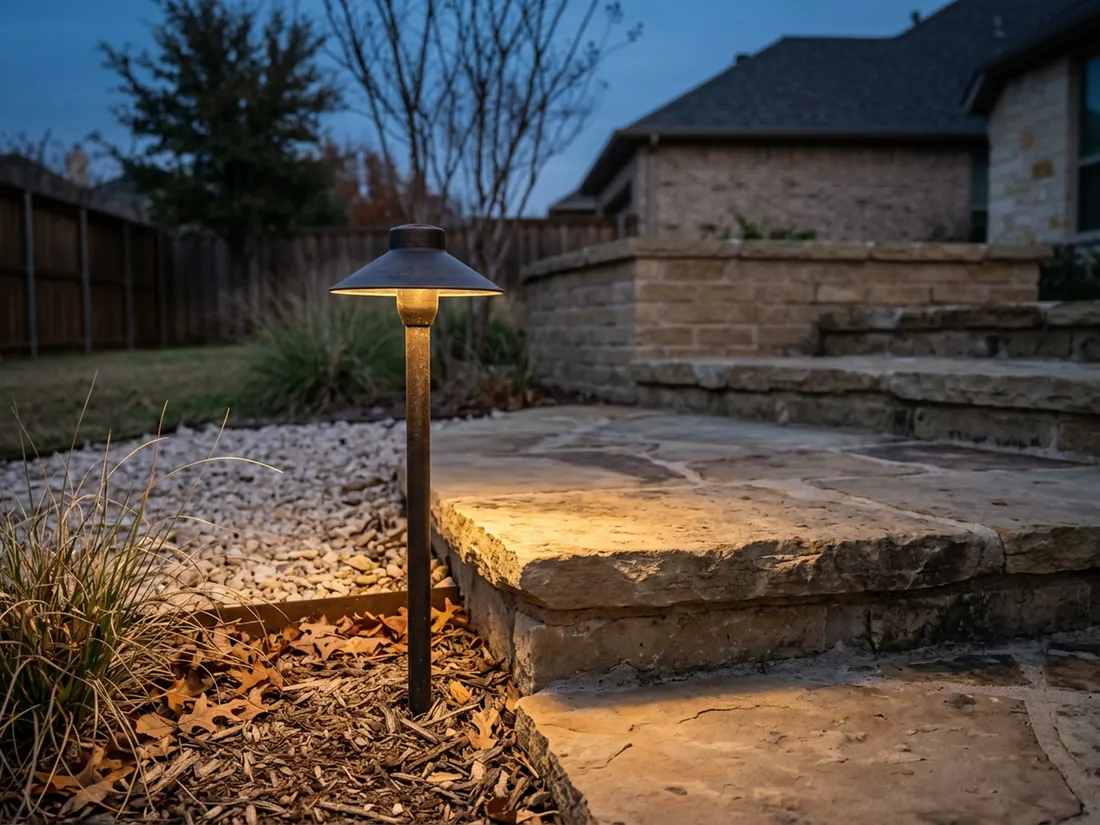
- Path and step lighting. Low, shielded fixtures mark edges and treads without lighting the whole yard.
Abilene backyards often open onto long views, with wide lots, big skies and few tall trees between neighbors. That makes glare more visible than it would be in a tight Frisco subdivision. A light that is merely bright from the street looks harsh from the far fence line. Warm, shielded fixtures aimed at surfaces give a calmer result in this kind of open yard.
Does outdoor landscape lighting actually make a backyard safer?
Yes for falls, and partly for crime. Lights on steps, level changes and paths remove the most common backyard hazard, which is not seeing where your foot lands. Lighting also removes dark cover near doors and gates. It does not stop a determined burglar, and no layout can promise that.
Fall risk is the benefit we can stand behind. Backyards are full of small level changes: a step down from the patio, a pool coping edge, a paver that has heaved after a dry summer. In daylight you see them. At night, with a plate in one hand, you do not. A low fixture at each change in height solves that for very little power.
Security claims deserve more caution. Plenty of web pages promise that lit homes are a set percentage less likely to be burgled. We could not trace those figures to a primary source, so we do not repeat them. What holds up is simpler: a burglar prefers to work unseen, and light on doors, gates and side yards makes that harder. Motion-activated lights add surprise, and neighbors who can see into your yard add more.
Where should the first lights go: steps, paths, gates or the patio?
Start where a fall or a surprise is most likely. Light steps and level changes first, then the route from the back door to the gates, then the seating area. Decorative lighting for trees and walls comes last, once the safety layer is in place.
- Steps and level changes. Every tread edge and every drop should be visible.
- The route to gates and the side yard. This is the path you walk at night with the trash or a flashlight.
- The patio door and seating area. Soft, dimmable light you can live with for hours.
- The kitchen and grill. Task light on the work surface, separate from the mood light.
- Trees, walls and planting beds. This is the finishing layer and the easiest to add later.
| Zone | Fixture that fits | Placement note | Common mistake |
|---|---|---|---|
| Steps and level changes | Step light or low path light | Under the tread edge or beside the riser, shielded | One bright light at the top that leaves the treads in shadow |
| Walkway to a gate | Path light | Staggered along one side, not paired | Rows of glowing mushrooms down both sides |
| Patio and seating | Recessed or beam-mounted downlight, wall sconce | Dimmable and warm in color | One bare floodlight that glares into every eye |
| Outdoor kitchen | Task light over prep counter and grill | Light the work surface from above and in front | Lighting from behind, so the cook’s shadow covers the food |
| Side yard and gate | Motion-sensing downlight | At the gate and the corner of the house | A floodlight aimed into a neighbor’s window |
| Trees and walls | Uplight or grazing light | Close to the base, with a shield | An unshielded uplight that shines into seated guests' eyes |
How do you keep glare and light spill off the neighbors' yard?
Use shielded fixtures, aim them at surfaces rather than at eyes, and keep the color warm and the output modest. A dimmer or timer finishes the job. Glare usually comes from a few fixtures aimed too high, not from the whole system.
DarkSky International, the group that certifies night-sky-friendly lighting, recommends fully shielded fixtures, warm color and light only where it is needed. That advice also happens to look better. A shielded fixture lights the wall or the path and keeps the bulb out of sight, so the yard reads as calm instead of harsh.
Test the layout the way a neighbor would see it. Wait for dusk, turn on every fixture, stand at the property line and look back at the house. If you can see a bare bulb, that fixture needs a shield or a new aim. Some HOAs also write their own lighting rules, so read yours before you buy.
How should you light a patio cover, pergola or outdoor kitchen?
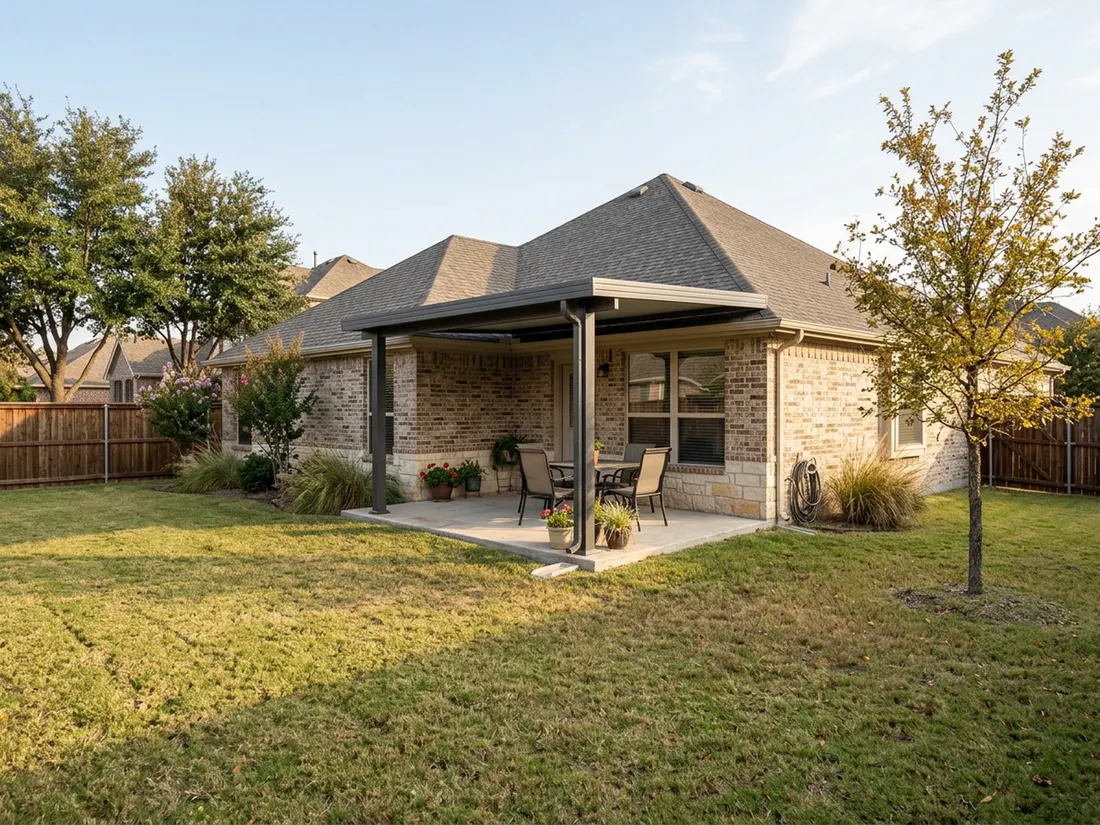
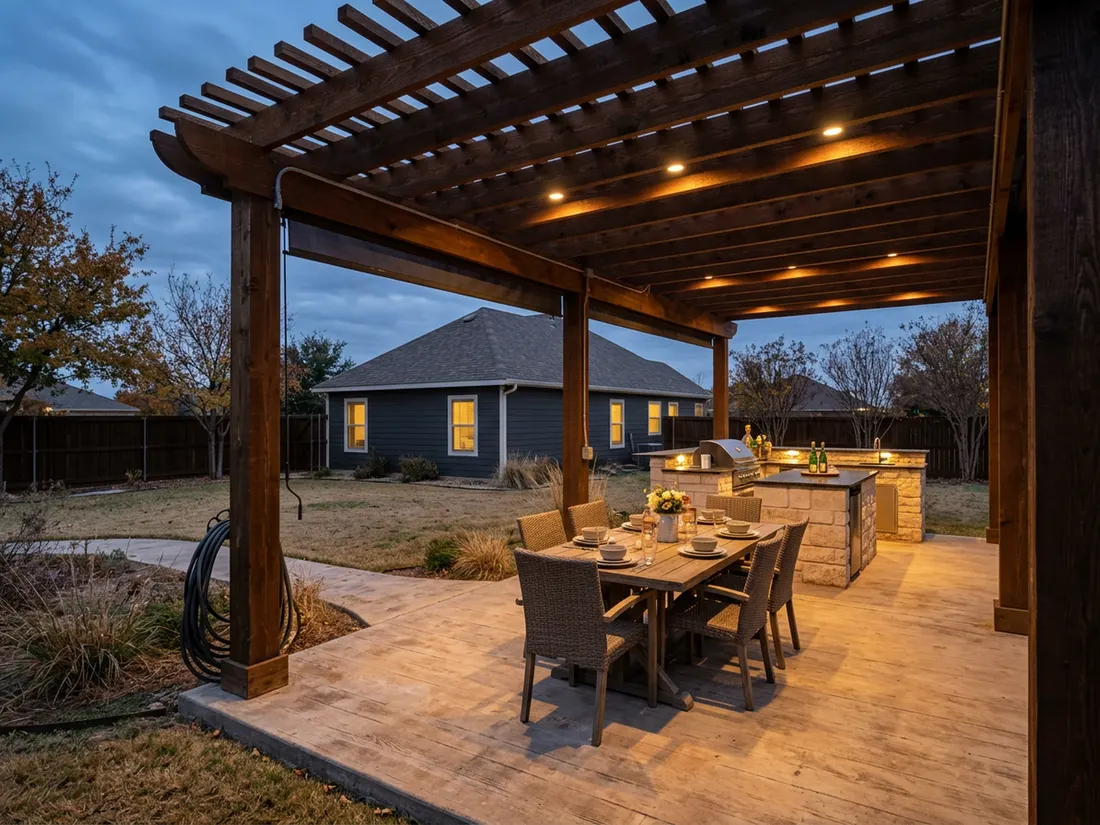
Light the structure from inside it. Dimmable downlights set into or under the beams wash the seating area, and separate task lights cover the grill and prep counter. Exposed bulbs create glare and draw insects.
A pergola gives you rafters to mount fixtures, and a solid roof gives you a ceiling. The wiring path is the real decision. Conduit and switch locations are easy to set before posts go in and ceilings close, and costly to open up later. That is why we suggest settling lights, fans and outlets before framing starts. Our post on patio covers built for Abilene heat and wind covers the structure itself.
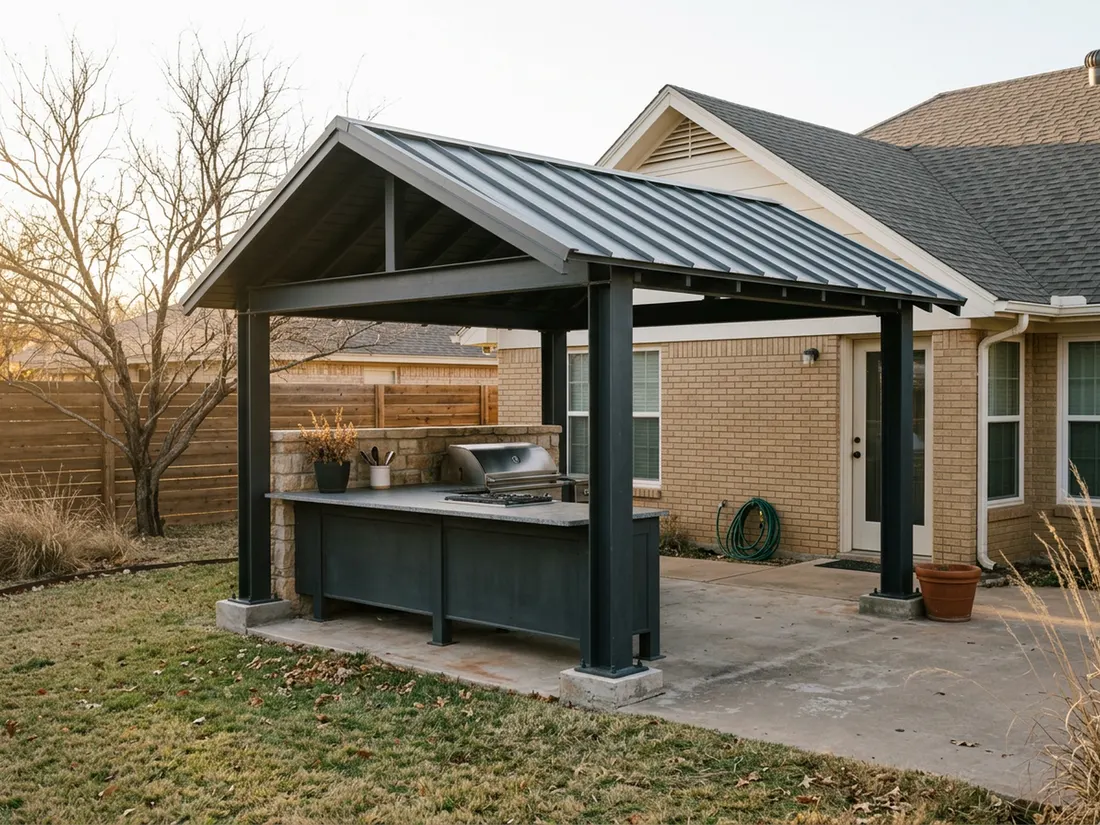
An outdoor kitchen needs more light than any other zone, because knife work and grill checks need a clear view. Put task light over the prep counter and the grill, and keep it on a separate switch from the mood light on the seating. Then you can dim one without losing the other. Our guide to outdoor kitchen design in Abilene covers the wind and hail side of the plan.
Permits are the part to check before work starts. Fans, lights and outlets on a roofed structure may need a separate electrical permit, depending on the city. As of November 2026 we have not confirmed Abilene’s current rule, so call the City of Abilene before you buy. Pool and spa lighting follow their own electrical code requirements, which our post on pool lighting in Abilene explains.
Is low-voltage, line-voltage, solar or smart lighting right for a Texas backyard?
Low-voltage LED with a transformer is the right default for most backyards. It is safer to handle, easy to adjust and cheap to run. Line-voltage suits a few fixed wall lights. Solar works only as a soft accent.
- Low-voltage LED. A transformer steps house power down to 12 volts. Fixtures can be moved as plants grow. On long runs the far end can dim from voltage drop, so the runs and transformer taps need planning.
- Line-voltage. These are 120-volt fixtures such as wall lights and floodlights. They are fixed in place, and the wiring is a licensed electrician’s job.
- Solar. There is no trenching, but the light is soft and depends on sun. Batteries wear out faster in heat. It suits a few path markers, not a lighting plan.
- Smart controls. Timers, dusk sensors and app scenes sit on top of a low-voltage system. Check that your Wi-Fi reaches the back fence.
LED fixtures draw far less power than the incandescent bulbs they replaced, and the lamps last far longer. That is why a well-built LED system adds little to the monthly bill, and why the electric bill is rarely a reason to hesitate.
What does landscape lighting cost in Abilene, and what drives the price?
We will not print a price. We have not found a trustworthy public price list for Abilene, and we have not published one for lighting. What we can give you is the list of things that move the number, starting with the ones that usually matter most.
- Trenching. Caliche, irrigation lines, pavers, retaining walls and tree roots all slow the work.
- Fixture material. Solid brass, copper or heavy cast aluminum cost more than thin plastic and last far longer.
- Transformer and controls. Size, spare capacity, timers and smart features all add to the price.
- Length of runs. Long runs need heavier cable or more taps to avoid voltage drop.
- Timing. Trenches and conduit cost least when the yard is still under construction.
Prices quoted for Dallas or Houston do not carry over to Abilene, where soil, labor and lot size differ. Ask each installer for an itemized quote that lists fixture count, fixture material, transformer rating, cable type and warranty. When one quote is far lower than the rest, the gap can come from cheaper fixtures and connectors rather than from the labor.
Do you need a permit or an electrician for landscape lighting in Abilene?
It depends on the wiring. A plug-in low-voltage kit needs no new wiring inside the house. A new outlet, a new circuit or any 120-volt work does, and that is usually work for a licensed electrician. Confirm Abilene’s rule with the city before you start.
Texas licenses electricians through the Texas Department of Licensing and Regulation, so you can check an installer’s license before you sign. Ask whether the installer pulls permits where the city requires them. A lighting job that skips a required permit becomes your problem when you sell the house.
What holds up to Abilene heat, wind and hard soil?
Solid brass, copper or heavy cast aluminum fixtures, sealed waterproof connectors, buried cable and a shaded transformer with spare capacity hold up best. Thin plastic fixtures and twist-on connectors are what fail first in West Texas.
Soil matters here. Where caliche, a hard, cemented mineral layer, or hard clay sits near the surface, trenching is slow and stakes loosen in wind. A fixture on a short stake in baked clay tips after the first spring gust, and then it lights the sky instead of the wall. Ask your installer how they set fixtures and how deep they bury cable. Our post on a low maintenance backyard in Abilene covers how the rest of the yard handles the same ground.
Weather adds two more tests. Summer heat bakes a transformer in direct sun and cooks cheap connectors. A hard freeze, like February 2021, makes thin plastic brittle, and a mower or a footstep then breaks it. Fixtures and connectors that are fine in a mild climate fail early here.
When is the best time to add landscape lighting to a backyard?
The best time is during the patio, pergola, pool or hardscape build, because trenches and conduit cost least before the surface is finished. If the yard is already done, add lights in stages, starting with steps and paths. November is a good month to plan, since dark falls around dinnertime and you see the result at once.
Staging works if the transformer is sized for the final system, not just the first phase. Ask for spare capacity and spare terminals so the second and third phases do not mean replacing equipment. If you are also planning plantings, fold lighting into the landscaping plan so that fixtures are not hidden behind shrubs in three years.
If you are planning a cover, pergola, kitchen or pool in Abilene, bring lighting into the first conversation. Wiring paths are cheap to settle on paper and expensive to cut into a finished roof or slab.
Thinking about this for your own home? See how Longhorn builds hardscaping.
Questions we get asked about this
It helps, but it is not a guarantee. Light removes dark cover near doors, gates and side yards, and motion-activated fixtures startle someone who expects to work unseen. Claims that lighting cuts break-ins by a set percentage rarely trace to a primary source. Pair lighting with good locks and neighbors who can see into your yard.
Build quality sets the lifespan. LED lamps last a long time, but fixtures and connectors set the real limit. Solid brass, copper or cast aluminum with sealed connectors usually outlast thin plastic, particularly under Abilene summer sun and the occasional hard freeze. Ask for warranty terms in writing for the fixtures, lamps and transformer separately.
Yes, and it works best when planned with the structure. Downlights mount in or under beams, and task lights go over the grill and prep counter. Settle switch locations and conduit before framing and roofing close things up. Fans, lights and outlets may need a separate electrical permit, so check with the city.
Yes. Start with steps, paths and gates, then add the patio, then the trees and walls. The one condition is the transformer. Have it sized for the finished system with spare terminals, so later phases connect to what is already there instead of replacing it.
We have no reliable Abilene figure and will not quote one. Lighting clearly improves how a yard looks and how long you can use it after dark. Treat it as something you will enjoy, not as a line on an appraisal.
Very little with LED fixtures, and a timer or dusk sensor keeps lights from burning all night. LEDs use far less energy than the incandescent bulbs older systems relied on. Your exact figure depends on fixture count and hours, which an installer can estimate from the transformer rating.