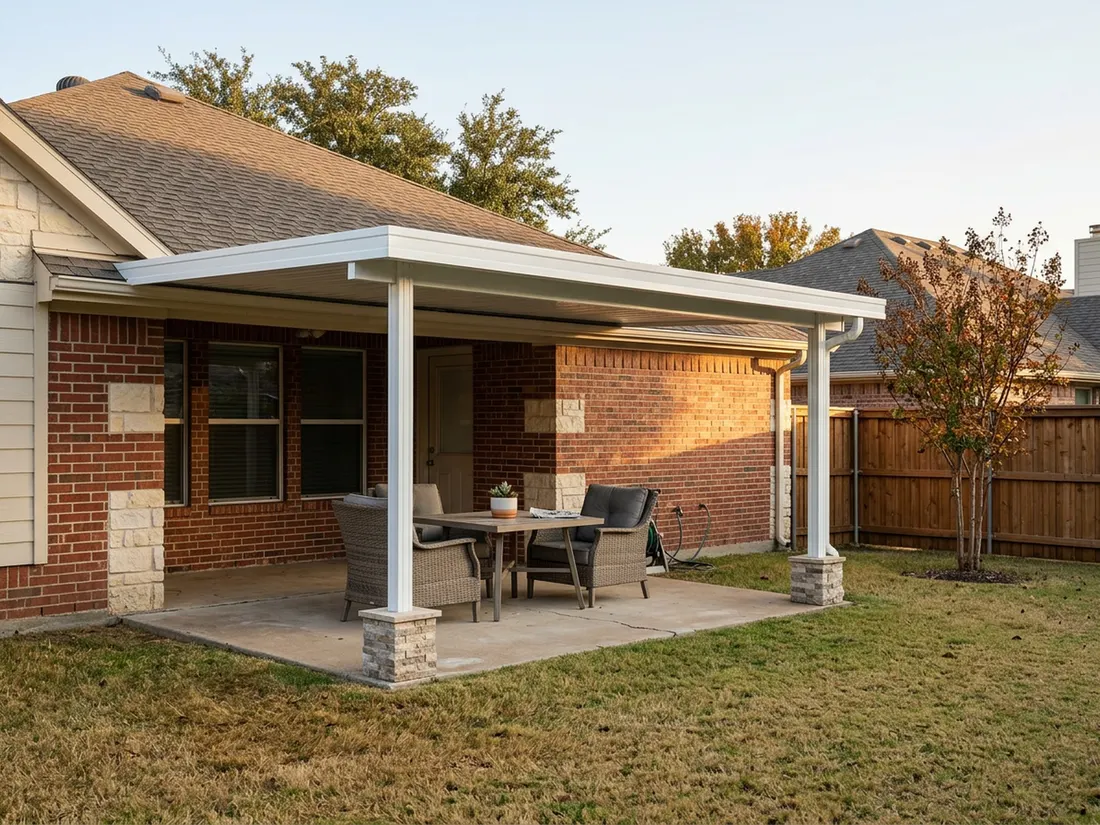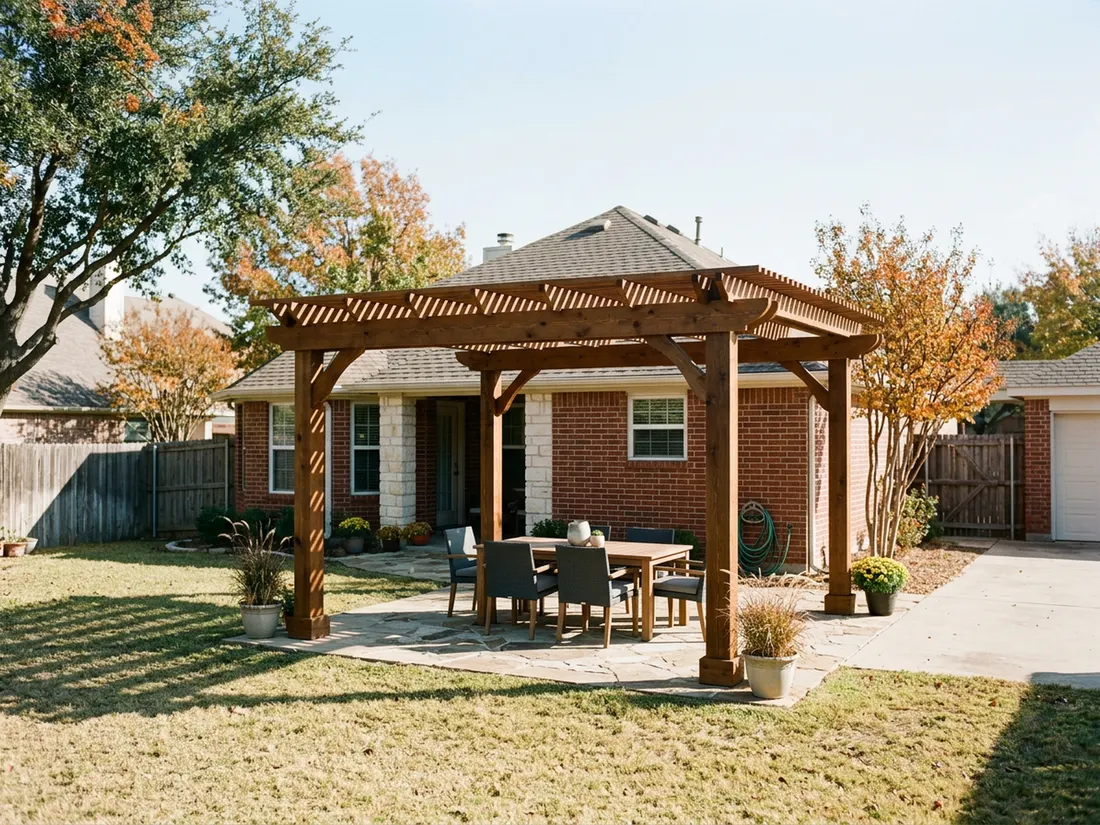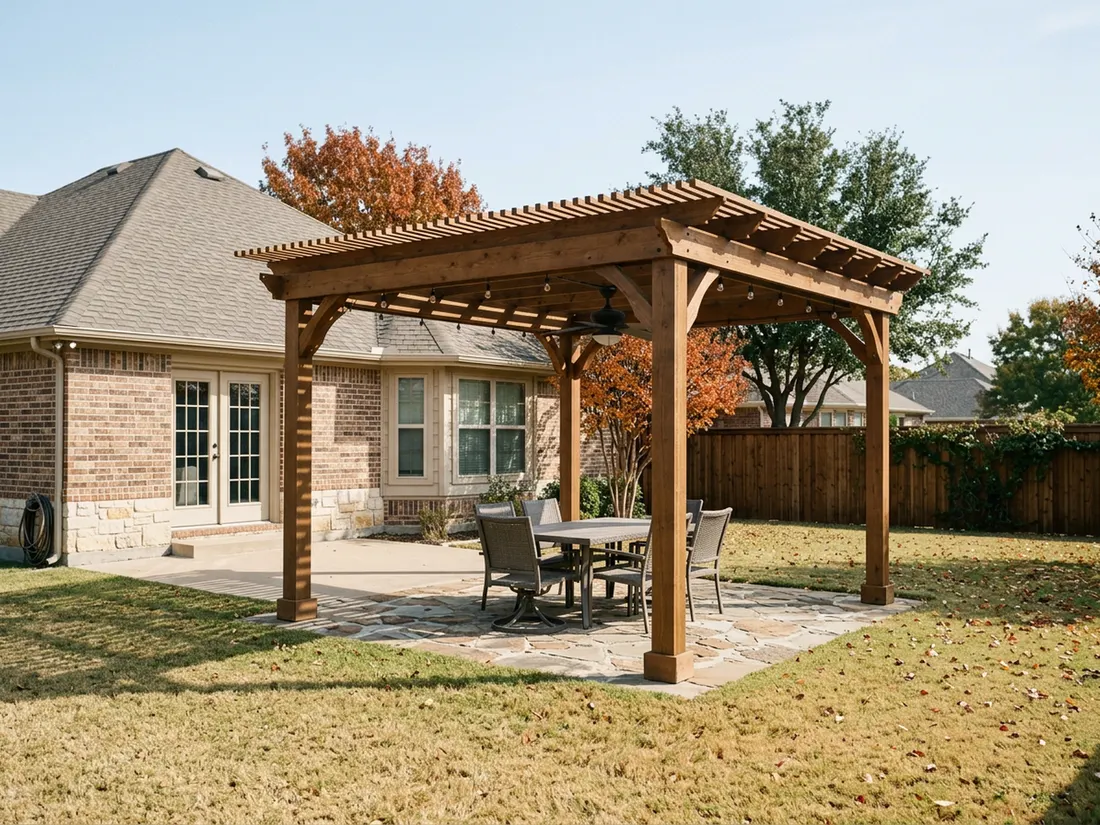


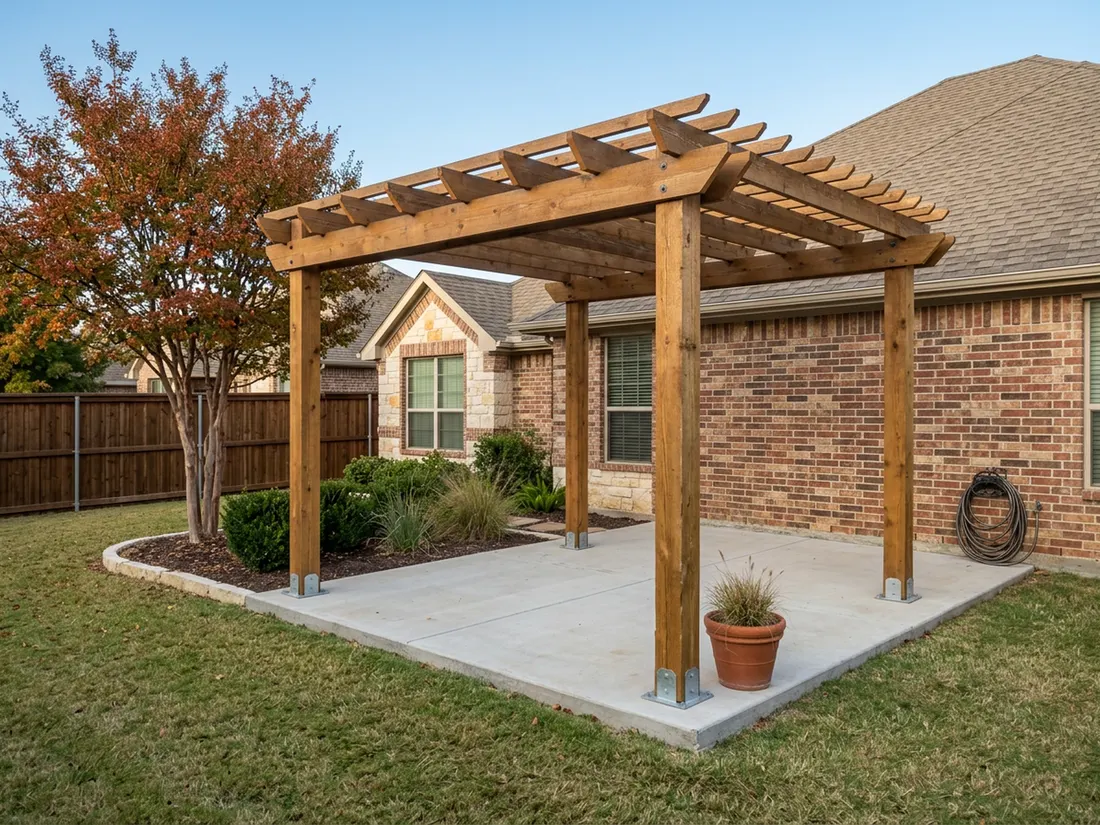
People expect a wooden pergola in Texas to be killed by sun. Sun is what fades it. What actually causes pergola rot here is water that is allowed to sit somewhere it cannot dry, and in nearly every case we are called out to, that somewhere is the post base, a cut end or a flat joint within a foot of the ground.
The short answer
- Rot in a North Texas pergola almost always starts at the post base where the wood meets concrete or soil, and at the exposed end grain of rafter tails, not on the sun-facing faces everyone inspects.
- The black staining on a pergola is usually mildew feeding on surface residue, not rot. It wipes off; rot does not, and the difference is a thirty-second test with a screwdriver.
- Lawn irrigation is a bigger threat to a wooden structure here than rainfall, because a sprinkler head hitting a post does it several times a week all summer, every summer.
- The maintenance window that works in this climate is fall, roughly October into November: the wood is dry from summer, the temperatures let a finish cure properly, and you are ahead of the wet spring.
- A post with soft wood you can sink a screwdriver into is structural, not cosmetic. But it is usually a post replacement, not a pergola replacement, and that distinction saves people a great deal of money.
Where does pergola rot start in Texas?
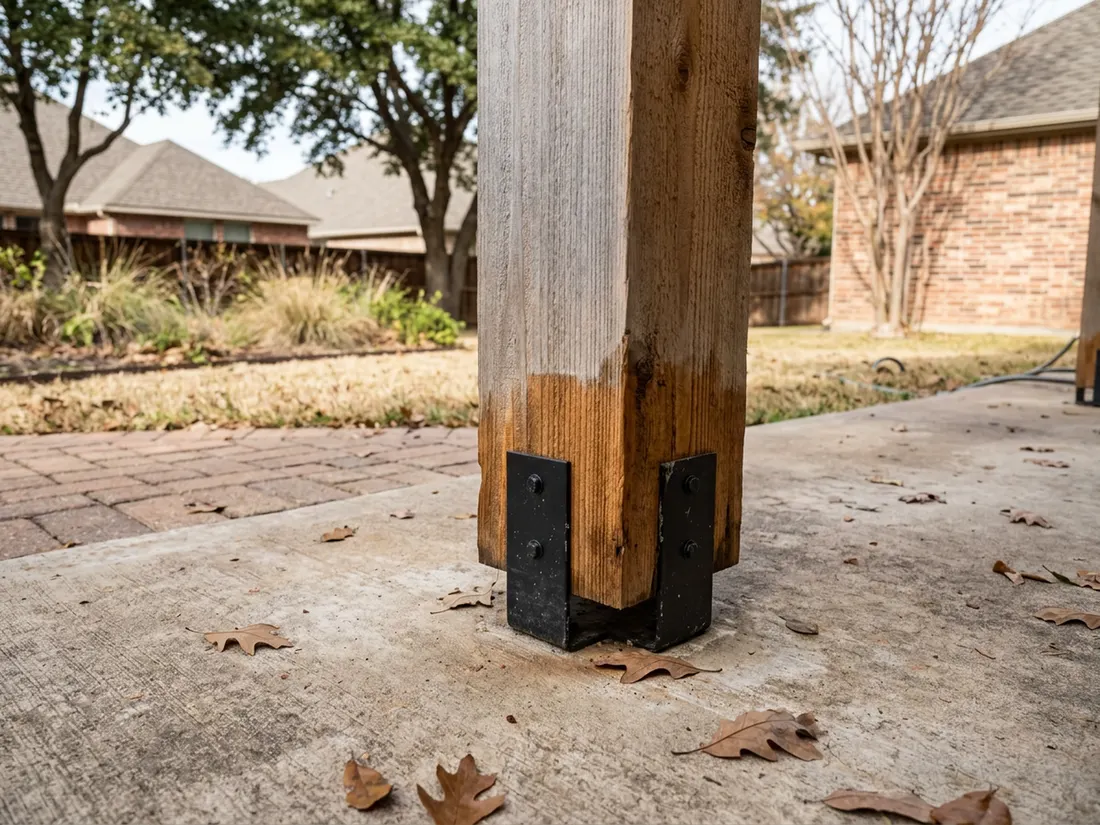
Pergola rot starts low: at the post base, the cut ends and any flat joint where water sits. Wood decay needs moisture, and it needs that moisture to hang around. A cedar beam eight feet in the air gets rained on and then gets a Texas afternoon to dry off, which is why the tops of pergolas mostly weather rather than rot. The bottom of a post is a different environment entirely.
Three places do nearly all of the failing here.
- The post base. A post sitting flat on a slab or set into concrete has end grain in contact with a surface that stays wet after rain, after a wash-down, after every sprinkler cycle. End grain drinks water far faster than the sides of a board do. It is the cut ends of thousands of tiny straws. Water goes up into the post and has no path out.
- Rafter tails and any cut end. Same mechanism, up in the air. Every place a saw went through is a place water gets in more easily than it gets out.
- Flat surfaces and unsealed joints. The top face of a beam, the notch where a rafter crosses it, a bolted connection with no sealant. Anywhere a puddle can form and sit through a cool damp week in March.
Notice that none of the three are visible from where you sit. That is the whole problem with pergola maintenance: the parts that fail are the parts nobody looks at.
Is it rot, mildew or just weathering?
Go out with a flathead screwdriver and five minutes. Push the tip (moderate pressure, the amount you would use to open a paint can) into the wood at the base of every post, at a few rafter tails, and anywhere the color looks off. Sound wood resists. Rotten wood gives.
| What you see | What it usually is | What to do |
|---|---|---|
| Silver-gray surface, wood still hard | UV weathering. Purely cosmetic. The surface fibers have broken down, the wood has not | Clean and re-finish when you are ready. No urgency |
| Black or dark green patches, often on the shaded side | Mildew feeding on surface residue and pollen, common here after a wet spring | Wash gently with a mild cleaner. It comes off. It is not decay |
| Fine surface cracks running with the grain | Checking as the wood moves between our wet springs and dry Augusts. Normal in cedar and pine | Seal so water does not sit in the checks. Not a structural issue on its own |
| Screwdriver sinks into the post within a few inches of the base | Decay. This is the one that matters | Get it looked at. It is a post repair or replacement, not a paint job |
| Soft, spongy rafter tails, darker than the rest | End-grain decay working back from the cut | Often cut back to sound wood and re-detailed rather than replaced whole |
| Powder, small holes, or a sawdust-like trail | Insects, and they are usually there because the wood was already damp | Treat the insects and fix the water, in that order, or it returns |
| White crusty film on a post base | Efflorescence from the concrete, not from the wood | Cosmetic, but it tells you that base stays wet |
One more test worth doing: after a rain, look at where water stands. If there is a puddle against a post twelve hours later, that post is being asked to sit in water several times a year, and no finish schedule fixes a grading problem.
Can sprinklers rot a wooden pergola?
This is the one that surprises people. North Texas rain arrives in bursts, mostly in spring, and then the wood gets weeks of heat to dry out. An irrigation head that clips a pergola post wets it on a schedule, several mornings a week, right through the months when it would otherwise be bone dry. That is far more total wetting than the sky delivers, and it is applied to exactly the worst part of the structure.
Walk the yard during a zone cycle and watch. If any head throws spray onto a post, a column wrap or a skirt board, adjust or move it. It is a twenty-minute job and it is probably the single highest-value maintenance thing in this article.
While you are in there, the city’s watering rules matter more than people assume, because midday irrigation restrictions exist partly to reduce evaporation, which means your system is very likely running in the early morning, when wood dries slowest. Grapevine bans irrigation between 10am and 6pm, and Mansfield prohibits it between 10am and 6pm year-round, so in those cities your heads are almost certainly running at dawn.
Pool decks and spray zones
A pergola over a pool deck takes splash, cannon-ball spray and wash-down water that a lawn pergola never sees, and it takes them all summer. Column bases in that position deserve a standoff base and a hard look every fall, and stone or metal column wraps at the bottom are worth considering from the start rather than as a later repair.
Does the soil under a pergola add to rot?
Yes. East of I-35 (Dallas, Plano, Frisco, Allen, Garland, Rockwall, Forney, Waxahachie), you are on Blackland Prairie clay. It holds water at the surface rather than letting it soak away, and it shrinks back in August, opening gaps around anything set into it. A post set directly into that ground has a seasonal moisture cycle applied to it whether you water or not.
Through the Eastern Cross Timbers (Denton, Argyle, Flower Mound, Keller, Grapevine, Aledo), sandy loam drains quickly at the surface onto clay that does not, so water collects a little below grade. Posts there can look fine at the surface and be sitting in a damp layer just underneath.
West of the Trinity on Fort Worth Prairie limestone (Fort Worth, Crowley, Haltom City, Weatherford), shallow soil over rock sheds water sideways rather than down, so the question becomes where that sideways water is going. Often it is going toward the patio.
In all three cases, the fix is the same and it is not a wood product: get the grade falling away from the structure, get downspouts discharging clear of it, and get the posts up off whatever stays wet.
A maintenance year that fits this climate
| When | What to do | Why then |
|---|---|---|
| Late winter, February to early March | Walk the structure after the cold snaps. Check connections and look for anything that moved | Hard freezes here tend to arrive in winter. The February 2021 storm kept DFW below freezing for days and put snow and ice weight on outdoor structures |
| Spring, April to May | Wash off mildew and pollen. Clear debris out of beam notches and joints | It is the wet season, and that residue is what mildew eats |
| Early summer, June | Run the irrigation and watch for spray hitting wood. Adjust heads | Before the long hot stretch when the system runs most |
| Late summer, August | Look, do not coat. Note what needs attention | Finishes applied to wood in extreme heat can skin over before they penetrate |
| Fall, October into November | The real maintenance window: clean, sand where needed, seal or stain | Wood is at its driest after summer, temperatures suit curing, and you are ahead of the wet spring |
How often the finish needs redoing depends on the product, the exposure and which faces take the afternoon sun. A horizontal beam top facing straight up takes far more punishment than a shaded post face, which is why structures rarely need refinishing uniformly. Do what needs doing, not the whole thing on a calendar.
What not to do, including some popular advice
- Do not pressure wash it hard. A high-pressure tip tears out the soft spring growth between the grain lines and leaves a furred surface that holds more water than it did before. Low pressure, a cleaner, and a soft brush is the version that helps.
- Do not seal wood that is wet. A finish applied over trapped moisture holds it in. After a wet stretch, give the structure real drying days before you coat it, which is another argument for fall over spring.
- Do not paint a post base to hide softness. It looks solved for a season. The decay keeps going underneath, out of sight, and the next time anyone looks at it the repair has grown.
- Do not replace the whole pergola over one bad post. This is the expensive mistake in this category. Posts are replaceable. Rafter tails can be cut back to sound wood and re-detailed. A structure with good beams and one failed column is a repair.
- Do not pack soil or mulch up against a post. Mulch beds that creep up a column hold moisture against it all season. Keep the base clear and visible.
When it genuinely is past saving
There are a few honest end points. Multiple posts soft at the base at the same time usually means a site condition rather than a material one, and rebuilding in the same place without fixing the water buys you the same problem again. Beams that have lost section where rafters bear on them are a structural issue, not a finish one. And a structure that was undersized or under-connected from the start (toe-nailed rafters, posts with no real footing) is generally worth rebuilding rather than restoring, because the repairs never address why it moved.
Short of that, most of what we look at is fixable, and a fair amount of it is fixable by the homeowner with a screwdriver, an afternoon and a sprinkler adjustment. If you are not sure which one you have, take a photo of the post base with something for scale and send it over. Pergolas Longhorn Outdoor Living builds get detailed for this from the start, but the diagnosis is free either way.
Questions we get asked about this
Long enough that the finish schedule and the details matter more than the number. A cedar structure with standoff post bases, sealed end grain, water draining away from it and sprinklers kept off it lasts for decades here. The same wood with posts sitting on a wet slab and an irrigation head hitting them can show decay in a few years.
Almost always mildew, which feeds on surface residue and pollen and is very common here after a wet spring. It washes off with a mild cleaner and a soft brush. Rot does not wash off. Test with a screwdriver, and if the tip sinks into the wood under moderate pressure, that is decay, not staining.
Fall, roughly October into November. The wood is at its driest after a North Texas summer, the temperatures let a finish cure rather than skin over, and you go into the wet spring already protected. Sealing in August risks a finish that sets before it penetrates, and sealing in spring risks trapping moisture in the wood.
Yes, and they are usually the biggest single source of wetting a structure gets. A head that clips a post applies water several mornings a week through the hottest months, at the exact place where water cannot drain away. Walk the yard during a zone cycle and adjust anything spraying wood.
Usually, yes. The structure gets temporarily supported, the failed post comes out, and a new one goes back on a proper base and footing. Replacing an entire pergola because of one bad column is the most expensive avoidable mistake we see in this category.
Treated lumber resists decay well and is a sensible choice for posts and anything near the ground. It moves more than cedar, so expect more checking and cupping on exposed members, and it wants a finish to look right. Many structures here use treated material low and cedar where it is seen.