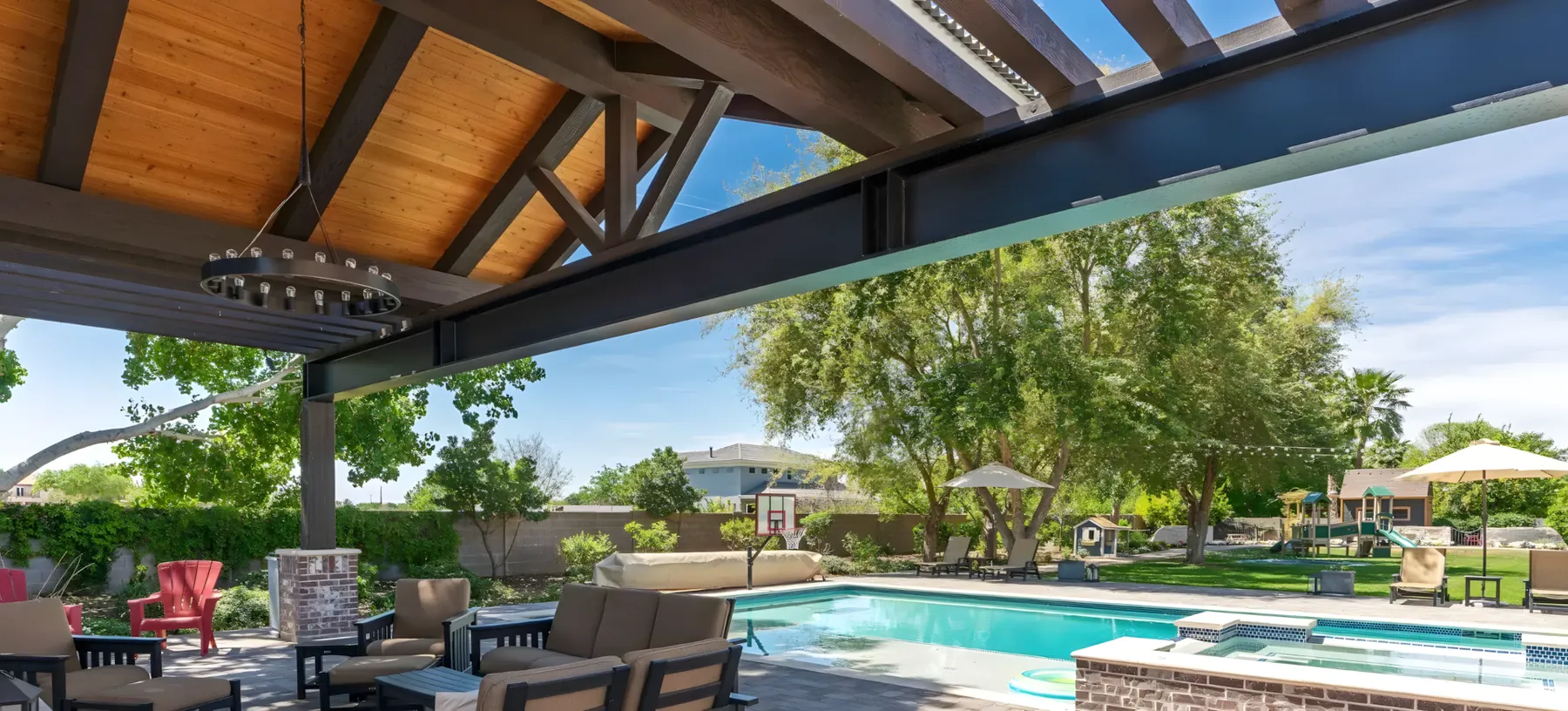

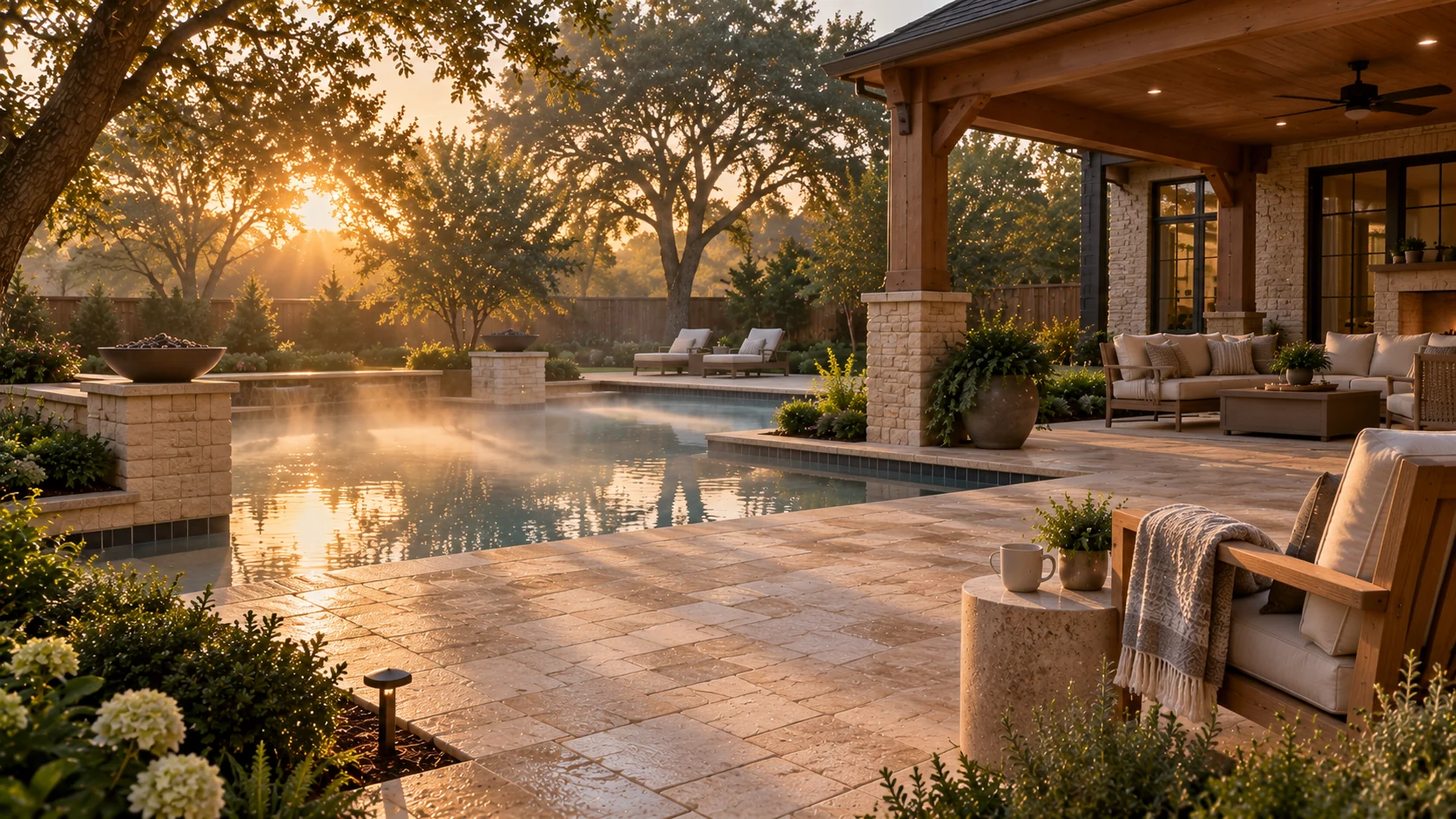
We get asked whether pergolas really work in Texas often enough that it is worth answering plainly. Yes — for a specific job, in specific spots, through most of the year. And no, not for the job most people think they are buying, which is making a hot patio cool. Those are two different purchases and confusing them is the most expensive mistake in this whole category.
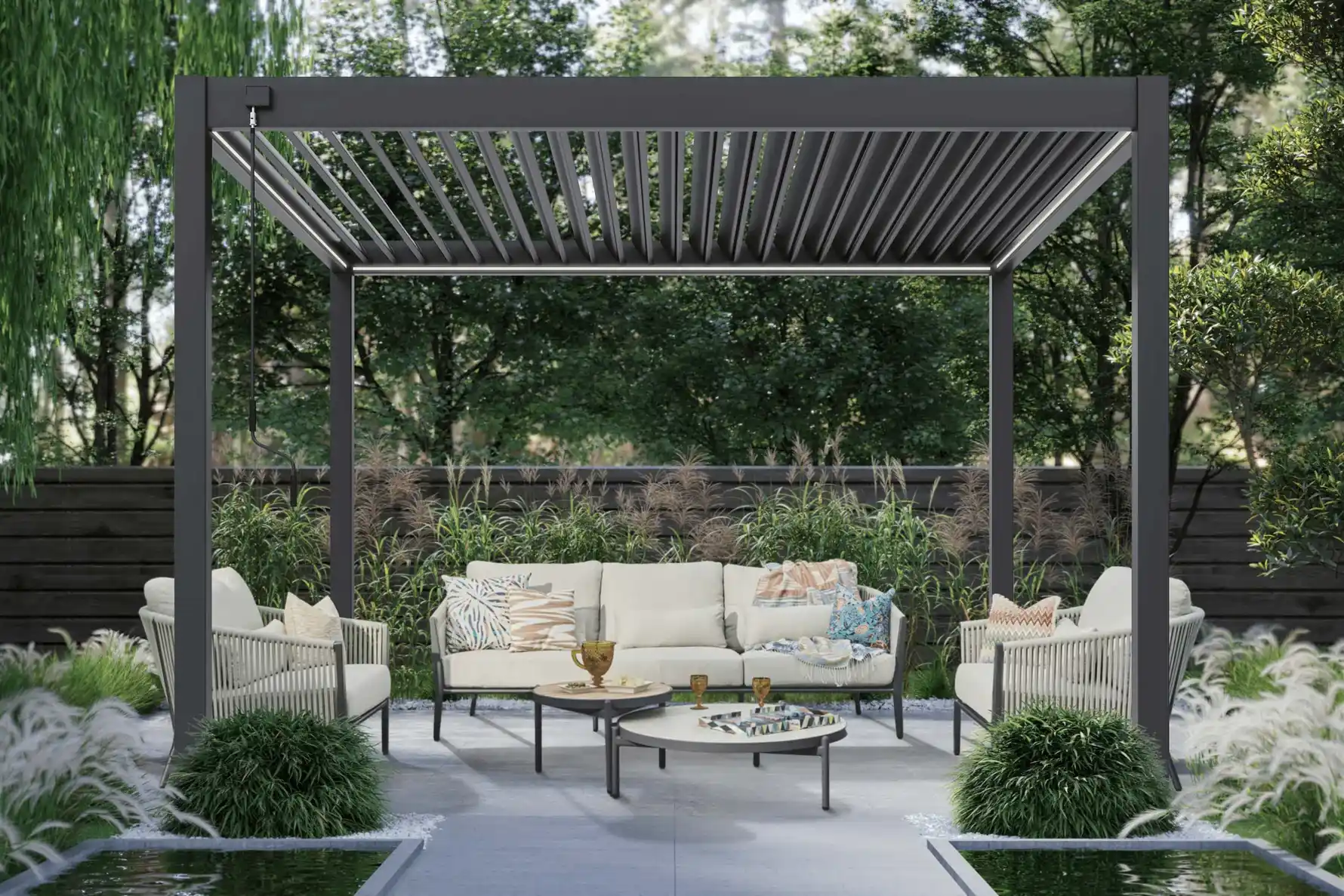
What a pergola is actually good at
Strip away the marketing and a pergola does four things well, and they are all real.
- It makes a room out of a rectangle. A flat fenced yard with a slab on the back has no rooms. Put a structure over the dining end and the yard has a dining end. On the newer lots around Frisco, Prosper, Celina and Little Elm, where nothing has grown up yet, this is the fastest way to make a backyard feel designed.
- It filters overhead sun. At midday, when the sun is high, a slatted roof genuinely takes the edge off. You can feel the difference standing under one at one in the afternoon.
- It gives you something to build from. Fans, lighting, heaters, speakers, shade fabric, a screen on the west side — none of those have anywhere to go on an open slab.
- It keeps the sky. This matters more than people expect. A solid roof over a small patio can make the back of a house feel dark inside, particularly on a north-facing rear elevation. An open structure gives you shape without taking light away from the room behind it.
That is a genuinely useful list. It just does not include “makes August bearable,” and that is the one people most often think they are buying.
The North Texas year is mostly not about heat
It is easy to design a backyard entirely around the worst six weeks of summer, and it is usually the wrong design. Look at how the year actually runs here.
| Season | What limits outdoor use | What a pergola does about it |
|---|---|---|
| March to May | Storms, hail and wind, not temperature. These are some of the best weeks of the year out here | Plenty — definition, filtered light, somewhere to put lighting. Retract any fabric when a line comes through |
| June to September | Heat, and specifically low western sun from mid-afternoon. The 2023 run of triple-digit afternoons is the version people remember | Useful at midday, limited from about four o’clock unless you add louvers, a solid section or vertical shade |
| October to November | Very little. This is arguably the best stretch of the year in DFW | Everything you want — structure, lighting, a place to sit outside in the evening |
| December to February | Cold snaps, occasionally severe ones — February 2021 and the December 2022 freeze both shut the metro down | Nothing thermally. A structure to hang heaters from helps on ordinary cool evenings; nothing helps in a real freeze |
Two thirds of that table is a case for an open structure. One third is the case against relying on one. Which is why the honest answer to “do pergolas work in Texas” is that they work very well for eight or nine months and need help for the other three.
A straight test for which one you need
Answer these out loud. The first one that gets a firm yes is your answer.
| If this is true | Buy this |
|---|---|
| “I want to sit out there in July at six in the evening and be comfortable” — and the patio faces west or southwest | A solid or insulated roof over the seating, or a louvered system. Not fixed slats |
| “I want to keep a table, a television and cushions dry through a spring storm” | A roof. Slats are not a roof, and adding a canopy to fix that is a compromise on both counts |
| “The patio is already shaded by the house or a big tree by mid-afternoon; I just want the space to feel like something” | A pergola. This is exactly the job it does best |
| “The back of the house gets dark and I do not want a roof making it worse” | A pergola, or a partial roof set away from the windows |
| “I want to define a firepit or dining area out in the yard, away from the house” | A freestanding pergola. It reads as a destination without blocking the sky over the lawn |
| “Some of both — shade where we sit, open where we cook” | A split structure. Solid over the seating, open slats over the grill and the walkway. It is the most common configuration we build here |
The ground still gets a vote
Whichever way that test lands, the structure lands on North Texas dirt, and that is where the cost difference between two otherwise identical quotes usually lives.
East of I-35 — Dallas, Plano, Frisco, Allen, Richardson, Garland, Rockwall, Forney — Blackland Prairie clay swells through a wet spring and shrinks hard by late August. Because a pergola is tall and light, a small amount of seasonal movement at a footing becomes a visible lean at the top. Piers here have to reach past the soil that is actively moving, and a design with fewer posts often costs less than a design with more, even in heavier material.
Through the Eastern Cross Timbers — Denton, Argyle, Flower Mound, Keller, Grapevine, Aledo — sandy loam drains onto clay that does not, so water collects just below the surface and drainage gets solved with the structure, not after it.
West of the Trinity — Fort Worth, Crowley, Haltom City, Weatherford, Joshua — thin soil over limestone largely removes the movement problem and replaces it with rock in every hole. That is a real number and it belongs in the quote at the design visit rather than in a change order.
What weather does to an open structure
There is a genuine structural advantage to open slats: wind passes through them. A solid roof is a surface for a spring storm line to push on and lift; a pergola is much less so. That is a real point in its favor in a metro that takes thunderstorm lines every spring.
The catch is that everything you add to make a pergola shadier turns it back into a surface. A tensioned shade sail, a retractable canopy left out, a set of louvers left closed — all of those catch wind. Same with ice. February 2021 put days of freezing weight on every horizontal surface in the metroplex, and a grid of rafters carrying ice is loaded across its whole span at once. Structures that came through were the ones with mechanically fastened connections and spans sized with something in hand.
When we tell people not to buy one
- When the complaint is heat on a west-facing patio. A fixed-slat pergola will look excellent and change almost nothing about how that space feels at six in July. That money belongs in a roof you can sit under.
- When the slab is cracked with a lip, or water stands near the house. Posts and footings set into a moving, badly drained site inherit the problem. Fix the water, then the concrete, then build. Nobody enjoys this answer and it is still the right order.
- When it would go somewhere nobody walks. A structure in the middle of an untouched lawn photographs well and gets used rarely. Build where people already go.
- When the real want is a room. If the description keeps drifting toward screens, glass, heat and air conditioning, you are describing an enclosure or a sunroom, and building a pergola first usually means paying to remove it later.
- When the budget only covers a kit. A kit sized for a generic slab puts posts where the instructions assume, not where your slab edge, door swing and grill want them, and it assumes footings that Blackland clay does not honor. It is better to wait a season and build one properly than to build one twice.
The bottom line
Pergolas work here. They are the right answer for definition, for filtered midday light, for a place to hang everything else, and for the eight months of the year when heat is not what is keeping you inside. They are the wrong answer for temperature and for rain, and no amount of slat spacing changes that.
The best outcome on most DFW patios is not one or the other. It is a solid section where the afternoon sun lands and an open one where it does not, on the same slab, designed together. If you want someone to stand in your yard and tell you which half is which, that is the conversation we would rather have than one about what a pergola costs.
Questions we get asked about this
They work well against overhead sun, so from late morning into early afternoon they make a real difference. They do much less about the low western sun that makes a patio unusable from mid-afternoon in July and August. If the goal is comfort at six in the evening in summer, you want a solid roof, an insulated roof, or louvers you can close.
Decide by which way your patio faces and what you want out of the space. West and southwest-facing patios want a roof or louvers, because that is where the afternoon sun lands. North and east-facing patios are shaded by the house for much of the afternoon anyway, so an open pergola gives you structure and light without closing the space in.
Much less than a solid roof will. That is one of its genuine advantages, especially on a north-facing rear elevation or where the patio sits right outside a kitchen or family room. If you want a roof but are worried about the light, setting a freestanding structure a few feet off the house keeps a light well between the two.
An open structure is better in wind than a solid roof, because air passes through instead of pushing on it. What matters is the connections — mechanically fastened rafters and beams rather than toe-nailed ones — and spans sized for ice load of the kind we saw in February 2021. Anything you add for extra shade becomes a surface for wind, so plan for how it comes down.
A timber one needs cleaning and sealing on a schedule, with the real attention going to post bases and cut ends rather than the faces you can see. The practical window in North Texas is fall, once the wood has dried out over summer. Aluminum and steel structures ask for much less, and that is a legitimate reason to choose them.
Sometimes, but it is rarely a clean upgrade. An open structure is sized for loads that pass through it, and adding a solid roof adds wind uplift, water load and often weight the posts and footings were not designed for. If you think a roof is likely, it is far cheaper to design for it now than to retrofit it.