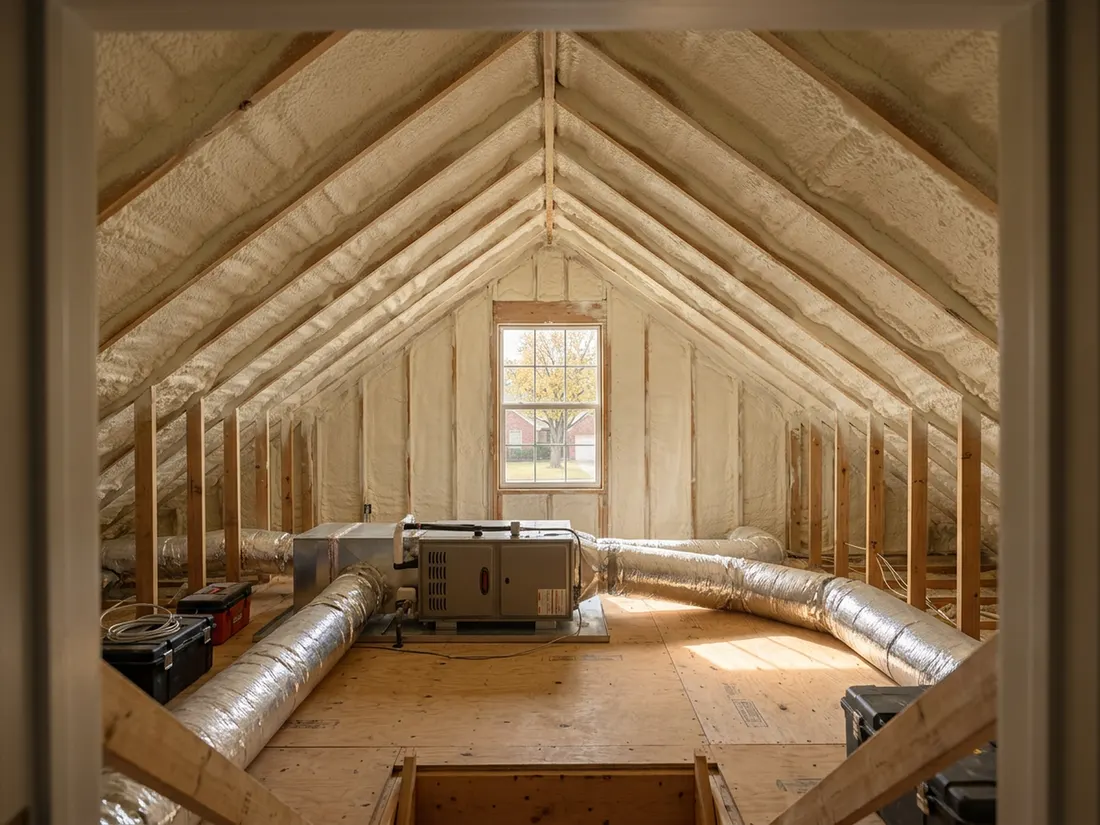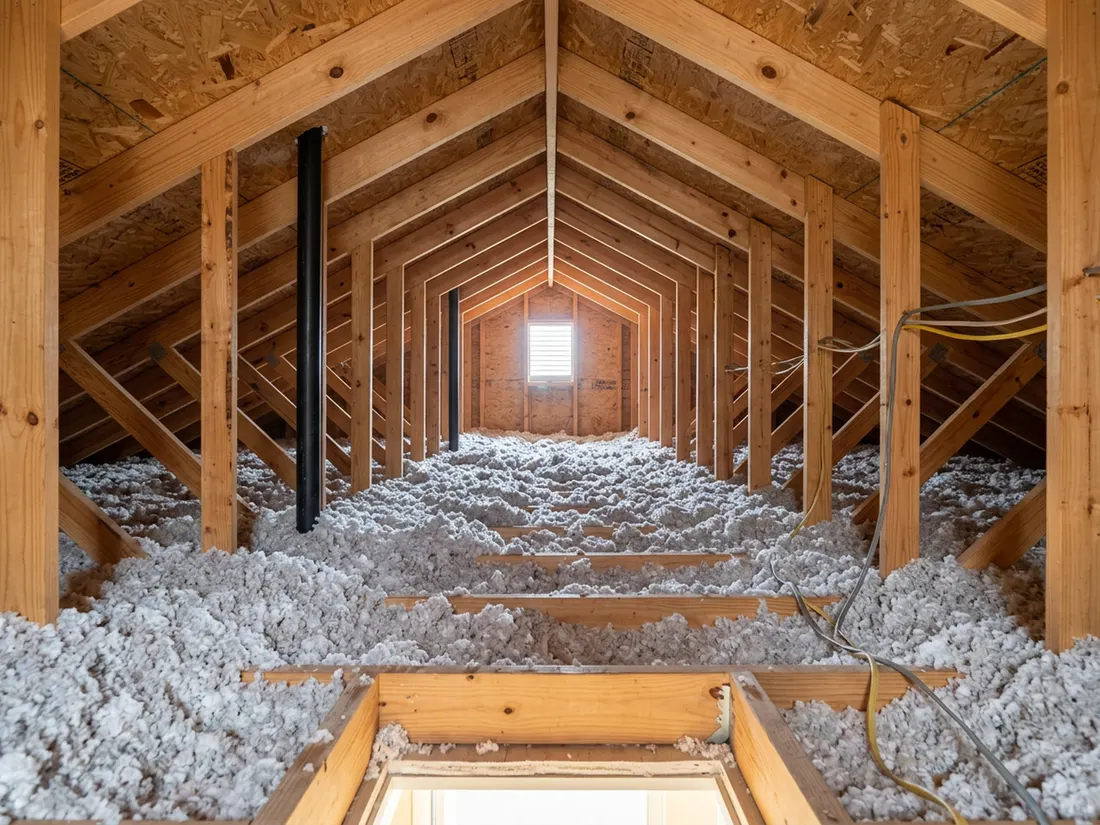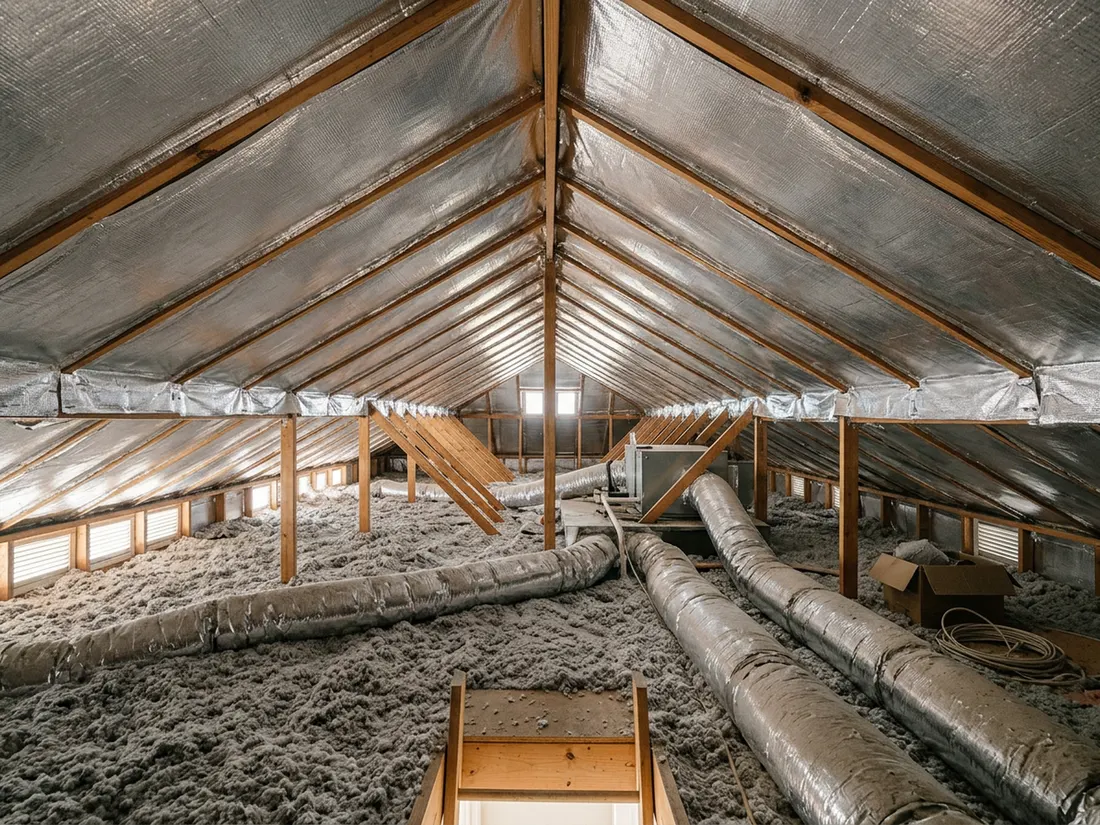


Spray foam insulation is a two-part liquid that expands into a solid foam and seals gaps in attics and walls. Humidity is the water vapor held in the air. Does spray foam insulation help with humidity? Partly: it stops humid outdoor air from leaking in, but your AC still removes the moisture your household makes.

The short answer
- Spray foam helps with humidity mainly by sealing the gaps that let hot, wet outdoor air into an attic or wall.
- Spray foam does not remove moisture created inside the house, so your AC, exhaust fans and ventilation still decide your indoor humidity.
- Closed-cell foam resists vapor and liquid water better, while open-cell foam is vapor-permeable and lets a roof leak show up as a stain sooner.
- A foamed attic can still run humid, and the usual causes are leftover vents, leaky ducts, negative pressure or an AC that shuts off before it dries the air.
- Foam applied to the underside of a roof deck can hide a leak and may affect a shingle warranty, so fix the roof and read the shingle maker’s terms before you sign.
- The IRC allows unvented attics with air-impermeable insulation, but Texas cities adopt code editions on their own, so confirm your city’s rule before you design the job.
Does spray foam insulation help with humidity in a Texas home?
Spray foam expands as it cures and fills cracks, and that is how it helps with humidity: it seals the gaps that let hot, wet outdoor air into your attic and walls. It does not remove moisture your household makes, and it does not stop leaks.
Outdoor air is where the DFW moisture problem starts. Summer dew points in Dallas and Plano can climb into the 70s, and a leaky attic breathes that air in whenever the HVAC fan runs. Sealing those paths with foam cuts the moisture that arrives. What foam cannot do is take over the air conditioner’s job of pulling water out of the air already inside the house.
What kind of moisture problem does your DFW house actually have?
Four different problems get called humidity: humid outdoor air leaking in, moisture made indoors, liquid water from a leak, and condensation on cold surfaces. Spray foam helps with the first, can reduce the fourth, and does little for the other two. Sorting out which one you have comes before any purchase.
| Problem | What it looks like | Does spray foam help? | What actually fixes it |
|---|---|---|---|
| Humid outdoor air leaking in | Sticky attic, clammy rooms when the AC cycles off, musty smell in summer | Yes, if the air sealing is done well | Foam at the roof deck or attic floor, plus sealed gaps around ducts, can lights and top plates |
| Moisture made indoors | Window fog, damp bathrooms, steamy kitchen, humid laundry area | No | Exhaust fans and dryer vented outdoors, a properly sized AC, ventilation |
| Liquid water from a leak | Ceiling stains, soft sheathing, water pooling near the foundation | No, and foam can hide it | Find and fix the roof, plumbing, gutter or grading problem |
| Condensation on cold surfaces | Sweating ducts, drips at supply registers, wet duct insulation | Sometimes | Seal and insulate ducts, correct airflow, check the AC |
Start with a reading, not a guess. A hygrometer from any hardware store will show your indoor relative humidity, and the target range is covered below. Check two or three rooms for a week, then look at AC runtime, duct leaks, bath and dryer venting, gutters and grading. Those checks tell you whether foam is even on the list.
What does spray foam stop, and what is left for your AC?
Spray foam stops air movement, and air movement is how most outdoor moisture gets in. In many DFW homes, the biggest leaks are around attic penetrations, top plates and duct boots. Foam seals those. Your air conditioner still has to remove the moisture that people, cooking and showers add every day.
A tighter house also changes the math. In an efficient home the temperature load shrinks but the humidity load stays about the same. If the AC is oversized for the newly sealed house, it can cool the air fast and shut off before it removes much moisture. An HVAC contractor can check sizing and runtime, and that is their call, not ours.
Open-cell or closed-cell spray foam: which handles moisture better in DFW?
Closed-cell foam resists water vapor and liquid water better, so it is the stronger moisture barrier. Open-cell foam is vapor-permeable, which lets a roof deck dry and shows leaks sooner. Neither is wrong for DFW. The right one depends on the assembly, the roof’s age and your leak history.
| Open-cell | Closed-cell | |
|---|---|---|
| Vapor permeability | Permeable, about 10 to 16 perms at 3.5 inches | Below 1 perm, which makes it a Class II vapor retarder |
| Liquid water | Absorbs and can hold water | Resists liquid water |
| Roof leaks | A leak tends to show as a stain | A leak can stay hidden for years |
| Typical DFW use | Attic rooflines and interior walls | Crawl spaces, metal buildings and moisture-prone spots |
| Cost driver | Lower cost per board foot, but more thickness for the same R-value | Higher cost per board foot, more R-value per inch |
Roofers and building scientists split on roof decks, and the split is real. Many Texas roofers favor open-cell because a leak shows as a stain. Many inspectors and building-science sources prefer closed-cell for its moisture resistance. Both camps have a point, so settle it with your own house.
- How old is the roof? If the shingles will need replacing within a few years, foam on the deck will make that job harder.
- Has it ever leaked? A history of leaks favors open-cell, or a different plan.
- Which part of the house is it? Roof decks, walls and crawl spaces each have different moisture behavior.
- What does the shingle maker say? Read the current warranty terms before the foam goes on.

Why is my attic humid after spray foam, and how is it fixed?
A foamed attic holds whatever humidity the house and the outdoor air bring into it. Relative humidity in sealed attics can run above 60 percent in spring, summer and fall. The fix is usually to close leftover air paths first, then add dehumidification only if the numbers stay high.
- Seal every gable vent and soffit vent completely. An open vent in a foamed attic pulls humid air straight in.
- Check duct leakage, especially return ducts in the attic. A leaky return pulls attic air into the house.
- Look for negative pressure, such as a large range hood or exhaust fan with no makeup air.
- Read a hygrometer for two weeks. If the attic stays high, an attic dehumidifier set around 50 to 60 percent is a common fix.
- Ask an HVAC contractor to check AC size and runtime.
Longhorn Outdoor Living installs spray foam, and our crew tells homeowners plainly that a humid foamed attic often traces back to leftover air paths or duct leaks, not to the foam itself. That is why we like to walk the attic and check the vents and ducts before we quote. Our spray foam myths and facts post covers other claims worth checking.
Can spray foam hide a roof leak or void a shingle warranty?
Both risks are real. Closed-cell foam on the underside of a roof deck can hide a slow leak for years, and some shingle makers will not warrant their shingles over foam applied to the deck. Check your shingle maker’s current terms before you sign.
Atlas Roofing says it does not warrant its shingles when foam is applied directly to the underside of the roof deck, and a published Atlas page on sprayed-in-place foam explains why. A home inspector writing for ASHI lists hidden leaks, shingle warranty and resale as reasons to think twice about foaming roof decks. Other manufacturers have their own terms, so read the one on your roof.
When we say no to foam on the deck
If the roof is old, has ever leaked, or will need new shingles within a few years, do not bury the deck under closed-cell foam. Fix the roof first, then insulate. A leak you cannot see is a leak that rots sheathing.
Is a sealed, unvented attic allowed in Texas?
Yes, the model code allows it. IRC section R806.5 permits unvented attic assemblies when air-impermeable insulation such as spray foam is used and other conditions are met. DFW sits in climate zone 3, where condensation rules are more forgiving than in cold climates. Cities adopt code editions on their own, so confirm yours.
The 2018 text of R806.5 lists conditions for these assemblies, including no Class I or Class II vapor retarder on the ceiling side. Building Science Corporation’s residential spray foam guide notes that unvented conditioned attics are common in warm climates. As of October 2026, we have not confirmed which edition each DFW city has adopted. Ask the building department in Dallas, Fort Worth, Plano or your own city.
Does spray foam help a damp pier-and-beam crawl space in Dallas?
Sometimes, but foam is rarely the first fix. Older Dallas pier-and-beam homes often have vented crawl spaces that pull humid summer air under the floor. Closed-cell foam on the walls can limit that, but drainage, a ground vapor barrier and a dehumidifier often have to come first.
Soil is part of the reason. Much of the Dallas area sits on Blackland Prairie clay, which swells when wet and shrinks when dry, so a crawl space on it sees periodic moisture. Water running toward the foundation after a hard spring rain will beat any foam. Fix gutters, downspouts and grading, then deal with the crawl space itself. Some western parts of DFW have thin soil over limestone that drains differently, so the same house may need a different plan.

What indoor humidity should a DFW home aim for in summer?
The EPA recommends keeping indoor relative humidity between 30 and 50 percent. In a DFW summer, outdoor humidity can climb well above that on a morning, so holding that range means the AC and ventilation are doing real work. Spray foam lowers the load, and a hygrometer reading is the only way to know where you stand.
- Read a hygrometer in two or three rooms for a week, not once.
- Note AC runtime. Short, frequent cycles can leave air clammy.
- Look for duct leaks in the attic and at the air handler.
- Check that bath fans and the dryer vent outdoors, not into the attic.
- Walk the yard after rain. Water pooling near the slab is a moisture source.
When is spray foam the wrong fix for a humid house?
Spray foam is the wrong first move when the moisture is liquid water, indoor-generated moisture or an oversized AC. In those cases foam adds cost and can hide the real problem. Fix the leak, vent the dryer and bath fans, and have the AC checked, then decide on insulation.
Family-owned since 1984, Longhorn Outdoor Living would rather check your attic than sell you foam for the wrong problem. A vented attic with dry blow-in attic insulation may be all a home needs, and our attic R-value guide and radiant barrier post compare the options. If sealing the attic does make sense, see our spray foam insulation page.
How do you check a contractor’s moisture plan before signing?
Ask the contractor to explain the moisture plan in plain words. A good answer names the foam type for each part of the house and says why. A vague answer about foam being a vapor barrier that stops everything is a warning sign.
- Which foam goes where, and why that type for that assembly?
- How will every attic and soffit vent be sealed?
- Who checks duct leakage and AC sizing after the foam goes in?
- What does the shingle maker’s current warranty say about foam on the deck?
- If the roof leaks later, how would we find it?
Questions we get asked about this
It reduces the humid outdoor air that leaks in through attic and wall gaps, which lowers the moisture load on your AC. It does not remove moisture made indoors by showers, cooking and people, and it does not fix leaks. Your AC and ventilation still control indoor humidity.
Closed-cell foam is below 1 perm, which makes it a Class II vapor retarder. Open-cell foam is permeable. DFW is in climate zone 3, where condensation rules are more forgiving than in cold climates, so a separate vapor barrier may not be needed. Ask your contractor and building department about your assembly.
Foam does not cause mold by itself, because mold needs moisture. Problems come from foam over a leaking roof, leaky ducts, open vents or negative pressure that bring damp air into a sealed attic. Fix the water source first, then insulate.
Maybe not. Many homes do fine once vents are sealed and ducts are tight. If a sealed attic stays above about 60 percent relative humidity for weeks, an attic dehumidifier set around 50 to 60 percent is a common fix. Check a hygrometer first, and ask an HVAC contractor about AC sizing.
It can. Atlas Roofing says it does not warrant its shingles when foam is applied directly to the underside of the deck. Other manufacturers have their own terms, and those can change. Read the current warranty for your shingles, and get answers in writing before the foam goes on.
Closed-cell resists vapor and liquid water better, so it suits crawl spaces and moisture-prone spots. Open-cell is permeable and lets a leak show as a stain, which many Texas roofers prefer on roof decks. The better choice depends on the assembly, roof age and leak history.