

The attic insulation R-value North Texas cities work to is R-42 in the ceiling, set by the regional amendments to the 2021 energy code. Ask three contractors and you will get three other answers, none of them sourced. And the number is only half of it: in a Texas attic, sealing the leaks first decides whether any depth pays.
The short answer
- The regional amendments to the 2021 energy code adopted through the North Central Texas Council of Governments set the ceiling R-value at R-42 for both climate zone 2 and climate zone 3, amended down from the code’s R-49.
- Those are new-construction and permitted-work requirements. There is no rule obliging you to bring a 1985 attic up to R-42. It is a benchmark to aim at, not a deadline.
- Depth is worth less than it looks if the attic leaks. Air sealing the top plates, chases, flue gaps and the attic hatch comes before adding inches, because loose-fill does nothing to stop air moving through a hole.
- A radiant barrier works on the part of the problem a vented North Texas attic has in abundance: solar heat re-radiating off the roof deck in a July afternoon. It complements depth on the attic floor. It does not replace it.
- The most common waste of money we see is new insulation blown over compressed old insulation, around leaking ducts, and on top of can lights that were never sealed.
What R-value should attic insulation be in North Texas?
The answer is R-42 in the ceiling. Model energy codes are written nationally and then amended regionally, and in this metroplex the amendments come through the North Central Texas Council of Governments, whose recommended amendments to the 2021 energy code were approved in October 2021 and are what member cities adopt.
For ceilings the amendment is explicit. The code’s prescriptive ceiling R-value of R-49 is amended to R-42, and the same figure applies in both climate zone 2 and climate zone 3, which matters, because the 2021 code redrew the climate-zone line straight through this metroplex and split it between the two. Whatever side of that line your county falls on, the ceiling number is the same.
Two honest caveats before anyone reaches for a quote. First, adoption is city by city. Most North Texas cities follow the regional amendments, but which edition your city is on and what it has changed is a question for your building department, not for us. Second, and more importantly: these requirements govern new construction and permitted work. Nothing obliges you to bring an existing attic up to R-42. It is the target that the region has decided is sensible for this climate, which makes it a good thing to aim at and a poor thing to be frightened by.
Ask about the eaves, not just the middle
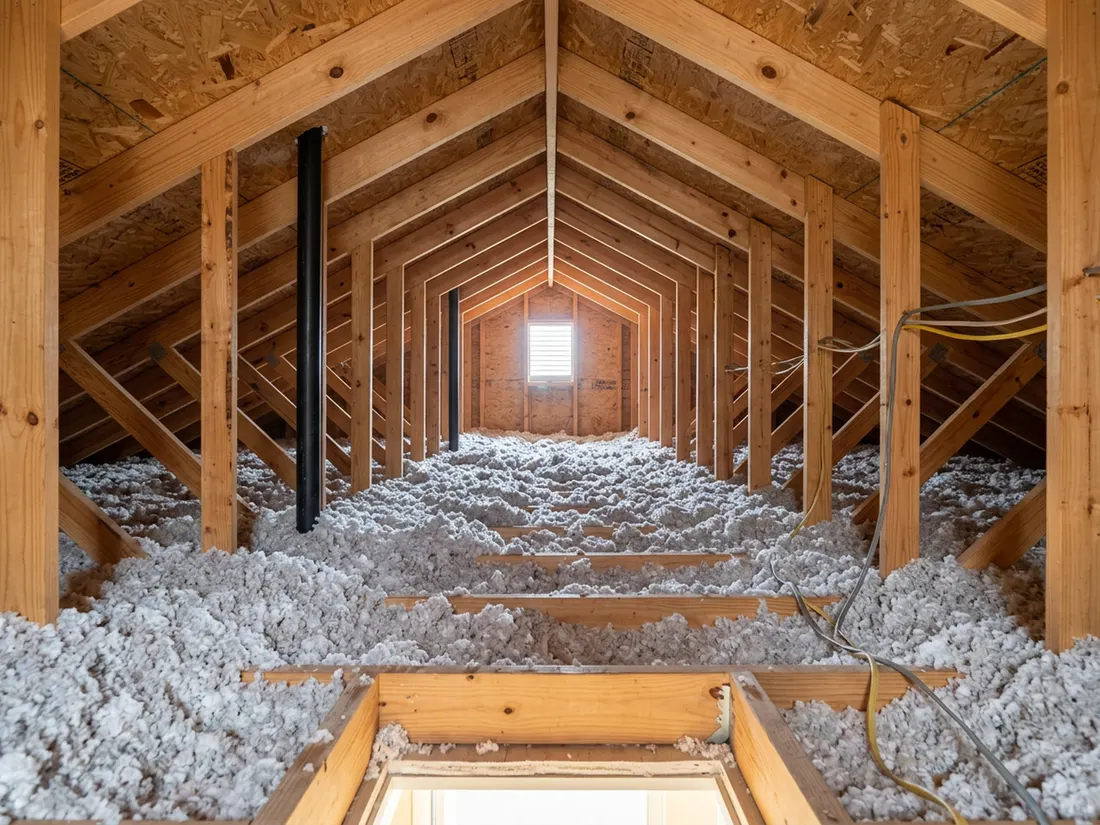
The code cares as much about coverage as depth, and specifically about insulation carrying its full depth over the wall top plate at the eaves, the place it is most often compressed or simply stopped short. An attic with an impressive figure in the middle and nothing over the top plates leaks heat around the edge of every exterior wall. When you are getting quotes, ask what the plan is at the eaves and whether baffles are going in to keep the soffit vents clear.
Should you air seal the attic before adding insulation?
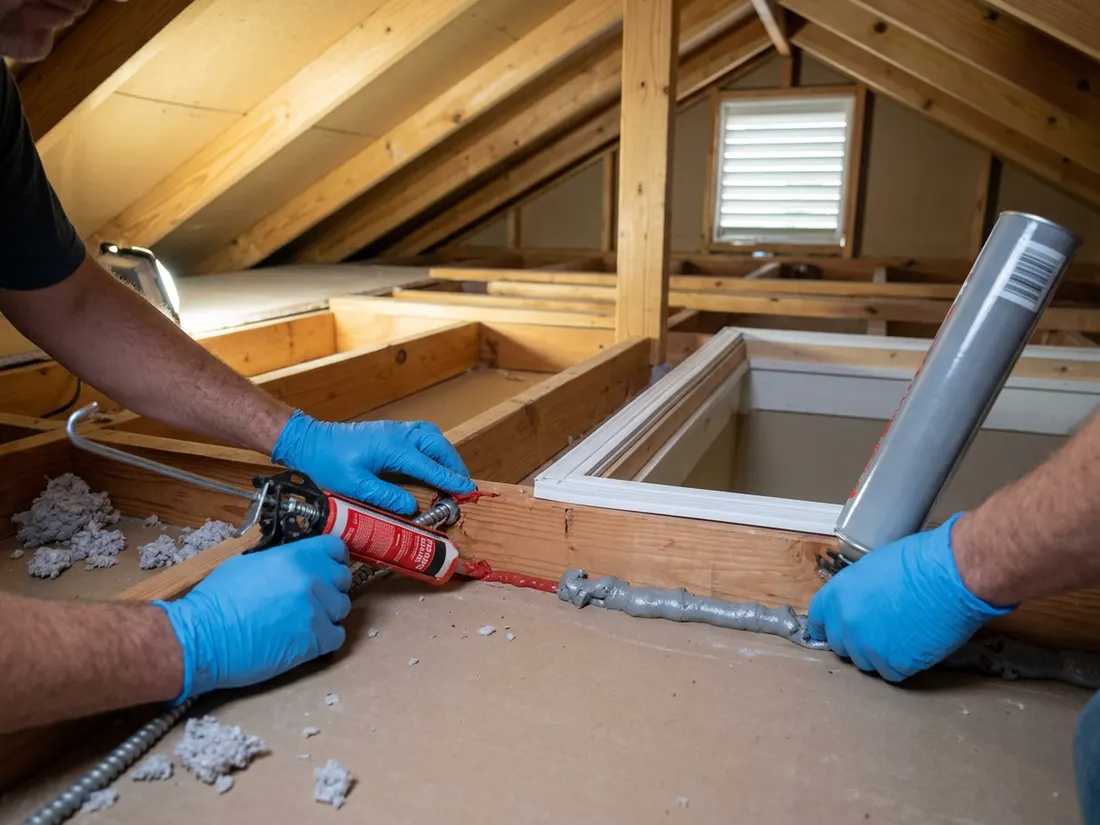
Yes, and the order is what decides whether an attic job shows up on a bill. Insulation slows heat conducting through a surface. It does almost nothing about air moving through a gap. So if you add depth to an attic that leaks, you have improved the part that was already working and left the part that was not. ENERGY STAR’s attic guidance puts air sealing before insulation for the same reason.
| Step | What it does | Why it goes in this position |
|---|---|---|
| 1. Air sealing | Closes top plates, wiring and plumbing penetrations, dropped soffits, chases and the gap around the flue | Cheapest step, and it is the one that makes everything after it perform as advertised |
| 2. The attic hatch | Weatherstrip it, insulate the back of it, fit a retainer so loose-fill does not spill through | A single uninsulated hatch undoes a surprising amount of a well-insulated ceiling |
| 3. Ductwork | Seal the joints, check the plenum, insulate anything bare | Leaking supply duct in a hot attic is conditioned air you paid for, thrown away. Insulating over it just hides it |
| 4. Depth on the attic floor | Even, uncompressed coverage carried right out over the top plates | This is where the R-value target lives, and it only performs once 1 to 3 are done |
| 5. Radiant barrier | Reflects solar heat back out at the roof deck before it loads the attic | Attacks a different mechanism, so it adds to step 4 rather than substituting for it |
If your budget only reaches step two, do steps one and two properly and stop. They are the best value in the whole sequence and nobody sells them hard, because there is no product in them.
What each product is actually good at
Blow-in loose fill
The practical answer for most DFW attics, because most DFW attics have the same problem: they were built to the standard of their decade and have never been touched since. Loose-fill goes in fast, flows around framing and existing material, and gets you to an even depth without demolition. It is the cheapest route to a real change in the attic floor, and it is the right default.
What it does not do is seal anything. Air moves through loose-fill essentially unimpeded, which is exactly why steps one and two above come first.
Radiant barrier
This is the genuinely Texas-specific product, and it is worth understanding why. A vented attic here gets hot in summer not mainly because hot outdoor air comes in, but because the roof deck absorbs sun all afternoon and re-radiates that heat downward into the space. A reflective layer on the underside of the deck pushes a large share of that radiant energy back out before it ever loads the attic.
That makes it a strong complement to floor insulation and a poor substitute for it. It works on radiation; insulation works on conduction. It also does most of its work in summer, which in this climate is not a complaint. And it is worth noting that a radiant barrier keeps its value when your ductwork is in the attic, because a cooler attic is a cooler environment for those ducts to run through.
Spray foam
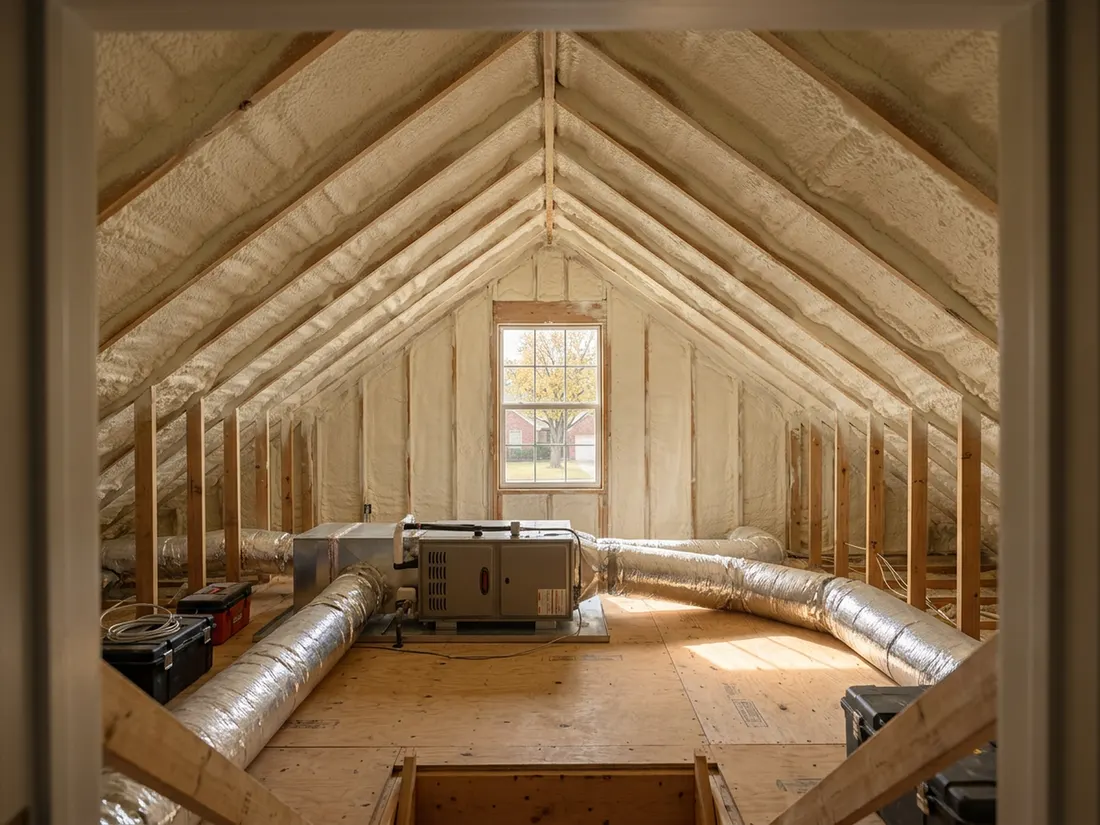
The strongest tool and the most situational one. Foam seals and insulates in one pass, and applied to the roof deck it moves the thermal boundary up so the attic, and the ductwork in it, comes inside the conditioned envelope. That is a serious change and it can be the right one, particularly in a two-story house whose upstairs never quite catches up in August.
It is also expensive, disruptive to retrofit, and it changes how the house handles air and moisture in ways that have to be designed rather than assumed. If your attic is simply thin on insulation with nothing dramatic wrong, it is not the product that earns its keep fastest.
Three ways we see this money wasted
- Blowing new insulation over old compressed batts without looking underneath. Batts that have been walked on, pushed aside for wiring runs or flattened by stored boxes are not performing, and burying them does not fix that. Worse, you have just made every future problem in that attic harder to reach.
- Adding depth around ductwork nobody has tested. If the supply side leaks, you have insulated a system that is throwing conditioned air into the attic. It will feel like the insulation underperformed. It did not.
- Burying can lights, fans and flues that are not rated to be covered. Recessed lights that are not IC-rated, bath fan housings and anything near a flue need proper clearance or a rated cover. This is a fire and safety item, and it is the one thing on an attic job worth asking a direct question about.
And one more, which is less a waste than a misunderstanding: do not expect a number. Anybody who tells you what percentage you will save before they have been in your attic is making it up. The honest version is that most DFW attics were built under an older, less demanding standard, that bringing one up to a proper depth with the leaks sealed first shows up in how evenly the house holds temperature, and that the size of the change depends on how bad it was to start with.
When is the best time for attic insulation work in Dallas?
Winter, if you can. An attic in Dallas in late July is a genuinely dangerous place to work, crews move slower, and careful air sealing is detailed work that does not happen well in that heat. The same job in January is faster, cleaner and better executed.
There is a second reason. Doing it in winter means the work is finished and settled before the first real heat run, which is when you will actually notice the difference. Booking attic work in June means competing for crews with everyone else who has just noticed their upstairs is losing the fight.
The bottom line
The region has settled on R-42 in ceilings for new work, split climate zones and all, and that is a reasonable target for an existing attic even though nothing forces you to hit it. But the number is the second question.
The first is whether the attic leaks, whether the hatch is sealed, and whether the ducts are sound. Get those right and a modest amount of insulation performs like a lot. Get them wrong and no depth on the label will save you.
Questions we get asked about this
The regional amendments to the 2021 energy code adopted through the North Central Texas Council of Governments set the ceiling R-value at R-42, applying to both climate zone 2 and climate zone 3 in this region. That governs new construction and permitted work rather than existing attics, so treat it as the sensible target rather than a requirement you are behind on.
It is one of the few products that is more useful here than in most of the country, because a vented attic in a Texas summer is loaded mainly by the roof deck re-radiating solar heat downward. A reflective layer on the underside of the deck pushes much of that back out. It works alongside insulation on the attic floor rather than instead of it, and it is especially worth considering if your ductwork runs through the attic.
Yes, and it is the step most often skipped. Loose-fill insulation slows heat conducting through the ceiling but does essentially nothing to stop air moving through a gap, so adding depth over unsealed top plates, chases and flue gaps improves the part that was already working. Sealing first is cheaper than the insulation and makes the insulation perform as intended.
Often yes, but look underneath first. Batts compressed by foot traffic, storage or wiring runs are not performing, and burying them locks the problem in place. The same goes for unsealed penetrations and can lights not rated to be covered. On Longhorn Outdoor Living attic jobs, a short inspection comes before the hose, and that is what separates a good top-up from an expensive one.
Winter. A North Texas attic in July is dangerous to work in, crews move slowly, and detailed air sealing is not done well in that heat. Doing the work in the cooler months also means it is finished and settled before the first serious heat run, which is when you would actually notice it.
We will not put a figure on it, and neither should anyone who has not been in your attic. What we can say is that most attics in this metroplex were built to the standard of their decade and have not been touched since, that the gain depends heavily on how leaky the attic is and where the ductwork runs, and that the most visible change is usually how evenly the house holds temperature rather than a single number.