

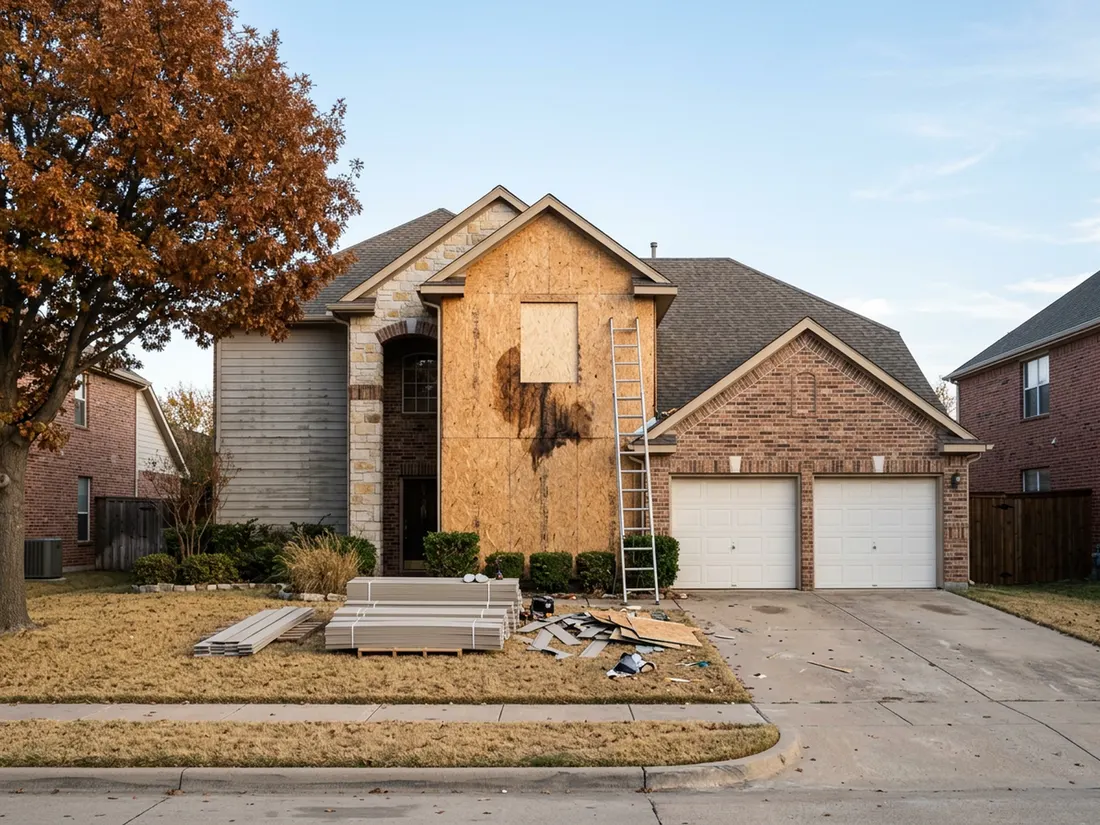
Rotten sheathing behind siding is the most common problem we find on tear-off day, and it almost always traces to missing or wrongly lapped flashing, not the siding itself. Sheathing is the layer of boards or panels nailed to the wall framing under the siding. Most North Texas walls come off clean. A few hide lead paint or asbestos-cement lap. That is why no honest quote promises a price that cannot change.
The short answer
- Tear-off is the only real inspection a wall gets. Every quote written before it is an estimate, and any contractor promising an unchangeable price has either padded it or plans to argue with you later.
- The most common find is wet or rotten sheathing under a window, at a roof-to-wall junction, or behind a deck ledger, and it’s almost always a flashing failure rather than a siding failure.
- Many pre-1980s homes have felt paper or nothing at all behind the siding rather than a continuous water-resistive barrier, so the new wall is a chance to build an assembly the original never had.
- Homes built before 1978 may have lead paint, which changes how the tear-off is legally performed. Longhorn is an EPA Lead-Safe Certified firm, and this is not a corner to let anyone cut.
- Mid-century homes sometimes have asbestos-cement lap siding hidden under a later layer. The hazard is in disturbing it, so the correct response is testing and proper handling, not guessing and not panicking.
Why is the tear-off the real inspection?
Because an estimate only sees the outside. A siding estimate is built from measurements, elevations, photographs, a press test on the bottom courses and experience with the era of the house. That gets you close on the material and the labor. It tells you nothing certain about the sheathing, the flashing, the framing at the corners or what the last crew did in 1994.
So the number that matters is the one that carries an honest allowance for repair and a stated unit rate for anything beyond it. A quote with no repair line is not a better price. It is the same price with the surprise moved to the end.
What is usually found behind old siding?
Usually a sound wall. Here is what comes off North Texas houses, in rough order of how often we see it.
| What is behind there | What it means | What it does to the job |
|---|---|---|
| Dry, sound sheathing with intact paper | The wall did its job. This is the common outcome and it is worth saying so. | Nothing. Wrap, flash, side, done. |
| Wet or rotten sheathing under a window or at a roof-to-wall junction | Water has been entering at a flashing detail, often for years, and the siding was only hiding it. | Cut out and replace the sheathing, and flash the detail properly. Half a day to a day per area. |
| Felt paper, or no water-resistive barrier at all | Standard for a lot of pre-1980s construction. The wall relied entirely on the siding. | Adds a barrier and window flashing the house never had. Not a defect, an upgrade. |
| A second, older layer of siding underneath | Somebody sided over instead of tearing off, usually decades ago. | Extra disposal, sometimes extra framing to get trim planes right. And it needs identifying before it is disturbed. |
| Asbestos-cement lap under a later layer | Common on mid-century homes. Intact and undisturbed it is stable; the hazard is in breaking it up. | Stops the work until it is tested and a proper handling plan exists. |
| Lead paint on siding, trim or window casings | Any house built before 1978 is a candidate. | Lead-safe work practices: containment, wet methods, cleanup and verification. |
| Missing or undersized insulation in the stud bays | Very common on older frame stock, and invisible until now. | The cheapest opportunity you will ever get to fix it, while the wall is open. |
| Wasp nests, mud tubes, carpenter ant galleries, rodent runs | Something found a gap, which means there was one. | Remove, treat if needed, and close the gap that let them in. |
| Pipes run in an exterior wall, sometimes with a patched repair | Common in this region, and the February 2021 freeze made a lot of those patches. | Worth insulating properly on the warm side while access is free. |
| Bruised or punctured sheathing from old hail | Hail that cracked the siding also reached what was behind it. | Replace the damaged panel and document it, especially if a claim is open. |
| Framing gaps, missing blocking, corners that never got nailed off | Original construction shortcuts. | Straightforward to correct while open, impossible to correct later. |
That first row matters as much as the rest. On plenty of houses we take the old panels off and find a wall that is entirely fine. That is particularly true of the post-2000 stock in Wylie, Little Elm, Frisco and Prosper, where the siding is confined to gables and sides and the assembly behind it is modern. Good news is a legitimate outcome and you should expect a contractor to report it as readily as bad news.
What causes rotten sheathing behind siding?
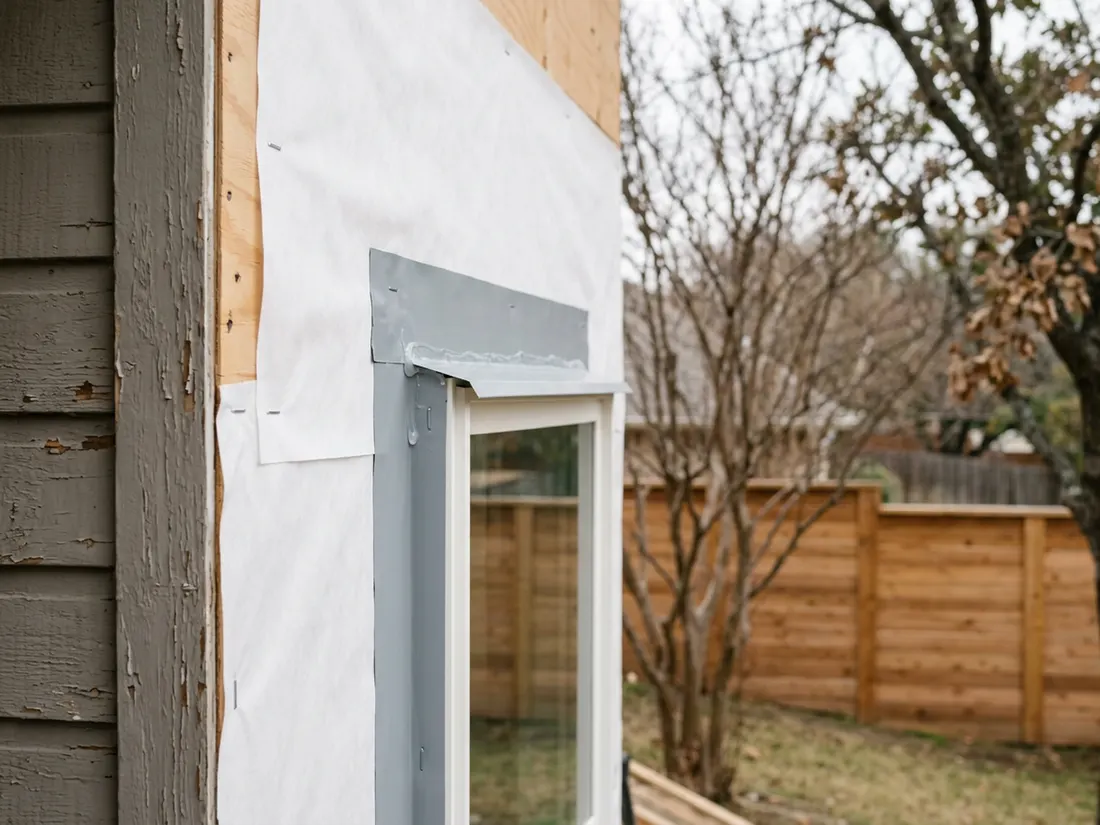
Rotten sheathing behind siding almost always comes from water entering at a flashing detail, not through the field of the siding. When we open a rotten section, the answer is nearly always one of four places.
- The window head. No head flashing, or head flashing tucked behind the paper the wrong way, so water running down the wall is guided into the assembly instead of out of it. This is the single most common one.
- A roof-to-wall junction with no kickout. Where a roof edge dies into a wall, a small piece of metal should kick the runoff out onto the roof. Leave it off and you concentrate an entire roof plane’s water into one stud bay. The rot under those is spectacular.
- A deck or patio cover ledger. Anything bolted through the wall is a hole in the wall. Flashed properly it is fine forever. Caulked, it is a countdown.
- Penetrations. Hose bibs, dryer vents, electrical, gas lines, satellite mounts. Each one sealed with the tube of caulk the last guy had in his truck.
The common thread is sealant used as a water barrier. Sealant is a maintenance item with a service life. Flashing is a piece of metal shaped so that water has nowhere to go but out, and it does not have a service life in the same way. When we quote a wall, that distinction is most of what you are buying.
The two finds that stop the clock
Lead paint, on anything built before 1978
Lead-based paint was in residential use until it was banned in 1978. Federal lead-safe renovation rules apply to work that disturbs painted surfaces in housing built before that date. Across the older stock here (Haltom City’s post-war frame homes, the 1960s and 1970s ranches through Hurst and Garland, Duncanville, Mesquite, the pre-war neighborhoods around Waxahachie’s courthouse square), that is a large share of the houses.
What it means in practice is containment, wet methods rather than dry sanding and scraping, proper cleanup and verification, and disposal that follows the rules. Longhorn is an EPA Lead-Safe Certified firm, which is a requirement rather than an accolade for this kind of work. The thing to know as a homeowner is that a crew ripping old painted siding off a 1965 house dry, with no containment and no dust control, is not saving you money. They are moving lead dust into your yard and your house.
Asbestos-cement siding, on mid-century homes
Asbestos-cement lap siding was widely used mid-century and still exists across the older neighborhoods of this metroplex. Sometimes it is hidden under a layer of vinyl or aluminum that was installed over the top of it in the eighties. It looks like a thin, brittle, cement-gray board with a slightly wavy butt edge, and it usually breaks rather than bends.
Two things are true at once here, and both matter. Intact and undisturbed, this material is stable. It is not releasing anything into your living room. And breaking it up with a hammer is exactly the wrong thing to do. The correct sequence is to stop, have it tested by a qualified lab, and handle it according to current requirements. Nobody on a roof with a pry bar should be making that call by eye, ours included.
What we would talk you out of
Do not let anyone side over the existing siding to save a tear-off. It buries whatever is happening behind the old layer, makes trim and window planes awkward, adds weight to fasteners that were sized for one layer, and guarantees that the next crew, fifteen years from now, inherits a genuinely ugly problem. There are narrow cases where going over is defensible. Wanting to skip disposal is not one of them, and neither is a price that looked better because the wall never got opened.
What should you ask before a siding tear-off starts?
A short list, and the answers tell you nearly everything about who you have hired.
- Is this a tear-off or an overlay? And if it is an overlay, why, in specific terms about this wall.
- What is the allowance for rotten sheathing, and what is the unit rate beyond it? A number and a rate, in writing, before anything comes off.
- Will I see it before it is covered? Photos of every wall open, or an invitation to walk it. A crew that is doing the flashing right is usually glad to show you.
- What water-resistive barrier are you installing, and how does it integrate with the window flashing? The word to listen for is integrate, not tape over.
- Are you putting kickout flashing at every roof-to-wall junction? If this question gets a blank response, get another quote.
- Was the house built before 1978, and are you lead-safe certified? One question, and the answer is yes or it is not your contractor.
- What happens if you find a second layer of siding under the first? They should have a plan for identification and testing, not a shrug.
The one thing an open wall is worth
It is worth saying plainly, because it is the most valuable paragraph here. The labor to take a wall down to the sheathing is the expensive part of improving that wall, and on tear-off day you are paying it anyway. Whatever else you might want done to that assembly in your life will never again be this cheap. That includes a proper barrier, real window flashing, kickout at the roof junctions, insulation in bays that never got any, and a pipe in an exterior wall finally insulated on the right side.
That is also the honest case for insulated siding over a plain panel, and for sealing the gaps that a bare wall makes visible. Not because either transforms your energy bills on its own, but because the access will not come around again for twenty years.
Most walls come off clean, and the rest are manageable
Most walls in this metroplex come off clean. A meaningful minority hide a flashing failure that has been quietly rotting a stud bay, and a handful hide something older that needs testing before anyone swings a bar. None of those outcomes is a disaster if the contract anticipated them and the crew tells you what they found.
Ask the questions in that list, get the repair allowance in writing, and ask for photographs of every wall while it is open. If a wall in your house has already told you something, send us a photo and we will tell you what we would expect to find behind it. A soft spot, a stain on an inside corner or a musty smell near a window all count.
Questions we get asked about this
Most often, sound sheathing and an aging paper barrier. The wall did its job. The common problem finds are wet or rotten sheathing under a window, at a roof-to-wall junction, or behind a deck ledger, all of which trace back to missing or wrongly lapped flashing rather than to the siding itself.
It is sometimes done, and we would generally advise against it. Going over buries whatever is happening behind the old layer, complicates trim and window planes, adds weight to fasteners sized for one layer, and hands the next crew a much harder job. It also means nobody ever inspected or flashed the wall.
It is possible, including hidden under a later layer of vinyl or aluminum. Asbestos-cement lap was common in that era and is stable while intact and undisturbed. The risk comes from breaking it up. The correct step is testing by a qualified lab before any demolition, and handling it according to current requirements.
If the house was built before 1978 and the work disturbs painted surfaces, yes. Federal lead-safe renovation rules apply. That means containment, wet work methods rather than dry sanding, proper cleanup and verification. Longhorn is an EPA Lead-Safe Certified firm and this is not an area where a lower bid is worth considering.
It should already be in the contract. Ask for a stated repair allowance plus a unit rate for anything beyond it, agreed before work starts. Sheathing repair itself is routine: cut out the wet material, replace it, flash the detail that caused it. On most houses it is a matter of hours, not a rebuilt wall.
It is the cheapest chance you will ever get, because the expensive part is the access and you are paying for it anyway. Whether it is worthwhile depends on what is in the cavities now and how the framing is built, which is exactly the thing that becomes visible on tear-off day. Decide it then, with the wall open.