

You need siding replacement in Dallas–Fort Worth when the wall behind it is getting wet: soft sheathing under a pressed panel, splits and gaps, or stains inside that wall. Fading and chalking alone are not reasons to replace. Plenty of tired-looking siding is still doing its job, and the difference is worth knowing before anyone quotes you a number.
The short answer
- Fading, chalking and dirt are surface conditions, not failures. Siding that has lost its color can still be shedding water correctly, and replacing it buys you looks, not protection.
- The signs that actually matter are soft or springy spots under the panel, a panel that moves when you press it, water stains or peeling paint on the inside of an exterior wall, and gaps at corners, trim and window heads.
- Vinyl gets brittle in a hard freeze and flexible in high heat, so the cracks from the February 2021 and December 2022 freezes and the warping from a long summer heat run look nothing alike and mean different things.
- North Texas hail usually hits one or two elevations, not the whole house, and a competent repair on a single wall is a legitimate answer if a color match exists.
- Before you replace a wall because it leaks, rule out the flashing above it. Most water we find behind siding entered at a window head, a roof-to-wall junction or a deck ledger, not through the siding itself.
What does siding actually do?
Siding is a rain screen and a sunshade. It takes the weather so that the sheathing, the housewrap and the framing behind it stay dry, and it keeps direct sun off the wall. That is the whole job. It is not structural, it is not usually the main thing holding heat out, and its color has nothing to do with whether it is working.
That matters because it sets the test. A wall that looks bad but is dry behind is a cosmetic decision. It’s a real one, since a house is a thing you look at every day, but a cosmetic one. A wall that looks fine and is wet behind is an emergency you cannot see. Almost every expensive siding surprise we walk into is the second kind.
How do you know if your siding needs replacing?
Walk the perimeter on a bright morning, when low sun rakes across the wall and shows every ripple, and check for the signs in this table. You do not need a ladder for most of it, and ten minutes tells you whether you have a looks problem or a water problem.
| What you see | What it usually means | Repair, replace, or leave it |
|---|---|---|
| Color faded unevenly, worst on the south and west walls | Normal ultraviolet weathering. Older vinyl fades far more than current lines do | Leave it, or replace when you want the look changed. It is not a failure |
| A chalky film that comes off on your hand | Surface oxidation on vinyl or aluminum. Extremely common on anything from the 1980s and 1990s | Wash it. On aluminum it can also be painted. Not a reason to tear off a house |
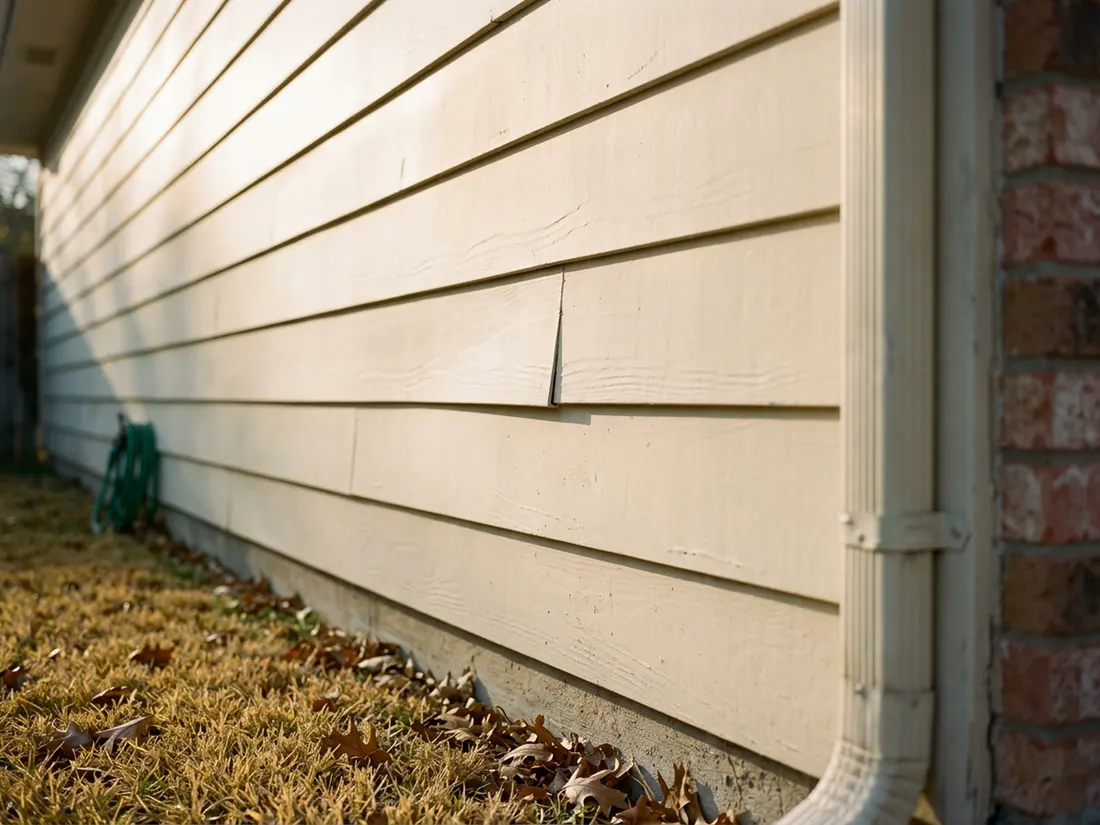
| Panels that ripple or wave in raking light | Nailed too tight or butted too close, so the panel could not move when it got hot. An installation fault, usually from day one | Repair if it is one elevation. If it is everywhere, the whole install was wrong |
| Cracks and splits, often near a nail line or a corner post | Cold-weather brittleness: vinyl loses impact resistance as it gets colder, and a hard freeze plus an impact splits it | Repair the cracked pieces if a match exists. Water gets in through these |
| Board edges swollen, soft, or mushrooming along the bottom | Hardboard or engineered wood that has been taking water. Common on 1980s and 1990s construction | Replace. Swelling means the core is wet and it will not dry out |
| Press a panel and it gives, or you hear a crunch | The sheathing behind it is wet or rotten. The siding is the last thing wrong here | Open it up. This is the one that gets expensive if you wait |
| Peeling paint, stains or a musty smell on the inside of an exterior wall | Water is already through the assembly | Investigate now, before any cosmetic work |
| Gaps opening at corners, around windows, under the roofline | Sealant and trim failure, or panels that shrank. This is where wind-driven rain enters | Repair promptly. Cheap now, very expensive ignored |
| Wasps, mud tubes or sawdust at the bottom course | Something is living behind the siding, which means there is a gap and probably moisture | Open and look |
The single most useful of those is the press test. Walk the bottom two feet of every wall, especially under windows, at the ends of a deck ledger, and where a roof valley dumps water, and push with your thumb. Solid is solid. Anything that feels springy, or gives with a papery crunch, has wet sheathing under it. That is a wall that needs opening up, whatever the siding looks like.
What a North Texas year does to a wall
Siding fails here on a schedule, and the schedule is the weather. Knowing which season produced which mark tells you a lot about whether it is serious.
Spring: hail and wind-driven rain
North Texas sits in one of the most hail-prone corridors in the country, and the season runs from early spring into early summer. Hail damage on siding shows as cracks, punched holes, chipped or dented panels, and (the one people miss) impact marks concentrated on whichever elevation faced the storm. Storms here have direction. A hailstorm that shreds the north wall will often leave the south wall untouched.
That is why a whole-house quote after a single storm deserves a question. If three walls are intact and one is not, the honest answer is a one-wall repair if the profile and color can be matched, and a full replacement only if they cannot.
Summer: heat, movement and the west wall
A long run of triple-digit afternoons (the 2023 summer is the one most people around here remember) puts real thermal movement into a wall. Vinyl expands and contracts more than most materials, which is exactly why it is hung loose on its nails rather than pinned. An installer who nailed it tight gets waves, bowed courses, and panels that eventually pull out of the lock. Those ripples show up in August, not in February, and they are an installation problem revealed by heat rather than heat damage.
Winter: the brittle season
Vinyl gets harder and more brittle as it gets colder. That is why the February 2021 freeze and the December 2022 freeze produced a wave of split panels across the metroplex. Not because the cold itself broke anything, but because anything that hit a wall during those weeks hit material that had lost most of its give. Cracks dating from those events are still out there, quietly letting water in at the nail line. If you have not looked since, look.
The trap: the siding is usually not the leak
When we open a wet wall, the water almost never came through the field of the siding. It came in at the head flashing over a window, at a roof-to-wall junction with no kickout flashing, at a deck ledger, or at a penetration someone caulked instead of flashing. Replacing the siding over an unflashed detail gives you a new-looking wall that rots on exactly the same schedule as the old one.
What you probably have, based on when your street was built
Housing stock in this metroplex is tightly clustered by era, and the era tells you most of what you need to know about the material on your walls.
- Post-war through the 1970s: Haltom City’s frame and brick homes, Hurst’s 1960s and 1970s ranches, Garland’s brick ranch neighborhoods, Duncanville and Mesquite. Expect original wood, asbestos-cement lap, or aluminum, often with one or two later layers over the top. Also expect lead paint: federal lead-safe renovation rules apply to housing built before 1978.
- The 1980s and early 1990s: Bedford, North Richland Hills, much of Carrollton and Lewisville. This is hardboard and early engineered-wood territory, plus first-generation vinyl. Hardboard is the material we most often find swollen along its bottom edges.
- Late 1990s through the 2000s: better vinyl, and the start of fiber cement. Usually still serviceable, though the sealant at trim joints is long past its life.
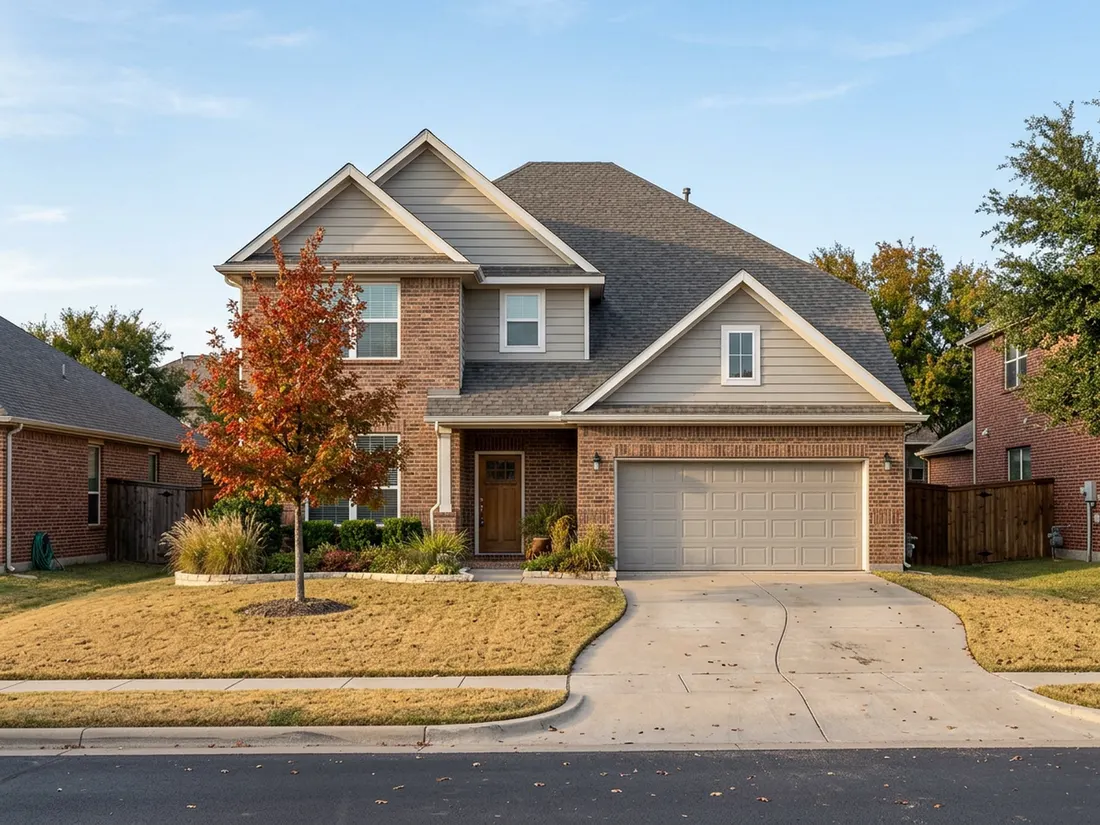
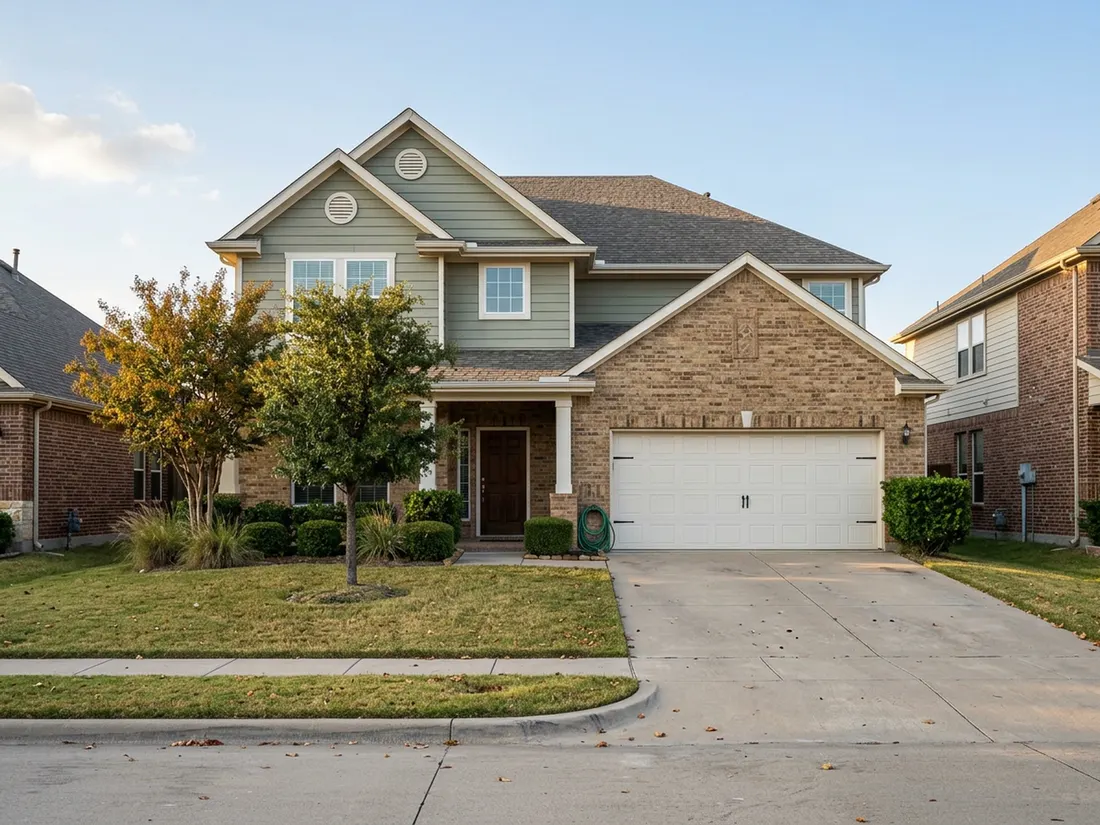
- Post-2000 subdivisions: Wylie, Little Elm, Prosper, Celina and Frisco. Typically brick or stone on the front with siding confined to gables, dormers and the sides. On these houses a siding job is a much smaller job than people assume, and it is worth measuring before you assume otherwise.
Siding repair or replacement: where is the honest cut line?
We replace whole houses when one of four things is true, and not otherwise.
- The sheathing behind is wet or rotten across more than one area. At that point you are opening most of the wall anyway, and re-siding in pieces costs more than doing it once.
- The material itself has systematically failed. Hardboard that is swelling in multiple places is not a repair candidate. The same water is reaching all of it.
- No match exists. Profiles and colors get discontinued. We have tracked matches down after a manufacturer changed lines, but sometimes there is genuinely nothing, and a patchwork wall is worse than a new one.
- You are changing the house anyway. If you are adding insulation, changing windows, or reworking the exterior look, doing the siding in the same sequence is cheaper and produces a better-detailed wall than doing it later.
Everything else is a repair. A cracked elevation, a run of panels under a valley, a gable that took hail. Those are afternoons, not projects. If you want the options side by side, our pages on non-insulated vinyl, insulated siding and fiber cement lay out what each material is good at.
What we would talk you out of
Do not replace siding to fix a draft. Air leakage in a North Texas house is mostly attic bypasses, top plates, recessed lights and duct boots. The walls are rarely the main path, and new siding does almost nothing about any of it. And do not re-side to solve a leak until someone has found where the water actually enters. A new wall over an old flashing detail is money spent on a delay.
What to have ready before you call anyone
Photos of each elevation from the corner of the lot, close-ups of anything you are worried about, and a note of which walls you pressed and what they felt like. If you had a hail claim, the date. If you have an insurance adjuster’s report, that too. It tells us which elevations were documented and which were not.
At Longhorn Outdoor Living we have been working on exteriors across this metroplex since 1984, and the visit that starts with a press test on the bottom course is the one that ends with an honest number. Sometimes that number is zero, because the wall is fine and what you actually want is it washed.
Questions we get asked about this
Fading and chalking are surface conditions and do not affect whether the wall sheds water. The failure signs are physical: a panel that gives when you press it, soft sheathing underneath, splits and gaps, or stains and peeling paint on the inside of that same wall. If none of those are present, you have a looks decision, not a repair.
Often, yes. Hail in North Texas is directional and usually concentrates on one or two elevations. If the profile and color can still be matched, replacing the damaged run is a legitimate repair. A full replacement becomes the right answer mainly when no match exists or when several walls were hit.
Vinyl loses impact resistance as temperature drops, so during events like the February 2021 and December 2022 freezes it was far easier to split than usual. The cold did not break it by itself. An impact did, on material that had gone brittle. Those cracks let water to the nail line and are worth repairing.
Usually it is an installation fault rather than a product fault. Vinyl has to hang loose so it can expand and contract through a Texas summer. Nailed tight or butted hard against the trim, it has nowhere to go and buckles. If it is one elevation, it can be re-hung; if it is the whole house, the original install was wrong throughout.
Not much on its own. In most North Texas homes the dominant heat paths are the attic and air leakage, not the wall cladding. Siding replacement is worth doing for protection and appearance, and it is a good moment to improve the wall while it is open, but as a standalone energy measure it is the wrong first purchase.
It depends far more on what is found behind the old siding than on the square footage. A straightforward tear-off and replace on a single-story home moves quickly; a wall with rotten sheathing, bad flashing or a hidden leak adds days, because the repair has to happen before the new siding goes on. Any schedule given before the wall is opened is an estimate.