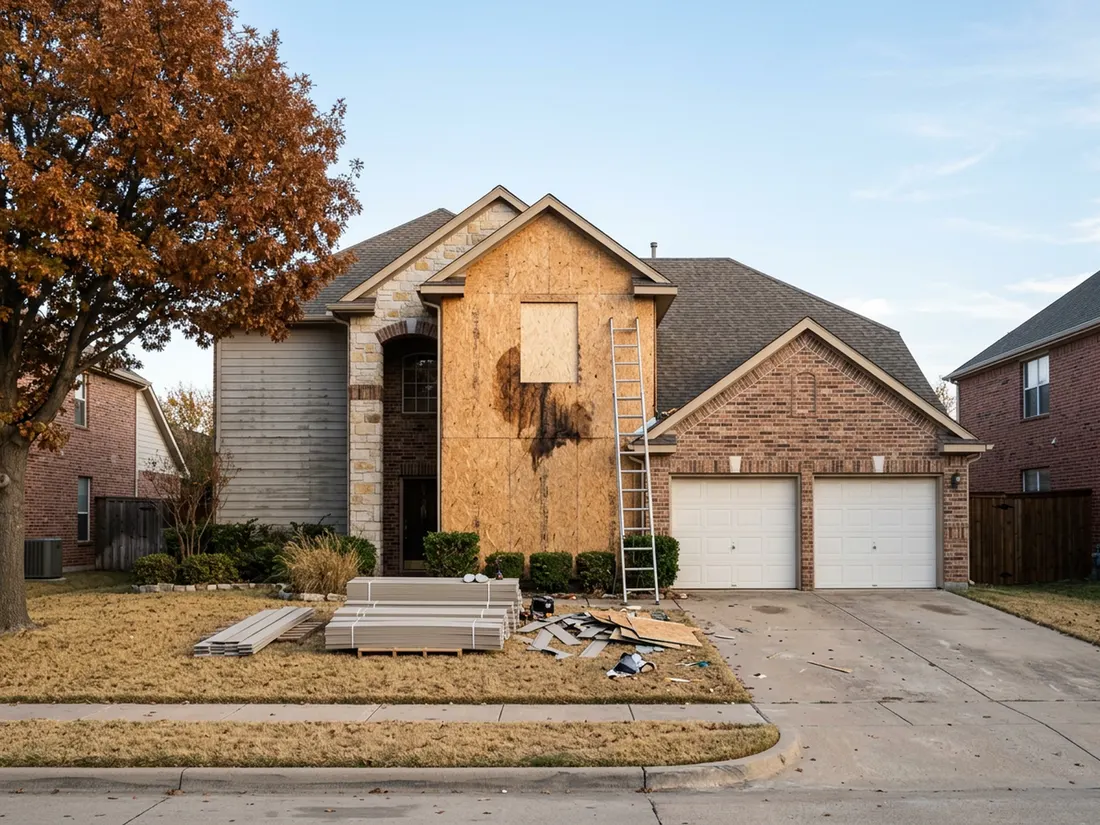

How long does siding last in Texas? Modern vinyl and fiber cement can last decades on the right wall, but almost none of the siding we take off North Texas homes reached its published life. It ended early from water behind it, hail, or an install that ignored summer heat, usually on one elevation rather than four.
The short answer
- Siding in this climate rarely fails from age. It fails from water reaching the sheathing behind it, from a hail event, or from thermal movement that the installation never allowed for.
- The south and west elevations do most of the aging. On the same house, in the same year, a shaded north wall and a sun-blasted west wall can look a decade apart.
- Each material has a characteristic first failure: vinyl cracks and fades, aluminum dents and chalks, hardboard swells along its bottom edges, and fiber cement fails at unsealed cut ends and joints.
- Most siding warranties are prorated and exclude what actually happens here (hail, wind and installation error), so the warranty is worth reading before it is worth counting on.
- Washing the walls and renewing sealant at trim, penetrations and window heads is the only routine maintenance that genuinely extends the life of any of these materials.
What makes siding fail early in North Texas?
Water behind the wall, hail, and movement the install never allowed for end most siding here long before its published lifespan. That lifespan describes the material without those three things. Siding is the outer layer of cladding that sheds rain and sun off a house’s walls, and how long it lasts is the number of years it keeps doing that job.
- Water behind it. This is first by a wide margin. Water entering at an unflashed window head, a roof-to-wall junction without a kickout, a deck ledger or a penetration does not attack the siding at all. It attacks the sheathing, the framing and the insulation behind it, and the siding is simply what has to come off to reach the damage.
- Impact. North Texas sits in an active hail corridor and the season runs from early spring into early summer. One storm can end a wall that had another fifteen years in it.
- Movement the install did not allow for. Vinyl expands through a summer here more than most people expect. Nailed tight, butted hard to the trim, it waves, bows and eventually pulls out of its lock. That failure was built in on day one; a long heat run like the summer of 2023 simply revealed it.
Ultraviolet fading is on nobody’s list of causes, because fading is not a failure. A faded wall sheds water exactly as well as a new one. It is a reason to replace siding when you have decided you want the house to look different, which starts with choosing a siding color for a Texas home. That’s a legitimate reason, and an entirely different decision from the three above.
How long does siding last, material by material?
No material has a fixed clock here, but each one has a signature first symptom. Knowing yours tells you where you are on the clock.
| Material | What shows up first | What ends it | What extends it |
|---|---|---|---|
| Vinyl, non-insulated | Fading, then chalking, then brittleness at the nail line. | Cracks and punctures (often a freeze-season impact or hail) and waving from a tight install. | A correct loose-nailed install with proper gaps, and prompt repair of any crack. |
| Insulated vinyl | Fading, on the same schedule as the vinyl it is bonded to. | The same impact damage, but the backing supports the face so it takes more to get there. | Same as above, plus keeping the bottom course clear of soil and mulch. |
| Fiber cement | Sealant failing at joints and penetrations, long before the board shows anything. | Water drawn into an unsealed cut end or a joint left open, then freezing. | Sealing cut ends at install, renewing joint sealant on a cycle, repainting when the factory finish is genuinely spent. |
| Hardboard and early engineered wood | Swelling and mushrooming along the bottom edge of boards. | Moisture in the core. Once it is swelling in several places, the same water is reaching all of it. | Little. Keeping it painted and away from sprinklers buys time, not a reprieve. |
| Aluminum | A chalky film that comes off on your hand, and permanent dents. | Cosmetics, usually, rather than function. It does not rot and it does not go brittle. | Washing, and it can be repainted, which is the one advantage it has over vinyl. |
| Original wood | Paint failing on sun-facing elevations, then soft spots at the ends of boards. | Rot where boards meet trim, sit near grade, or take sprinkler spray. | Paint on a real cycle and keep the bottom course clear of soil and irrigation. |
Why does siding wear out faster on one side of the house?
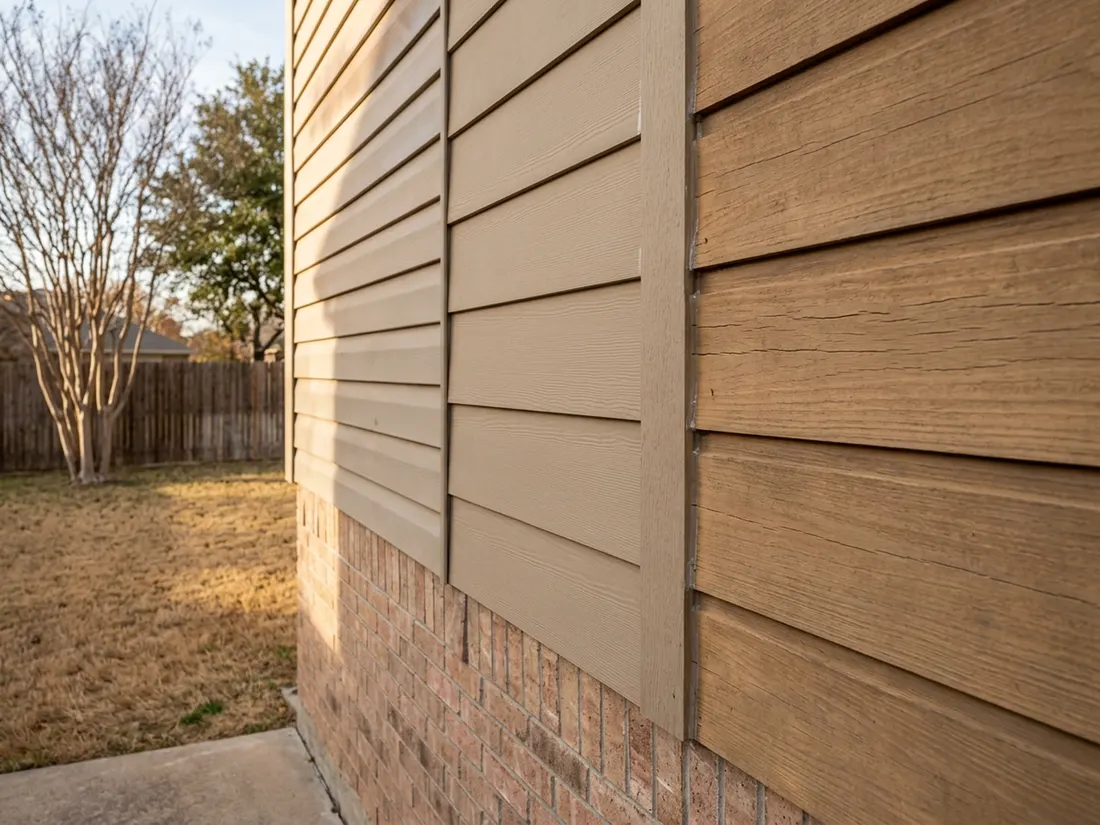
The west and south walls take the afternoon sun, so they age faster than a shaded north wall. Walk your own house and compare them. On many DFW homes they do not look like the same age of material, and in any way that matters they are not.
The west elevation takes the full afternoon in a Texas summer, every summer. It runs hotter, it takes more ultraviolet load, and on vinyl it does the most thermal cycling, which is why a west wall shows waving, gapping and color change first. The south elevation is close behind. The north wall, shaded and cooler, can look almost untouched.
Tree cover shifts this dramatically, and it varies by neighborhood. Bedford, Duncanville, Richardson and Carrollton have fifty-year-old canopy, and a shaded wall ages far more slowly, though it also stays damp longer after rain, which matters for anything organic. Celina’s newer lots are open prairie with barely a tree in sight, so a west wall there gets the full treatment with nothing in front of it. Two identical houses, one in each place, will not be on the same clock.
What does your street’s build era say about your siding?
Housing in this metroplex clusters tightly by decade, and the decade predicts the material and its failure mode more reliably than anything else.
- Post-war to 1970s: Haltom City’s small frame and brick homes, Hurst’s 1960s and 1970s ranches, Garland’s brick ranch neighborhoods, Mesquite and Duncanville. Original wood, asbestos-cement lap or aluminum, frequently with a later layer over the top. Anything from before 1978 also brings lead paint into the picture, which changes how the tear-off is handled.
- 1970s and 1980s: Bedford, North Richland Hills, parts of Lewisville and Carrollton. First-generation vinyl and a great deal of hardboard. If your boards are swelling along the bottom, this is almost certainly your era.
- 1990s: better vinyl, the arrival of fiber cement on higher-end builds. Often still serviceable, with sealant at trim and penetrations long past its life.
- Post-2000: Wylie, Little Elm, Prosper, Frisco, Celina. Modern vinyl or fiber cement, usually on gables and sides only. The clock on these is mostly about hail and install quality rather than material age.
What a siding warranty is really worth
Read yours before you rely on it. Most siding warranties in this category share a few features that homeowners find surprising at exactly the wrong moment.
They are usually prorated, meaning coverage declines with age, so the payout on a fifteen-year-old wall is not what the headline suggests. They typically cover manufacturing defect, not damage: hail, wind and impact are excluded, because those are an insurance question rather than a manufacturing one. They are commonly voided by improper installation, which means the workmanship warranty from whoever installed it does at least as much work as the product warranty. And transferability to a future owner is often limited.
None of that makes warranties worthless. It means the sentence “it has a lifetime warranty” tells you very little on its own. The questions worth asking are what is prorated, what is excluded, who honors the labor, and what happens if the color line is discontinued.
What we would talk you out of
Do not replace siding because it has faded. It is the most common reason people call us and it is almost never a reason to spend that money. A wash, and on aluminum or wood a repaint, gets most of it back. Replace when the wall has stopped protecting the house, or when you have genuinely decided you want a different house to look at. Those are both good reasons. “It looks old” on a sound wall is not one, and we would rather say so than sell you a tear-off.
The maintenance that actually buys you years
Short list, and it is genuinely short. None of these materials needs much.
- Wash the walls. Once a year, low pressure, from the bottom up and rinsed from the top down. Never a pressure washer aimed up under the laps. That drives water exactly where you spend everything else trying to keep it out.
- Keep sprinklers off the house. Irrigation hitting a wall every morning is a slow, reliable way to end the bottom courses and anything organic behind them.
- Keep soil, mulch and beds below the bottom course. Siding buried in a raised bed wicks moisture and hands termites a covered route in.
- Renew sealant where it is doing a job. At trim joints, penetrations and window surrounds. Sealant is a maintenance item with a life, not a permanent part of the wall.
- Walk the house after a hail storm. Every elevation, close up, checking for the signs your siding needs replacing. Cracks found in the spring cost a fraction of what the same cracks cost after two rainy seasons behind the wall.
- Trim branches back off the wall. Rubbing wears a finish, and a limb against the siding in a storm is an impact waiting for a windy night.
The bottom line
A wall here lasts as long as the flashing above it, the crew that hung it and the seasons it happened to catch. Modern vinyl and fiber cement both hold their shape and color in this sun for decades when they are installed properly and kept clear of water they were never meant to handle. At Longhorn Outdoor Living we have repaired siding we installed more than twenty years ago that was still in good shape, and we have taken off eight-year-old walls that were finished before they started.
The difference between those two outcomes was almost never the product on the box.
Questions we get asked about this
Modern vinyl is designed to hold its shape and color for decades in this sun, and properly installed it usually does. What shortens it here is impact (hail, or a freeze-season strike on brittle material) and installation that did not allow for summer expansion. Fading is not a lifespan question; a faded wall still sheds water.
Yes, markedly. The west elevation takes full afternoon sun all summer and does the most thermal cycling, so it shows waving, gapping and color change first, with the south wall close behind. A shaded north wall on the same house can look years younger, which is why partial replacements are so common here.
Rarely in the way people assume. Most are prorated so coverage declines with age, cover manufacturing defect rather than hail or wind damage, can be voided by improper installation, and are limited when transferred to a new owner. Read what is excluded and who honors the labor before treating the warranty as part of the value.
Only if you want the house to look different. Fading and chalking are surface conditions with no effect on whether the wall protects the structure. Washing recovers a surprising amount, and aluminum and wood can be repainted. Spend on replacement when the wall has stopped doing its job, not when it has stopped looking new.
Once a year is plenty for most homes, more often if you are under heavy tree cover or near a dusty corridor. Use low pressure, work from the bottom up and rinse from the top down. Never aim a pressure washer upward under the laps. That forces water behind the siding, which is the one thing you are trying to prevent.
Often, yes. We have tracked down matches even after a manufacturer changed lines, and a matched repair on one elevation is far cheaper than a whole-house replacement. When no match exists at all, the usual compromise is to re-side the affected elevations and accept the difference, or to replace fully if the walls are visible together.